

Uzbekistan's exports decreased by 3.6 percent in seven months
**Uzbekistan's exports decreased by 3.6 percent in seven months**
The reduction in gold sales in Uzbekistan is causing a decline in overall export revenues. At the same time, the share of imports increased by nearly 18 percent in seven months.
### Exports decreased, while imports increased significantly
In January-July 2026, Uzbekistan's foreign trade turnover reached 49.5 billion dollars. The Statistics Committee stated that this figure increased by 3.7 billion dollars or 8.1 percent compared to the same period in 2025. The growth occurred due to an increase in the volume of imports.
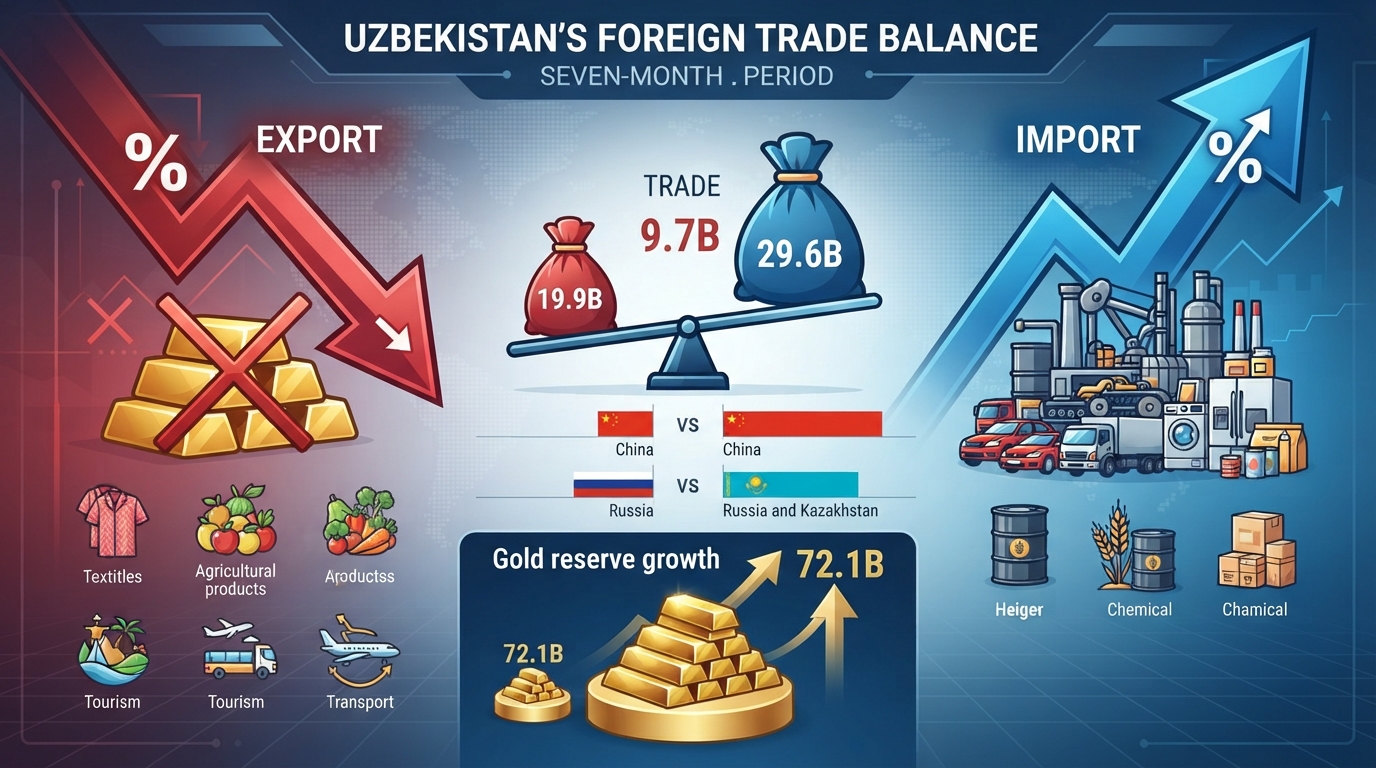
In seven months, export revenues amounted to 19.9 billion dollars, decreasing by 3.6 percent. The volume of imports was 29.6 billion dollars, increasing by 17.8 percent. As a result, a foreign trade deficit of 9.7 billion dollars occurred.
"Excluding gold, exports of goods increased by 27.7 percent compared to the corresponding period of last year and amounted to 9.8 billion dollars," the committee commented on the situation.
### Main trade partners
In seven months, Uzbekistan conducted the largest volume of trade with China — 11.26 billion dollars. Of this, only 1.7 billion dollars or 15 percent accounted for exports, while the remaining nearly 9.56 billion dollars (85 percent) accounted for imports.
The next largest trade was carried out with Russia. Trade of goods and services worth 8.12 billion dollars was recorded between the two countries. Of this, 2.8 billion dollars is Uzbekistan's exports, and 5.3 billion dollars is imports.
The third main partner country remains neighboring Kazakhstan. In seven months, the two countries traded 3.26 billion dollars. Of this, 868 million dollars accounted for Uzbekistan's exports, and 2.4 billion dollars accounted for imports.
In general, the share of imports in the country's trade with its main partners remains significantly higher than exports.
### What was exported?
The share of services leads in Uzbekistan's exports. Previously, gold sales accounted for one-third of export revenues, but now this place has been taken by services. During the seven months, 7.3 billion dollars of service revenues were received from abroad (an increase of 35.3 percent). This figure is equal to nearly 36.8 percent of total exports. In particular, 3.94 billion dollars of the revenues came from tourism, and 2.3 billion dollars from transport services.
The next largest export share belongs to the sale of industrial goods — 2.86 billion dollars (an increase of 22.4 percent). Of this, 1.15 billion dollars (an increase of 26.3 percent) accounted for textile products, and 1.04 billion dollars (an increase of 7.8 percent) for non-ferrous metals.
In January-July, Uzbekistan exported gold worth 2.8 billion dollars. This figure is 2.7 times less compared to the corresponding period of 2025. The sharp reduction in the sale of the precious metal significantly affected the overall export results.
Also, in seven months, the export of food products and live animals reached 1.5 billion dollars (an increase of 2.3 percent). In this direction, the share of vegetables and fruits was the largest, amounting to 1.05 billion dollars (a decrease of 4 percent).
Revenues from the sale of mineral fuels and lubricants amounted to 931.5 million dollars (an increase of 5.4 percent). Of this, 515.9 million dollars (an increase of 51.2 percent) accounted for the sale of petroleum and petroleum products, and 279.7 million dollars (a decrease of 36.2 percent) for natural gas.
In addition, chemical products worth 1.55 billion dollars were exported in seven months (an increase of 35 percent). Within this structure, the share of inorganic chemicals was high, amounting to 944.8 million dollars (an increase of 47.2 percent).
### Imported goods and services
The largest share in Uzbekistan's imports belongs to the purchase of machinery and transport equipment. In seven months, goods of this type worth 9.7 billion dollars were imported into the country (an increase of 20 percent). In this, the share of cars amounted to 2.4 billion dollars (an increase of 27.9 percent), and the purchase of electrical machinery, apparatus, and equipment amounted to 1.6 billion dollars (an increase of 38.1 percent).
During the reporting period, food products and live animals worth 3.3 billion dollars were purchased from abroad. In this direction, the largest share fell on the import of cereals and cereal products — 864.9 million dollars (an increase of 60.7 percent). In the following places, the purchase of meat and meat products amounted to 574 million dollars (an increase of 36.7 percent), and the purchase of sugar, sugar products, and honey amounted to 434 million dollars (an increase of 51.2 percent).
During the reporting period, mineral fuels and lubricants worth 2.5 billion dollars were imported (an increase of 10.7 percent). In particular, petroleum and petroleum products worth 1.33 billion dollars were purchased from abroad (an increase of 15.1 percent). Of this, 426 million dollars accounted for gasoline imports (an increase of 60.8 percent). In turn, natural gas worth nearly 1 billion dollars was imported from abroad (an increase of 8.2 percent).
Imports of chemical products and similar products amounted to 3.6 billion dollars (an increase of 15.6 percent), of which 1.1 billion dollars accounted for medical and pharmaceutical products.
Imports of industrial goods accounted for 4.4 billion dollars (an increase of 10.1 percent). In particular, in seven months, pig iron and steel worth 1.7 billion dollars and non-ferrous metals worth 612.9 million dollars were purchased from abroad.
Also, services worth 3.6 billion dollars were imported (an increase of 13.3 percent). In this, 1.57 billion dollars fell on tourism, and 989.6 million dollars on transport services.
Earlier, it was reported that in August of this year, the value of Uzbekistan's gold and foreign exchange reserves increased by 7.8 billion dollars, reaching a total of 72.1 billion dollars. According to analysis, against the background of the country reducing gold exports recently, the volume of reserves is increasing significantly. As of September 1, 2026, 14.1 million ounces (438.56 tons) of gold are held in the country's reserves. At the beginning of January, this figure was 12.6 million ounces (391.9 tons). In eight months, the volume of the precious metal increased by nearly 46.66 tons.