

Uzbekistan’s budget revenues reach over $17.6bn in first half of 2026
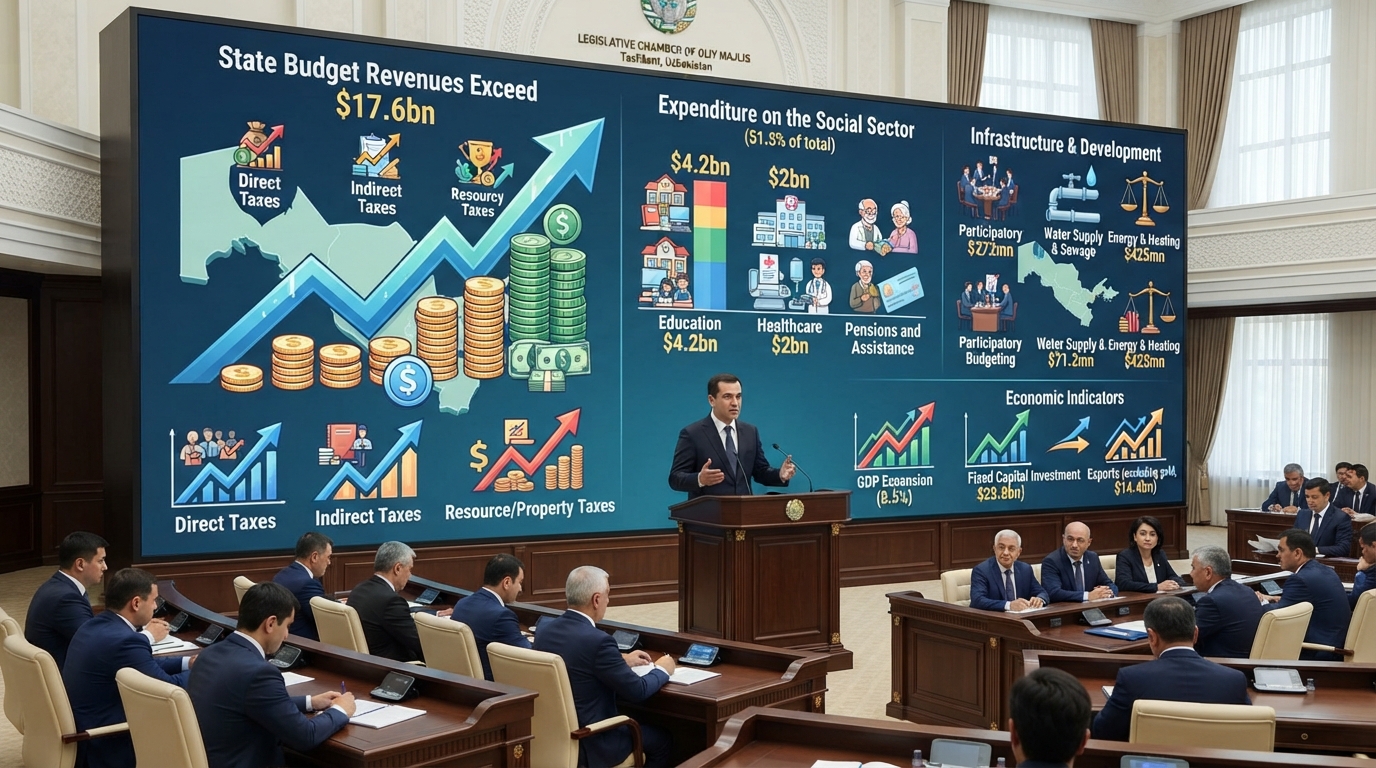
Uzbekistan’s budget revenues exceed $17.6bn in first half of 2026
Uzbekistan’s State Budget revenues totaled UZS 207.4 trillion, or more than $17.6bn, in the first six months of 2026, up by UZS 63.2 trillion, or more than $5.3bn, from the same period a year earlier, according to a report examined by the Legislative Chamber of the Oliy Majlis.
The report on the execution of the State Budget and the budgets of state targeted funds for January–June was delivered by Deputy Prime Minister and Minister of Economy and Finance Jamshid Kuchkarov at a regular sitting of the lower house of parliament. Deputies also considered a number of draft laws on the status of judges and prevention inspectors in internal affairs bodies. These matters had earlier been discussed by political party factions, parliamentary committees and working groups with the involvement of experts and representatives of the relevant ministries and agencies.
The report said Uzbekistan’s GDP expanded by 8.5% in the first half of 2026. Market services rose by 16.9%, industrial output by 8%, construction by 13.8% and agriculture by 4.7%. Inflation was 3.3% compared with the start of the year. Fixed capital investment increased by 17.5% to UZS 338.9 trillion, or more than $28.8bn. Direct foreign investment and loans reached $12.4bn, while exports excluding gold climbed by 31.6% to $14.4bn.
Direct tax receipts came to UZS 77 trillion, or more than $6.5bn, marking a 75.1% increase. Indirect tax revenues grew by 20% to UZS 61.6 trillion, or more than $5.2bn, while income from resource and property taxes rose by 48.7% to UZS 29.1 trillion, or more than $2.4bn. Local budgets received an extra UZS 6.2 trillion, or around $528mn, from additional revenue sources.
Spending on the social sector amounted to UZS 105.8 trillion, or more than $9bn, equal to 51.5% of total State Budget expenditures and up 8.7%. Of this, UZS 49.5 trillion, or more than $4.2bn, went to education, UZS 22.7 trillion, or around $2bn, to healthcare and UZS 7.3 trillion, or more than $621mn, to pensions and financial assistance. Expenditure aligned with Uzbekistan’s National Sustainable Development Goals reached UZS 161.3 trillion, or more than $13.7bn, making up 78.5% of total spending.
The report also outlined financing for several programs affecting households and local infrastructure. Mortgage interest subsidies received UZS 814.2bn, or around $70mn, while UZS 3.2 trillion, or more than $272mn, was directed to Participatory Budgeting initiatives. Another UZS 837.2bn, or more than $71.2mn, was allocated to improving drinking water supply and sewage networks.
Total budget subsidies stood at UZS 13 trillion, or more than $1.1bn. Of this amount, UZS 5.5 trillion, or more than $468mn, was assigned to socially significant areas, including non-state preschool institutions, public transport and rental or tuition payments. Nearly UZS 5 trillion, or more than $425mn, was used to cover the gap between tariffs and costs in the energy and heating sectors.
While reviewing the report, lawmakers also examined shortcomings identified by the Audit Chamber in the use of public funds. Centralized investment spending under the social and production infrastructure development program was carried out at 88.6% of the planned level. Spending on science reached 85.4% of the plan, while landscaping expenditures were executed at 89.2%.
Deputies asked for explanations for the incomplete use of funds in these areas and questioned the effectiveness of tax and customs incentives granted in the first half of the year. The session noted that current monitoring of the economic and social impact of tax and customs incentives still does not meet required standards. Concerns were also raised about the work of internal audit services in ministries and government agencies, especially the mechanisms for detecting and preventing misuse or improper use of budget funds at an early stage.
Lawmakers suggested tighter oversight of budget spending and target indicators, ensuring that projects included in investment programs are commissioned within set deadlines, and carrying out more detailed evaluations of tax and customs incentives by sector and enterprise. They also called for greater accountability from internal audit units in ministries and agencies and stronger preventive measures to address the causes of improper use of public funds.
The State Budget execution report had first been reviewed by political party factions and parliamentary committees before the plenary session. During the review, deputies raised more than 60 issues related to budget revenues and expenditures, regional development, state programs and the impact of public spending. Relevant ministries and agencies answered the questions raised.