

Uzbekistan warns of fines for burning plant residues
In Uzbekistan, burning cotton stalks, leaves, and other plant residues in fields is prohibited. The fine for violations reaches up to 4.4 million sum.
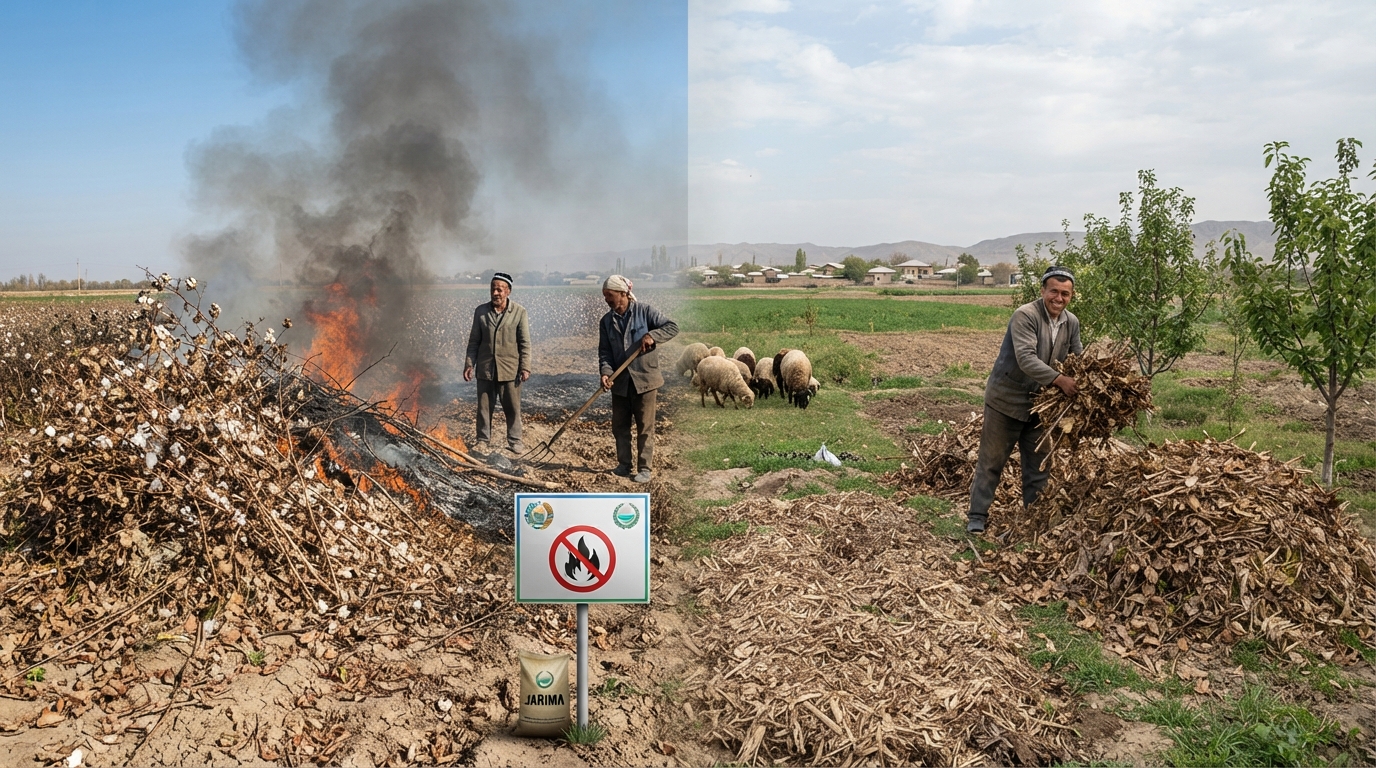
Warning issued regarding fines for burning plant residue in Uzbekistan
In Uzbekistan, citizens have been warned of administrative liability for burning cotton stalks, fallen leaves, branches, bushes, and other plant residue on agricultural lands.
The fine for such a violation can reach up to 10 base calculating quantities (BCQ), which equals up to 4.4 million sum. This was reported by the National Committee on Ecology and Climate Change.
The Committee emphasized that burning plant residue releases toxic compounds into the atmosphere that are dangerous to the environment and human health. These include carbon monoxide (CO), nitrogen oxides (NOx), nitrogen dioxide (NO₂), benzo(a)pyrene, dioxins, dibenzofurans, sulfur oxides, and phosgene.
According to experts, the negative consequences affect not only air quality. The high temperatures during the process of burning plant residue destroy macro and microelements in the soil composition. This, in turn, can lead to a decrease in its fertility.
The National Committee also reminded that burning plant residue on agricultural lands is prohibited by law. In addition to administrative fines, economic sanctions are also envisaged for damage caused by fires in crop fields. Their amount is determined taking into account the damage caused to each hectare of land.
Instead of burning plant residue, the Committee recommends using it for agricultural purposes. In particular, it can be converted into compost, used as mulch around saplings, or used as livestock feed.
The Ecology Committee urged citizens to comply with the requirements of environmental protection legislation and not to burn plant residue in the fields.