

Uzbekistan tries on Chinese wings
Uzbekistan received a batch of six Chinese J-10CE fighter jets.
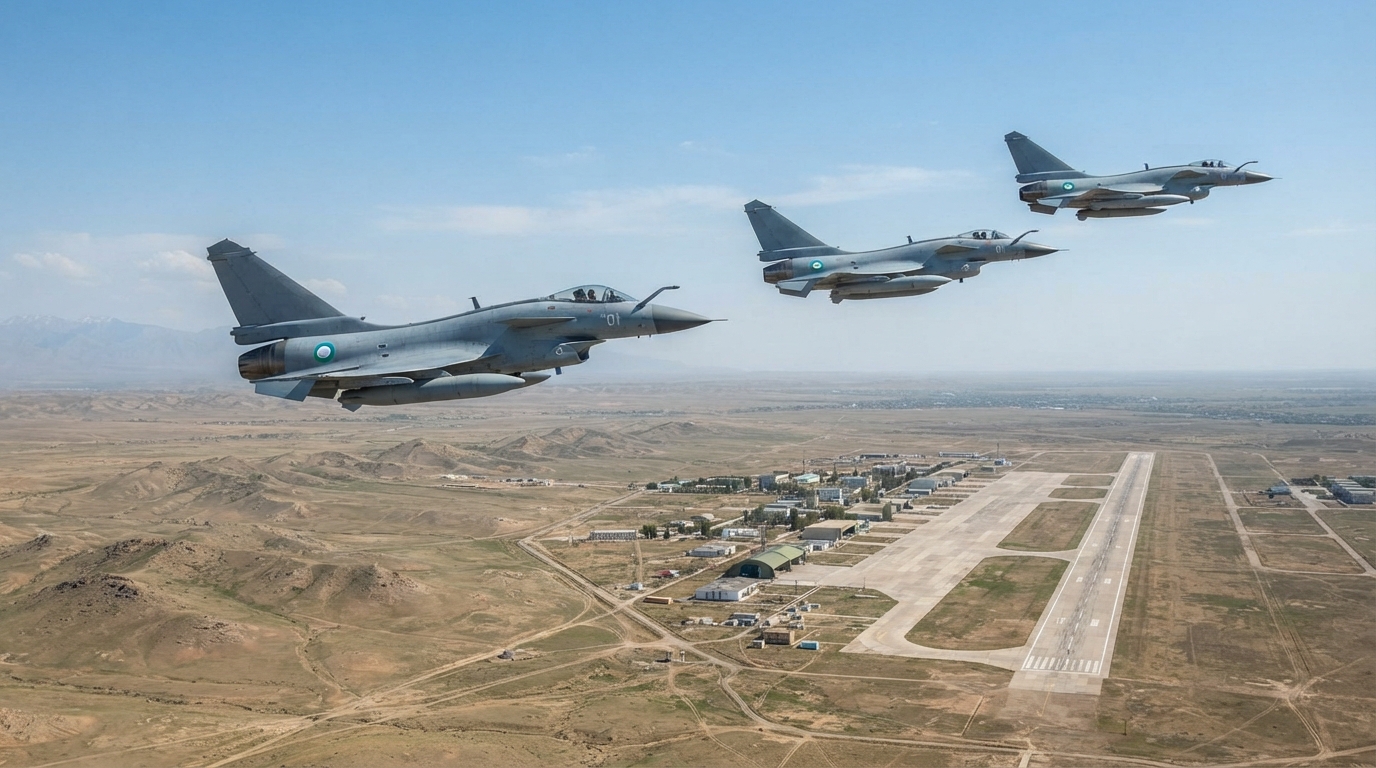
For the first time, Uzbekistan officially confirmed the purchase of Chinese Chengdu J-10CE fighter jets for its Air Force. On August 30, the Ministry of Defense published a video showing the flight and landing of several of these aircraft, captioned "Modern fighters protecting the country's airspace." Two days earlier, on August 28, at least six J-10CEs were featured in a celebratory broadcast on the state television channel O'zbekiston 24, dedicated to the 35th anniversary of Uzbekistan's independence. However, the Defense Ministry did not provide information on the number of aircraft purchased, the delivery timeline, or the contract value. China also did not officially confirm the details of the deal.
Negotiations on the delivery of the fighter jets lasted for over a year. In July 2025, Uzbek Defense Minister Major General Shukhrat Khalmukhamedov confirmed the existence of a "multi-year agreement" with China on the acquisition of aircraft and personnel training, without specifying their type or quantity. According to the Pakistani military-analytics publication Quwa, Tashkent may have ordered 24 J-10CE fighter jets manufactured by Chengdu Aircraft Corporation. The deal is valued at approximately $1 billion, but this figure has not been officially confirmed.
According to defense publications (Defense Security Asia, Military Watch Magazine, The Aviationist), the first batch of four aircraft arrived in Uzbekistan in July 2026. However, other media outlets reported that the first two J-10CEs were delivered to Tashkent as early as July 2025, and that four more aircraft arrived at the Karshi-Khanabad Air Base on July 21-22, 2026. Neither Tashkent nor Beijing has officially confirmed this information; the Uzbek Ministry of Defense declined to respond to a request for comment from the Times of Central Asia.
According to media reports, the aircraft are based at the Karshi-Khanabad (K2) airbase in the Kashkadarya region, which is Uzbekistan's largest military airfield with a 3,600-meter runway capable of handling heavy aircraft. This basing information has also not been confirmed by Uzbek authorities.
The addition of the J-10CE is intended to update the combat strength of the Uzbek Air Force. According to public estimates, the most combat-ready portion of the fleet includes 12 MiG-29 fighters and 12 Su-25 attack aircraft of Soviet origin. An additional 18 MiG-29s, 26 Su-27s, and 15 Su-24s are in storage. These figures provide an idea of the scale of the Air Force's fleet, but its actual technical condition and the number of aircraft capable of performing combat missions are not officially disclosed.
Transitioning to Chinese aircraft was not the only option for upgrading the Uzbek Air Force. In 2017, Russia and Uzbekistan discussed the possibility of supplying Tashkent with Su-30SM multirole fighters. In 2019, Russian media reported an official request from the Uzbek side to purchase these aircraft, including the possibility of debt financing. However, after 2022, the Russian military-industrial complex faced a sharp increase in domestic demand. In 2025, Rostec CEO Sergey Chemezov acknowledged a decline in arms sales abroad, while noting "advance shipments to the troops." However, exports are gradually recovering: according to Mr. Chemezov, since the beginning of 2025, Russian products have been supplied to more than 15 countries. Nevertheless, Moscow and Tashkent never reached the stage of concluding a contract for the Su-30SM. An attempt to purchase French Rafale jets in 2023 also failed.
The Chinese fighter has already been used in combat. In May 2025, Pakistani J-10s (Islamabad received the first aircraft of this type in 2022) armed with PL-15 missiles engaged in aerial combat with Indian aircraft. On May 8, Reuters, citing two American officials, reported that Pakistani J-10s shot down at least two Indian military aircraft, with one American source claiming that a French Rafale was among them. India did not confirm this information at the time.
Before receiving the new aircraft, Uzbekistan already had experience operating Chinese military equipment: it had previously purchased a number of FD-2000s from China, an export version of the Chinese HQ-9 air defense missile system. Now, Uzbekistan will become the second confirmed foreign operator of the J-10CE after Pakistan and the first in Central Asia. Other countries are also showing interest in the aircraft: on August 25, Reuters reported that Bangladeshi authorities had begun preparing a draft agreement for the purchase of the J-10CE.
Reference: The Chengdu J-10CE is the export version of the Chinese J-10C multirole fighter, developed and produced by Chengdu Aircraft Corporation. The aircraft belongs to the 4th generation and is designed to perform a wide range of missions, including air combat and ground attack. The J-10CE is equipped with an active electronically scanned array (AESA) radar. The fighter can also employ modern air-to-air weapons, including PL-15E air-to-air missiles. The J-10 aircraft bears strong resemblance to the Israeli Lavi fighter, developed by Israel Aerospace Industries (IAI), whose production was canceled following a government decision in 1988. According to foreign media reports, China later purchased the Lavi plans to accelerate the development of a domestic fourth-generation fighter and modernize its air force. The funds paid by China helped cover the costs of the project's termination in Israel. The aircraft is cheaper than the American F-16 and is being marketed to countries not interested in purchasing American fighters. The cost of one J-10CE is estimated at $40-60 million.
Reports of Uzbekistan's purchase of Chinese J-10CE fighters may indicate the growing diversification of Central Asian countries' arms sources and the weakening of Russia's traditional monopoly in this market. The transition of the air forces of several Central Asian republics (currently only Uzbekistan) to Chinese standards requires a complete overhaul of ground infrastructure, the purchase of new types of missiles, simulators, and expensive pilot training in China. This creates a long-term technological dependence on Beijing.