

Uzbekistan chose J-10C fighters. Why not Rafale?
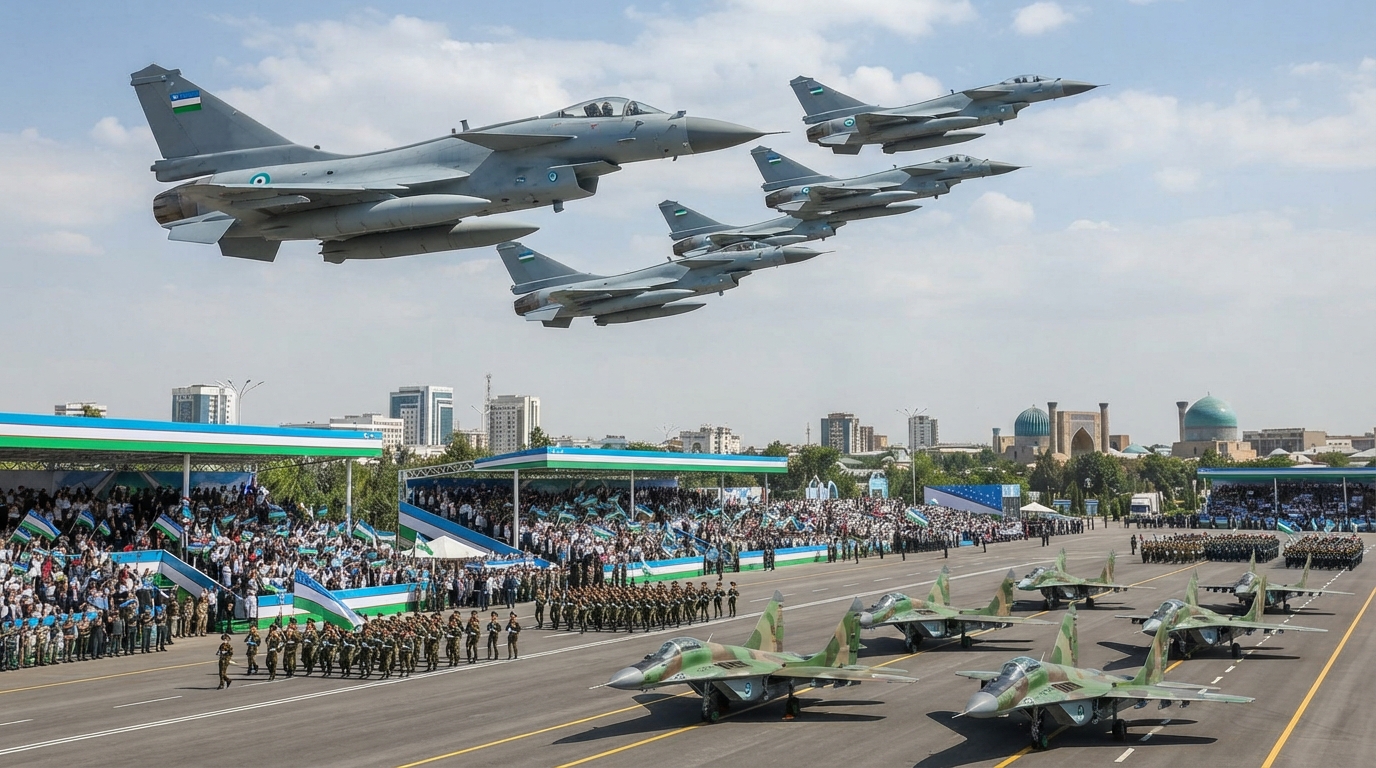
**Uzbekistan chose J-10C fighters: Why not Rafale?**
Since the years of independence, the airspace of Uzbekistan has been protected by the MiG-29 fighters, which were produced in the Soviet Union and have been modernized several times. Its partner, the Su-27, has long since disappeared from the media scene, which probably indicates that the aircraft have been put into long-term storage.
No technology, including the MiG-29, one of the most famous fighters of its time, can withstand time. This situation has forced Uzbekistan to seriously think about updating its fighter fleet. Finally, the country announced its choice during the celebrations of the 35th anniversary of independence. The new fighters were not imported from Russia or France. This article will talk about the J-10C fighters and why they will guard the air borders of our Motherland in the coming decades.
**China is a new player**
For several decades, the military aviation market was dominated by three countries - the United States, Russia (the Soviet Union) and France. They not only armed themselves with fighters, but also had a significant impact on the military aviation policy of other countries. But no status quo can last forever. China has proven this once again by becoming a full member of this club in a short time.
Beijing is now surprising the world with its fifth-generation J-20 and J-35 fighters, as well as the J-36 and J-50, which are supposed to belong to the sixth generation. But so far, the only model that has been sold to foreign markets and has demonstrated its capabilities in real combat is the J-10C. It is much cheaper than the models listed now, but it performs a wider range of tasks.
The J-10C, in terms of its body structure and dimensions, does not look as powerful as heavy fighters such as the F-22 and Su-57. In addition, the aircraft does not have the stealth features of the J-20 and J-35. Nevertheless, the combination of modern radar, advanced electronics, long-range air-to-air missiles and relatively low cost makes it a serious competitor to all fighters in the world.
The 2025 conflict between India and Pakistan especially showed what the J-10C is capable of. Then, Pakistani pilots used these fighters to shoot down three Dassault Rafales, as well as one Su-30MKI and one MiG-29 fighter jet each. Delhi has denied Islamabad's claims that the planes were shot down. However, experts and major publications have found evidence supporting the Pakistani version.
Surprisingly, during the Cold War, Beijing was dependent on the USSR for modern aviation technology. At first, China produced Soviet aircraft under license, thereby forming an engineering school. This experience later served as a basis for the country's own projects. However, over time, relations between Beijing and Moscow became strained. After that, the Chinese began to develop the industry independently. The rapidly developing economy played a major role in the process.
**J-10 program**
In the mid-1980s, the Chengdu Aircraft Corporation was tasked with developing a new multi-role fighter. However, the engineers were not easy to meet the requirements. According to the military, the aircraft should be relatively light, cheap and highly maneuverable, and at the same time be able to fight both air and ground targets. This was a very serious challenge for Chinese industry at that time.
When it comes to the history of the J-10C fighter, one of the controversial topics associated with the Jewish state is mentioned. The fact is that in the 1980s, Israel began developing its own Lavi fighter. The first prototype even successfully took to the air. However, the United States put pressure on the program to stop, fearing that the Lavi would become a serious competitor to its F-16 fighter. According to unconfirmed reports, after that, Jewish engineers handed over the drawings to their Chinese colleagues.
Both aircraft used an aerodynamic scheme based on canards and delta wings. In addition, at that time there were military-technical ties between China and Israel. All this increased the number of supporters of this theory. However, another group of experts rejects this version. According to them, Chinese engineers used domestic projects, in particular the J-9 program, when designing the J-10C.
**The biggest problem is the engine**
The Chinese faced engine problems in the early stages of the J-10 program. The country did not have sufficient capacity to independently develop a modern turbofan engine. Therefore, they turned to Moscow again. The new fighters began to fly on Russian Saturn AL-31FN engines. This situation continued until the Chinese developed its local version - the WS-10.
It is worth noting that the J-10 fighter is divided into several models according to its purpose and tasks:
* **J-10A** - the first serially produced version of the family.
* **J-10S** - a two-seat version. It is used mainly for training and combat training.
* **J-10B** - a significantly improved version.
* **J-10C** - the most popular model.
The Chinese fighter is mainly piloted by one person. The aircraft can reach speeds of up to 1,200 km/h and climb to an altitude of 18,000 m. The J-10C has a maximum take-off weight of 19 tons. Of this, 6-7 tons are ammunition and about 4 tons are fuel. In addition, the fighter can carry an additional 3 tons of kerosene through external tanks. The combat radius is estimated at 1,240 km.
**Armament**
As a multi-role fighter, the J-10C uses a large arsenal of weapons. If it is necessary to engage in close combat or eliminate low-flying targets such as drones, the 23 mm Gryazev-Shipunov GSh-23 cannon will be used. If the opponent is an enemy aircraft, the PL-8 and PL-10 short-range guided missiles will be used. For threats beyond the visual range, the PL-12 missile is used. It is designed to neutralize threats at a distance of 70-100 km.
However, the main missile of the Chinese fighter for long-range combat is the PL-15. According to the manufacturer, its flight range is 200-300 km. However, in the export version of the missile, the PL-15E, this indicator is reduced to 150 km. In addition, the Chinese have developed another missile for their armed forces - the PL-17. If you believe the figures, the missile can hit targets at a distance of 400-500 km.
When it comes to hitting ground targets, cruise missiles, laser-guided bombs, "floating" bombs and unguided missiles are used. However, the fighter's combat capabilities cannot be assessed by this alone. Because in modern conflicts, whoever detects the enemy first and successfully strikes will enjoy the sun the next day.
**Avionics**
For modern aircraft, avionics perform the functions of the “eyes”, “ears” and “brains”. This is one of the strengths of the J-10C fighter. The aircraft uses AESA radar. It is sharply different from the mechanical or PESA radars of the older generation. For example, in traditional radar systems, the central transmitter performs the main function. In addition, countless mechanical devices quickly fail. If one of them breaks down, the radar turns into unnecessary junk.
The AESA radar consists of many small transmitter-receiver modules. Even if one of them fails, the other continues the task. In addition, such radars are more resistant to electronic warfare measures and simultaneously perform tasks such as searching for targets, conducting terrain topography and jamming enemy radars.
However, avionics are not limited to radar. Modern displays, electronic warfare systems, infrared sensors and other auxiliary systems are also of paramount importance. The J-10C fighter is one of the few aircraft equipped with a HUD, or Head-Up Display. It displays the aircraft's speed, altitude, direction, attack parameters and other information in front of the pilot's eyes. In other words, the pilot does not have to look down during combat, losing precious seconds to control weapons systems.
But that's not all. Another display system mounted on the helmet also provides information to the pilot. Its name is HMD, and it serves to control weapons systems directly from the head. This is especially important in close air battles.
**Why is China the best option?**
One of the main factors that makes the J-10C fighter popular in the world market is its price. It can perform the tasks performed by expensive Western aircraft for a much cheaper price. The Pakistani case confirms this. The fact is that after India purchased Dassault Rafale 4++ fighters from France, Islamabad looked for options to respond appropriately. In the end, the Pakistanis purchased J-10CE aircraft (intended for export) from China.
According to open sources, Pakistan paid $ 1.5 billion for 24 fighters. This means that each aircraft cost an average of $ 60 million. Now for comparison: the Indians paid $ 240-260 million for 36 Rafale aircraft in 2016. But this did not prevent the Pakistanis from gaining air superiority in the 2025 conflict.
Indeed, the last conflict between the two countries was a golden hour for the J-10C. But this does not mean that the Chinese fighter is stronger than its French opponent. Because in modern air battles, a number of other factors play an important role, in addition to the aircraft itself. Intelligence, high-speed information exchange, integration with ground systems, long-range missiles, tactical training and pilot skills are the most important of them.
News that Uzbekistan may purchase French Dassault Rafale fighter jets first appeared in 2023. Since then, there has been no official information about the negotiations between the parties or their progress. However, the demonstration of Chinese-made J-10CE fighter jets on Uzbekistan’s main national holiday means that the Uzbek Air Force has already made its choice.
Many factors influenced this decision. The Chinese fighter jets have proven themselves well in the conflict with India, their relatively low operating costs and high production rates. Dassault already has 220 orders for Rafale aircraft. Of these, 45 are intended for the French military and 175 for export. Considering that the manufacturer delivered a total of 26 aircraft by 2025, Uzbekistan could have waited a long time. This would be unbecoming of a country that is rapidly modernizing its armed forces.
It is not known how many fighters Uzbekistan will buy, when they will be fully delivered, and the value of the contract. So far, it is known that the country has become the third operator of this aircraft after China and Pakistan, after Uzbekistan, Bangladesh has also signed a $2.2 billion contract for 24 fighters, Indonesia has already ordered 42 aircraft, and Serbia, Algeria, and Venezuela have expressed interest.