

Uzbekistan to purchase 10 Škoda electric trains for €157 million for suburban commuter services
Uzbekistan will purchase 10 Škoda electric trains for 157.1 million euros. To finance the purchase, a loan of 123.5 million euros will be obtained from the European Investment Bank. The four-car trainsets are planned to be used on suburban routes of Tashkent, the Fergana Valley, and Samarkand, covering a total of 7 routes.
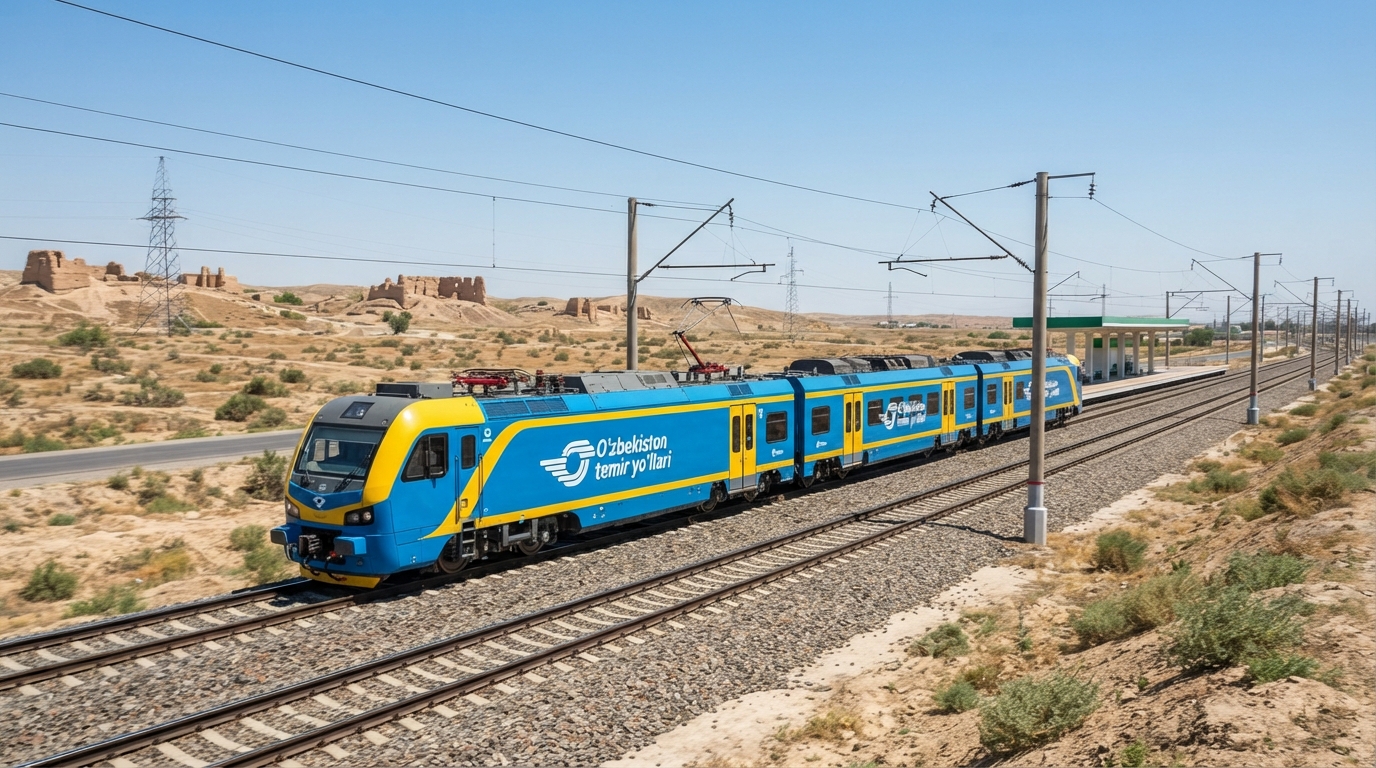
Uzbekistan to buy 10 Škoda electric trains for suburban routes for 157 million euros
By the decision of the Tashkent City Kengash of People's Deputies dated September 17, 2026, the concept of the project of JSC "O‘zbekiston temir yo‘llari" to purchase 10 modern electric trains from the Czech company Škoda Transportation was approved.
Within the framework of the project, it is planned to acquire 10 Škoda 25Ev electric trains, each consisting of four carriages. The document notes that the implementation of the project is scheduled for 2026–2030.
According to the distribution plan, the new trains can run on the following routes:
The document notes that some routes already exist in practice, while others will be established as new routes. In particular, it is planned to launch regular electric train services on the Samarkand-Bukhara and Samarkand-Karshi-Shakhrisabz routes.
Škoda 25Ev electric trains must meet the main requirements specified in the technical specifications.
According to the technical indicators in the project, the new trains are also planned to have USB charging sockets, LED information displays, a video surveillance system, and an automatic fire alarm.
According to the concept, the total cost of the project is 157 million 59 thousand euros. Of this, 141 million 564.3 thousand euros account for capital investments.
The sources of financing are defined as follows:
Within the framework of the project, 123.5 million euros are planned to be spent on the delivery of electric trains. Transportation costs are estimated at 5 million 622.4 thousand euros, financial costs during the investment period at 3 million 859.9 thousand euros, and unforeseen expenses at 6 million 456.1 thousand euros.
Also, the value-added tax on imported assets amounts to 15 million 494.7 thousand euros. The concept provides for exempting the project from VAT and certain customs duties.
The concept also indicates the potential of the new electric trains to save electricity. According to the calculations of JSC "UTY-Injiniring", the regenerative braking system can reduce electricity consumption by 24–27 percent compared to the mode without this system.
The document notes that due to the high acceleration and deceleration rates of the new trains, travel time on routes with many stops can be reduced. Depending on the track profile and the number of stations, the possibility of reducing travel duration by 10–15 percent has been calculated. This can create conditions for increasing the frequency of train services without changing the existing infrastructure.
The concept indicates that after the introduction of the new trains, the number of daily trips on some routes during peak hours can be increased from 2–3 pairs to 4–5 pairs.
The document notes that as of 2026, the suburban electric train fleet of JSC "O‘zbekiston temir yo‘llari" comprises 10 electric trains consisting of a total of 77 carriages.
A significant part of the fleet consists of ER9E series electric trains manufactured in 1983–1987. Their service life is approaching the standard limit.
According to preliminary calculations of JSC "Tashkent Carriage Construction and Repair Plant", about 135 billion soums are required for the capital repair and modernization of 45 carriages in the existing fleet. In this case, the remaining service life of the modernized trains may be approximately four years. Therefore, the concept considers the purchase of new electric trains as a long-term solution compared to short-term repairs of the existing rolling stock.
In 2025, 10.5 million passengers were transported by suburban rail transport in Uzbekistan. Presidential Resolution No. PP-391 sets the task of increasing this figure to 23.5 million by 2030, and the number of routes on which electric trains operate from 40 to 53.
Several fare tariff scenarios were analyzed in the project concept. They are divided into social, average, high, and options with minimal burden on the budget.
The base tariffs for some routes are indicated as follows:
The final amount of tariffs has not yet been determined. The document notes that when forming prices, it is necessary to take into account inflation, household incomes, prices of alternative modes of transport, the competitive environment, and passenger demand.
The document analyzes 3 different economic scenarios depending on the level of fare prices:
Social scenario (Fare price at the lowest level):
Base scenario (Fare price at a balanced level):
High scenario (Fare price at a high level):
The document indicates that in the social tariff scenario, due to relatively low fares, passenger flow will increase, but the need for budget subsidies will grow. In the high tariff scenario, revenues may increase and the volume of operational subsidies may decrease, but there is a possibility of a decline in passenger flow.
The base scenario is defined as a balanced option between tariffs, transport accessibility for passengers, and state support.
Within the framework of the project, it is planned to establish a modern service infrastructure for maintaining these trains on the territory of Uzbekistan, as well as to implement localization programs.
At the same time, it is planned to create new jobs for drivers, their assistants, and engineering and technical personnel maintaining the new trains. The concept indicates that approximately 156 jobs will be created.
It is emphasized that during operation, electric trains do not directly emit CO₂ and other harmful substances into the atmosphere, and the transition to electric traction will improve the environmental performance of transport.