

Uzbekistan to expand tax incentives for energy storage systems and business participation in power grids
In Uzbekistan, the application of ten-year tax incentives for energy storage projects will be clarified, extending them to substations and auxiliary infrastructure. The private sector is also planned to be involved in the management of power distribution networks in the Jizzakh and Tashkent regions.
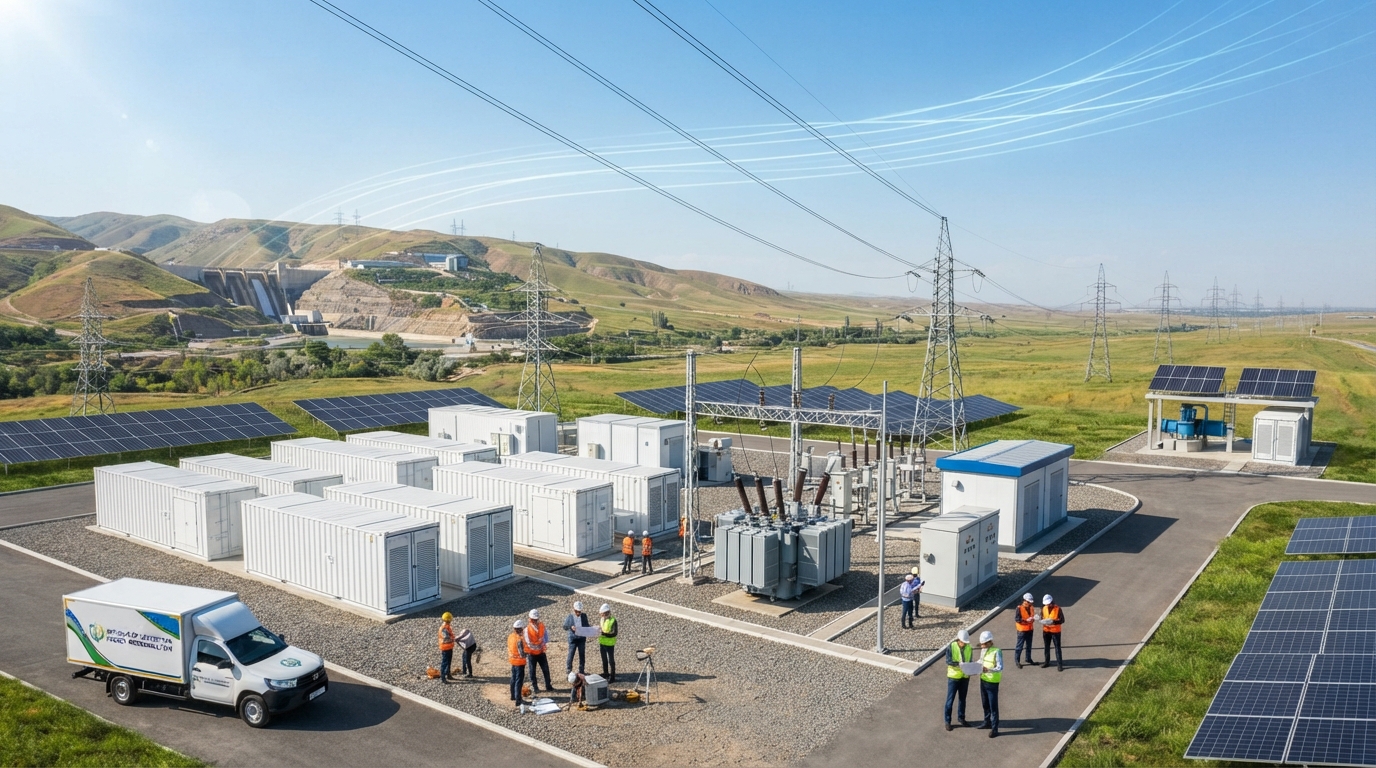
Uzbekistan intends to expand tax incentives for energy storage and increase business participation in power grids
Uzbekistan plans to take additional measures to support energy storage projects, expand private business participation in power distribution networks, and develop energy conservation. President Shavkat Mirziyoyev announced this on October 16 at an open dialogue with investors in the fuel and energy sector.
In particular, the president pointed out discrepancies in the application of existing tax incentives for energy storage projects.
Legislation provides for 10-year land and property tax exemptions for such projects. However, in practice, questions arise regarding which specific infrastructure facilities fall under the tax exemption.
To eliminate these discrepancies, plans are underway to explicitly stipulate in the Tax Code that incentives apply not only to areas occupied by batteries or solar panels, but also to necessary substations, control buildings, and auxiliary infrastructure.
The president also announced plans to expand the participation of private companies in power distribution networks.
The approach, the implementation of which began in the Samarkand region, is planned to be extended to the Jizzakh and Tashkent regions.
The stated goals are to reduce electricity losses and improve the quality of service for consumers.
As a reminder, a project for the modernization and management of power distribution networks based on public-private partnership is already being implemented in the Samarkand region.
By the presidential decree of August 14, 2026, measures were approved for the implementation of the project, under which the private partner is granted the right to manage and operate the region's distribution networks. Its responsibilities include modernizing and reconstructing networks, increasing their capacity, connecting new consumers, and attracting investment.
Investors will be able to earn from saved electricity
Special attention at the meeting was paid to attracting private capital to improve energy efficiency. "The cheapest energy is saved energy," Shavkat Mirziyoyev stated.
According to the president, private investments will be drawn toward modernizing social sector facilities and water management pumping stations using energy-saving technologies.
At the same time, plans are in place to provide investors with the opportunity to generate revenue through saved electricity and carbon credits.
As a reminder, in June 2026, the Ministry of Water Resources signed agreements under a project to modernize 19 large pumping stations with the integration of solar generation and energy storage systems. The total cost of the project is estimated at approximately $940 million, with its implementation scheduled for 2027–2030.
At the meeting, the president also confirmed plans to build 5,000 km of power grids and 16 large substations by 2030. The capacity of electricity storage systems is expected to be brought up to 4.5 GW.
Most of the projects will be implemented in Karakalpakstan, as well as the Bukhara, Jizzakh, Samarkand, Namangan, Kashkadarya, and Tashkent regions.
In the future, priority will be given to comprehensive projects that combine electricity generation, transmission, and storage. The authorities also intend to cooperate with investors in the construction of pumped-storage hydroelectric power plants designed for long-term energy storage.
Furthermore, the president announced that the project to export "green" electricity to Europe across the Caspian Sea jointly with Azerbaijan and Kazakhstan is moving into the practical stage. The markets of Afghanistan and South Asia were also named as promising destinations.