

Uzbekistan showcased J-10 fighter jets in a Defense Ministry video
The Uzbek Ministry of Defense published a video of Chinese J-10 fighter jets in flight, presenting them as part of the country's modern air defense system.
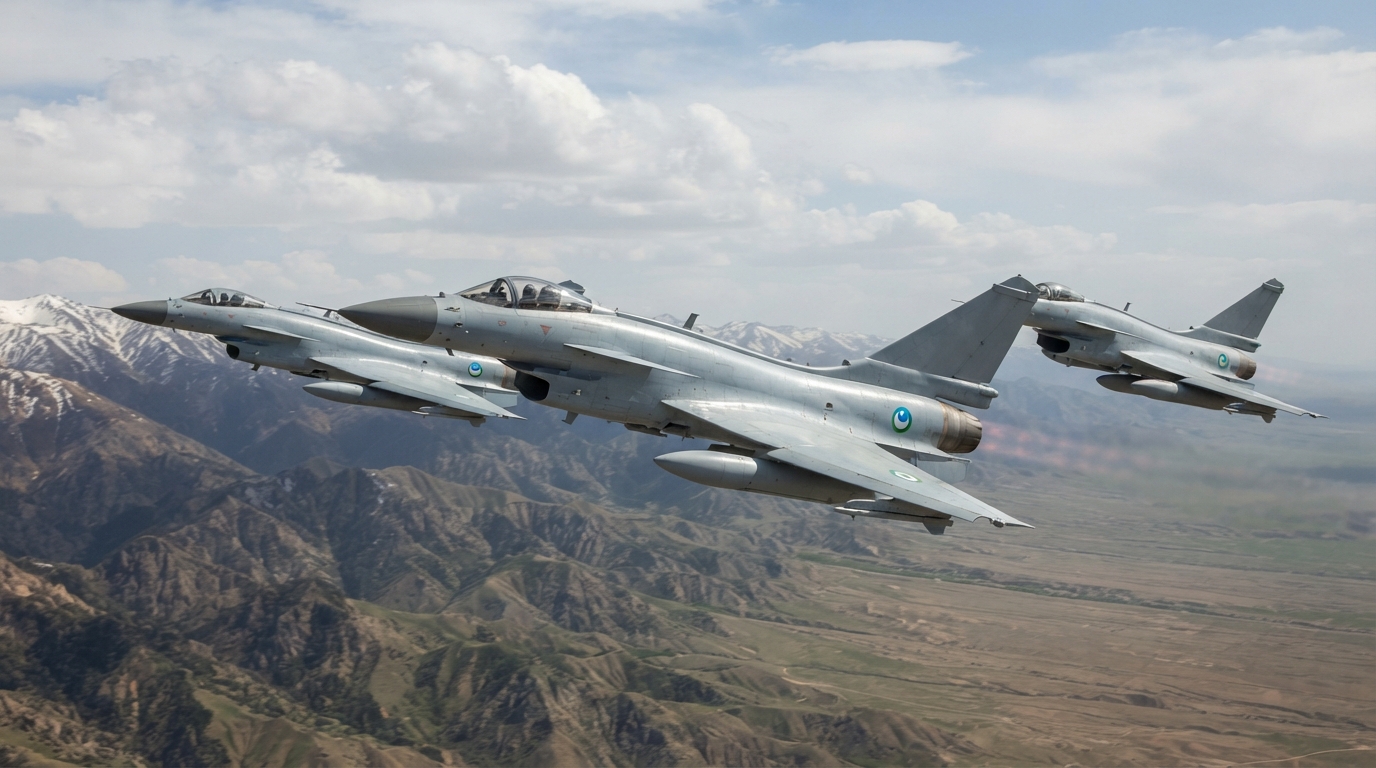
The Uzbek Ministry of Defense published a video showing modern combat aircraft in flight. According to the ministry's accompanying statement, these aircraft provide air defense for the country's airspace.
The video shows three J-10CE fighters conducting joint flights and aerial maneuvers. At least one J-10CE model aircraft can be clearly seen in one frame. However, the Ministry of Defense did not provide any technical specifications or official designations for the aircraft in the video.
The J-10CE is classified as a 4++ generation multirole fighter. It is equipped with an active phased array radar and is capable of employing advanced weapons, making it one of the key export models of the Chinese aviation industry.
According to military analysts cited by Defense Security Asia, Uzbekistan's interest in Chinese aircraft is driven by the need to modernize its combat aircraft. The country's current aircraft fleet still relies heavily on Soviet-era MiG-29 and Su-27 fighters, many of which have been in service for decades. Their maintenance is complicated by problems with component supplies and repairs.
The publication also notes that the acquisition of the J-10CE is in line with Uzbekistan's strategy to develop military-technical cooperation with China. Previously, in 2015, the country purchased Chinese HQ-9B, FM-90, and KS-1C air defense systems.
**Details about the J-10CE fighter**
**Origin and development**
The J-10CE is the export version of the Chinese J-10C fighter. It is a single-engine, multirole aircraft with a tailless canard configuration and was developed by Chengdu Aircraft Corporation (part of AVIC). The history of the J-10 family began in the 1980s. The first prototype flew in 1998, and the baseline J-10A entered service with the PLAAF in 2005. The J-10C is the most advanced production version, entering service with China in 2018. The export variant, the J-10CE, received approval for international sales in 2016.
Generation and Mission.**
The aircraft is a 4++ generation fighter designed for both air superiority and ground attack. It is positioned as a more affordable alternative to Western and Russian twin-engine fighters such as the F-16V or Rafale.
**Avionics and Radar.**
The key difference from earlier versions of the J-10 is its active electronically scanned array (AESA) radar, which is variously designated the KLJ-10A or KLJ-7A. This radar provides increased detection range and the ability to simultaneously track and engage multiple targets. The fighter is also equipped with a helmet-mounted targeting system and an electronic warfare suite.
**Armament.**
The fighter has 11 hardpoints and is capable of carrying PL-15 long-range air-to-air missiles, PL-12 missiles, PL-10 short-range missiles, and various precision-guided munitions for engaging ground targets, including the LT-2 laser-guided bomb.
**Powerplant.**
Export aircraft delivered to Pakistan are equipped with the Chinese WS-10 (Taihang) engine, reducing dependence on Russian powerplants. Some modifications and earlier batches use the Russian AL-31FN engine. The aircraft's maximum speed is estimated at approximately Mach 2.2, with a combat radius of over 900 km. However, the internal fuel capacity (approximately 4,950 liters) is considered a limiting factor without the use of external fuel tanks.
**Cost.**
The estimated price of one aircraft is approximately $40-50 million, making the aircraft relatively inexpensive compared to Western 4.5-generation fighters. However, according to some sources, the complete package for Pakistan (including aircraft, armament, and flight crew training) averaged closer to $76 million per aircraft.
**Operational Experience.**
Pakistan became the first foreign customer for the J-10CE, beginning to receive aircraft in 2022 (the initial order was for 20 aircraft, and with the second batch, the total could have reached 36). The fighter received its baptism of fire during the Indo-Pakistani air conflict of 2025. According to Chinese state media and several publications, this confirmed the effectiveness of its radar and PL-15 missiles. However, claims of downed targets during this episode remain a matter of dispute and have not been independently confirmed by all parties.
**Export Profile.**
Besides Pakistan, other countries have also expressed interest in the J-10CE. The aircraft has been actively showcased at defense exhibitions, such as LIMA 2025 in Malaysia.