

Uzbekistan Is Building Digital Payment Infrastructure. Can It Become SME Finance Infrastructure?
Uzbekistan’s digital-finance story is entering a more interesting phase. The country is no longer starting from a blank sheet of paper. It already has an instant-payment system, domestic card infrastructure, QR payments and a rapidly expanding agenda around fintech, Open Banking and account-to-account services.
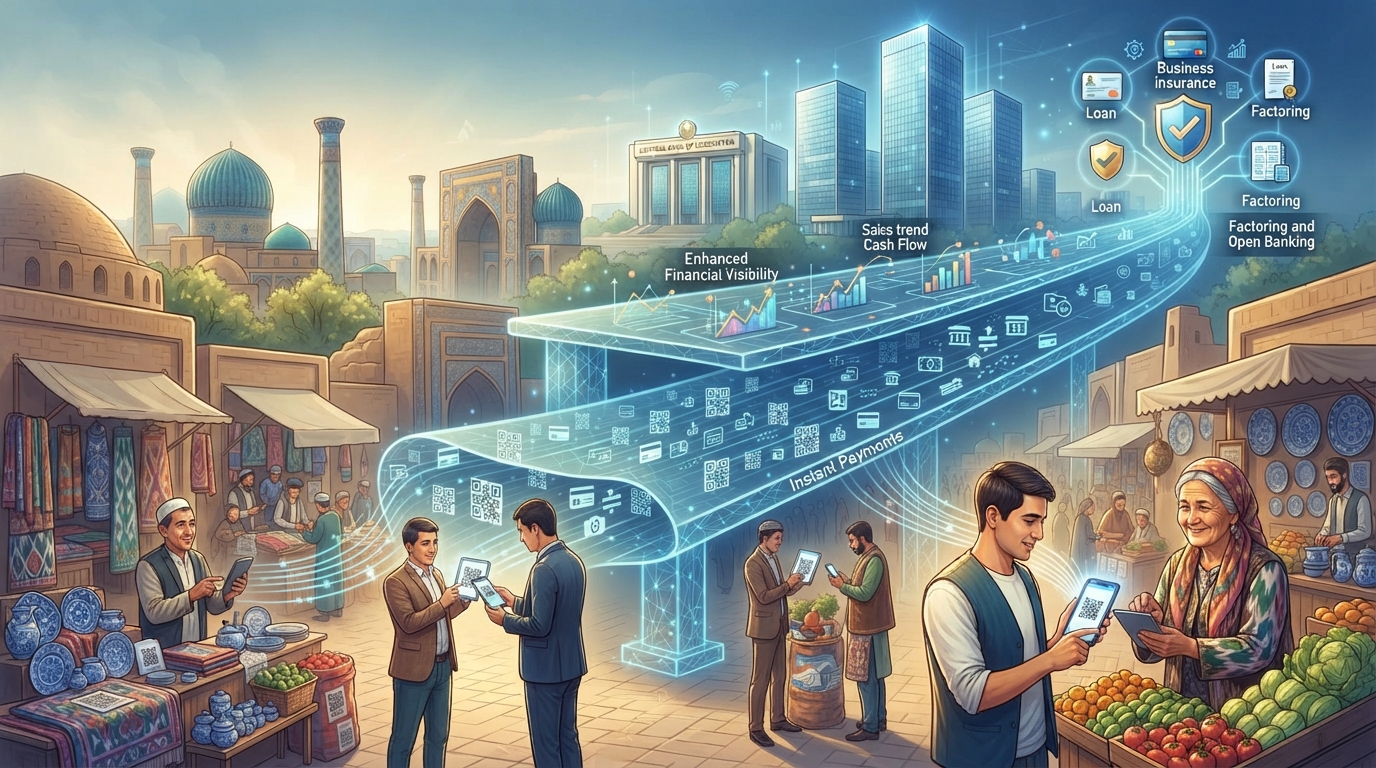
Uzbekistan's digital finance landscape is evolving rapidly, moving beyond foundational infrastructure to a more sophisticated phase. The nation has already established an instant payment system, a domestic card network, and QR payment capabilities, alongside a growing focus on fintech, Open Banking, and account-to-account services.
In 2024, the Central Bank's Instant Payment System processed 47.6 million transactions. QR code payments surpassed UZS 441.7 billion. The Central Bank's 2025 annual report indicated approximately 108,000 QR codes issued to businesses via the QR-online system, with the value of QR transactions increasing by nearly 1.3 times year-over-year.
The infrastructure is set to advance further. For its 2026–2030 fintech strategy, the Central Bank has prioritized a national payment switch, standardized QR protocols, Open Banking, and account-to-account transfers. Effective July 1, 2026, a unified UzQR acceptance framework was also implemented for trade and service sectors.
These developments are significant, but they prompt a crucial question from a business development standpoint: How can Uzbekistan leverage this payment infrastructure? The goal should be to view transactions not as an endpoint, but as a potential starting point for broader financial relationships.
**Addressing the Financing Gap**
Uzbekistan's micro, small, and medium enterprise (MSME) sector is substantial and economically vital, representing over 90% of businesses, 75% of employment, and approximately 55% of GDP, according to the World Bank.
However, access to finance remains a significant hurdle. The World Bank reports that over one-third of MSMEs lack bank accounts, less than 30% of sales are electronic, and only 10% of small enterprises and 16% of medium enterprises report access to loans. The estimated MSME credit demand is around US$13 billion, with a financing shortfall of roughly US$6 billion.
These figures should be considered in conjunction with the expansion of digital payments. The opportunity lies not in assuming that more digital transactions automatically lead to more credit, which they do not. Instead, it's about utilizing digital financial activity to mitigate a persistent challenge in SME finance: the limited insight into a smaller business's actual operations.
**From Payment Activity to Financial Transparency**
For businesses that increasingly receive revenue digitally, transaction flows can progressively offer valuable data on sales patterns, seasonality, revenue consistency, and cash-flow behavior.
This information should not, by itself, constitute a credit score. Revenue is distinct from profit, transaction volume does not equate to repayment capacity, and no digital footprint can eliminate fraud, economic shocks, or credit risk.
Nevertheless, transaction data can serve as an additional layer of context, complementing financial statements, account history, credit bureau information, collateral (where applicable), and other conventional underwriting inputs.
This distinction is crucial. The beneficial progression is not "digital payment to automatic loan," but rather "digital payment to enhanced financial visibility to more informed financial decisions."
This direction is already evident in Uzbekistan's policy discussions. In June 2026, the Central Bank, World Bank, and IFC explored digital tools for SME lending, partial and portfolio credit guarantees, and improvements to risk assessment systems under the FINGROW program.
**Payments as a Distribution Channel**
A second opportunity exists: payment infrastructure is not merely for moving money. As it matures, it can also become a conduit for distributing financial services.
A merchant relationship might begin with accepting a QR payment. Over time, this relationship could potentially expand to include a business account, cash management tools, working capital finance, supplier payments, factoring, insurance, or other services.
This is particularly relevant as Uzbekistan develops Open Banking and account-to-account capabilities. If regulated financial products can be distributed through the digital environments where businesses already transact, banks may not need every financial relationship to originate within a physical branch or even a traditional banking application.
The strategic question then shifts from "Who processes the payment?" to "Who can cultivate the most valuable financial relationship around the payment?"
**A Stronger Value Proposition for SMEs**
Digitalization offers clear advantages for regulators and financial institutions: more efficient payments, improved traceability, and a larger formal financial footprint.
However, sustainable adoption also necessitates a compelling value proposition for the businesses themselves.
For an SME, the value of digital payments is amplified when digitalization can ultimately improve access to useful financial services. A merchant should not merely be told, "Accept digital payments because the economy is becoming digital." The more powerful proposition is, "Your digital activity can help the financial system understand your business better."
This enhanced understanding does not guarantee finance, but it can help create conditions for more relevant working capital products and a deeper banking relationship.
**Connecting Fintech Innovation to Real Business Challenges**
Uzbekistan's fintech ecosystem is already exploring ideas beyond payments. In March 2026, fintech startups presented solutions to the Central Bank and commercial banks, including digital factoring for small businesses, transactional data analytics, marketplace and logistics tools, card aggregation, and AI-enabled services. Preliminary agreements were reached to explore pilot programs.
This is encouraging because the next phase of fintech development should not be judged solely by the number of apps, payment methods, or APIs launched.
It should also be evaluated by whether new infrastructure addresses costly business problems: access to working capital, slow supplier payments, fragmented financial information, weak cash-flow visibility, and expensive distribution of financial products.
In this context, digital factoring is a particularly interesting example. It integrates payments, receivables, business data, and financing around a genuine operational need, rather than treating fintech as an isolated technological layer.
**A Necessary Caution: Better Data, Not Easier Credit**
A crucial caution is warranted. The global fintech discourse often too quickly jumps from "more data" to "more lending." Uzbekistan should avoid this shortcut.
Recent cross-country research by the World Bank indicates a strong correlation between firms receiving electronic payments and lower credit constraints, especially where information gaps are significant. However, the authors themselves are careful about establishing causality.
The practical lesson is not that payment data proves creditworthiness. It is that digital payments can generate information that was previously unavailable in a usable format.
Therefore, the objective should be better underwriting, not looser underwriting; improved distribution, not indiscriminate lending; and financial inclusion that is commercially sustainable for both the business and the lender.
**From Payment Infrastructure to Productive Financial Infrastructure**
Uzbekistan is currently assembling several critical layers simultaneously: instant payments, unified QR acceptance, domestic payment infrastructure, Open Banking discussions, account-to-account services, fintech pilots, and new mechanisms for SME finance.
The greater opportunity lies in ensuring these layers reinforce one another.
Beyond transaction volume, QR deployment, and digital payment adoption, I would increasingly monitor a different set of metrics: the number of digitally active SMEs gaining access to formal finance; how many businesses adopt additional financial services after starting with payments; whether digital activity reduces the time and cost of underwriting; and whether working capital products become more relevant to actual cash-flow patterns.
These are not currently published as a national dashboard. They are proposed measures for a different question: