

Uzbekistan is adopting the German model of managing state buildings and lands.
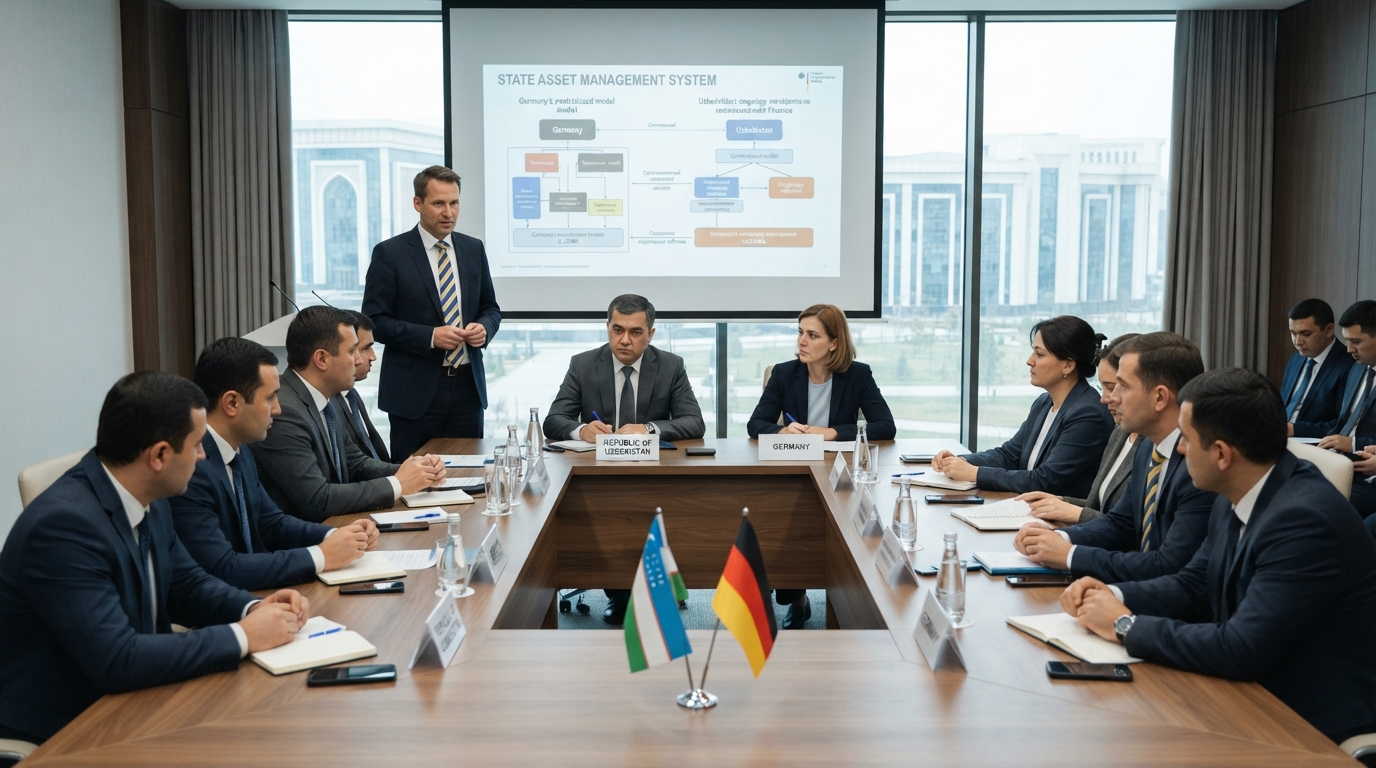
Uzbekistan is adopting Germany's experience in managing state buildings and land.
Uzbekistan is studying the German approach to state property management to improve the efficiency of assets remaining in state ownership. Representatives of the German Federal Agency for Real Estate Management (BImA) shared information with experts from the State Assets Management Agency of Uzbekistan (UzSAMA) on digital property records, centralized asset management, maintenance, sales, and leasing, all implemented in Germany.
Interest in the German model is driven by a large-scale reform of state property in Uzbekistan. By 2030, the country plans to increase the share of the non-state sector in the economy to 85% and reduce the number of state-owned enterprises by six times. Therefore, the state faces the challenge not only of asset privatization but also of effective management of assets remaining in state ownership.
The key highlight of the seminar was a presentation by BImA, the organization responsible for managing federal property in Germany. German specialists presented practical mechanisms for managing such assets to the Uzbek side.
Jörg Musial, Head of Sales at BImA, and Robert Erfen, Head of State Property, discussed centralized asset management, digital registries, property maintenance, and methods for utilizing unclaimed or inefficiently utilized assets.
Mechanisms for valuing, selling, and leasing state-owned assets were also discussed. The issue of integrating unused property into economic circulation, i.e., finding ways to generate economic benefit from idle state-owned assets, is particularly pressing for Uzbekistan.
Opening the seminar, UzSAMA CEO Sohibjon Murodov emphasized Germany's extensive experience in state-owned asset management. He stated that the BImA system, as well as transparent mechanisms for valuing, selling, and leasing state-owned assets, are of particular interest.
"Studying Germany's rich institutional experience is crucial for further improving Uzbekistan's state asset management system and developing a modern, digital, and transparent governance system," he noted.
This experience is also important for Uzbekistan because state property is distributed among various entities. A centralized approach allows for the development of uniform rules for its accounting, maintenance, and use.
However, this does not entail directly copying the German system. The Uzbek side intends to study existing instruments and determine which ones can be adapted to local legislation and the specifics of state property management.
Changes in this area are occurring against the backdrop of a reduced state presence in the economy. If a significant portion of enterprises and assets are transferred to the private sector, the state will simultaneously need to more effectively manage the property that remains in its ownership.
This is why the issue of state property is becoming a separate area of reform. This concerns buildings, land, and other assets that can be used by state entities, leased, sold, or incorporated into economic activity.
The German side, in turn, also views cooperation as mutually beneficial. Christina Klas, head of the German Federal Ministry of Finance's division, noted that Uzbekistan is currently actively reforming its state asset management and privatization systems.
According to her, it is important for Germany not only to share its own experience but also to observe how the state asset management system is changing in Uzbekistan.
The current seminar is a continuation of cooperation between Uzbekistan and Germany in the field of state property management, which has been ongoing since 2009.
During this time, with the expert and technical support of the German side, Uzbekistan developed the laws "On State Property Management" and "On the Privatization of State Property," as well as the first Corporate Governance Code.
A new version of the Corporate Governance Code is currently being developed jointly with German partners. Furthermore, a new version of the law "On Joint-Stock Companies and the Protection of Shareholder Rights" has been developed and is currently under government review.
Concurrently, specialist training, seminars, and delegation exchanges are being held. With the participation of the German Society for International Cooperation (GIZ), Uzbek specialists visited Germany to study practices in the management and privatization of state assets.
Now, cooperation is expanding, from privatization and corporate governance to the management of state-owned real estate.
The parties agreed to continue the work in three stages. First, a series of online seminars will be held for UzSAMA specialists. Then, German experts will visit Uzbekistan to study the local system and identify the most promising areas of cooperation. Following this, the Uzbek delegation will visit Germany and observe BImA's work firsthand.
Thus, the next stage of the reform is not simply the sale of state assets, but the creation of a more efficient system for their accounting, management, and use. The parties will determine which German instruments can be adapted to Uzbek conditions during subsequent meetings.