

Uzbekistan Expands Solar Capacity with 2,508 MW Installed
Uzbekistan installed 2,508 MW of solar capacity from 2023 to 2026, generating over 4.7 billion kWh and saving 1.27 billion cubic meters of gas.
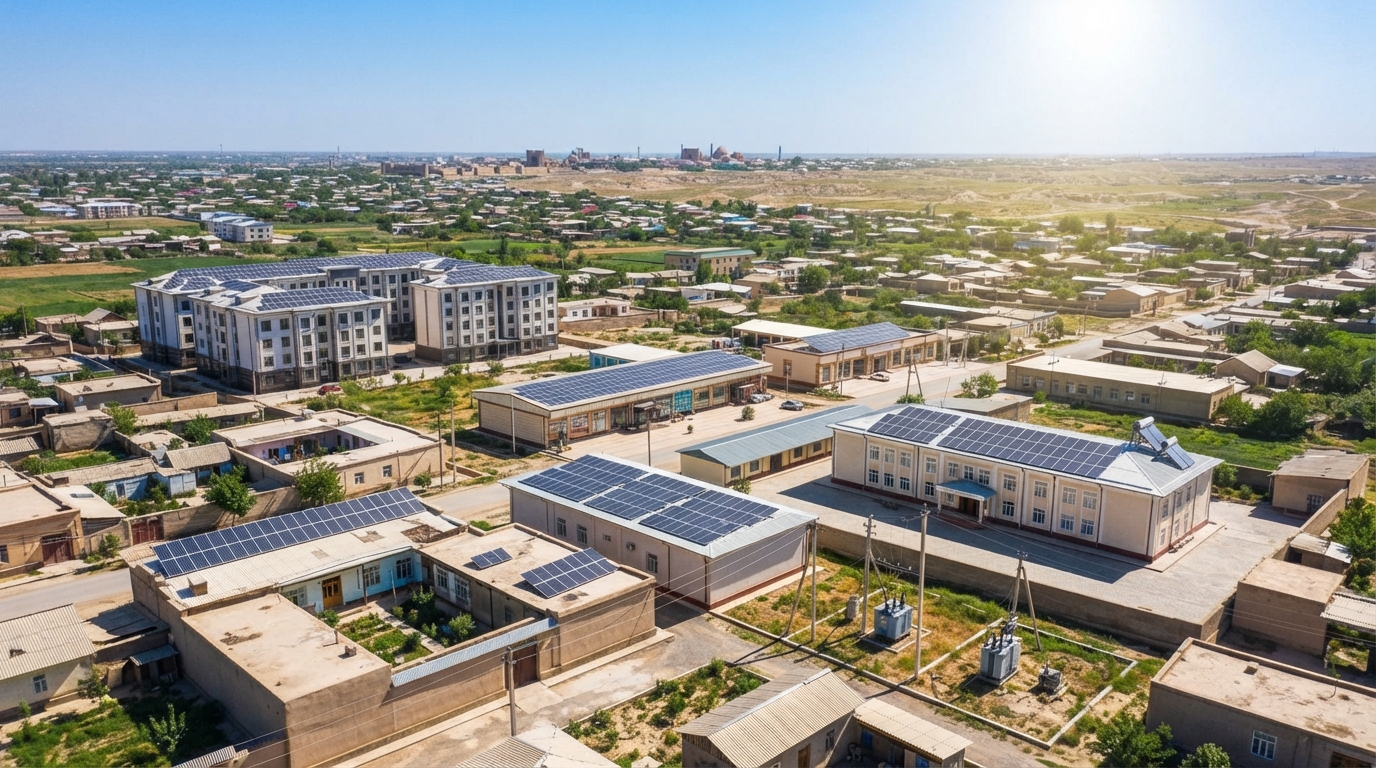
Tashkent, Uzbekistan (UzDaily.uz) — Uzbekistan has significantly boosted its solar energy capacity, installing small-scale solar panels totaling 2,508 MW between 2023 and 2026. This expansion has generated 4.715 billion kWh of electricity, saved 1.271 billion cubic meters of natural gas, and prevented 2.711 million tonnes of greenhouse gas emissions, as reported by the Ministry of Energy of Uzbekistan.
The growth in renewable energy generation has been facilitated by regulatory frameworks designed to ensure financial returns for power producers. Presidential Decree No. UP-220, issued on September 9, 2022, established support measures for low-capacity renewable installations in homes, businesses, and social institutions. Furthermore, Cabinet of Ministers Resolution No. 247, dated June 14, 2023, allowed individuals and businesses to sell surplus electricity, up to 1 MW, generated by solar, wind, and biogas systems back to the national power grid.
Under the "Solar Home" (Solnechny Dom) initiative, individual citizens receive 1,000 soums per kWh for surplus electricity fed into the grid. From 2023 to 2025, total payments to individuals and legal entities for grid-fed electricity amounted to 462.1 billion soums, with households receiving 222.9 billion soums and commercial entities 239.3 billion soums.
Disbursements saw a sharp increase during the first seven months of 2026, reaching 632.7 billion soums between January and July. Of this, households received 436.7 billion soums and commercial entities 196 billion soums. Notably, 48 billion soums of the funds allocated to businesses were used to offset existing electricity bill debts. The payments during this seven-month period represented 137 percent of the total amount disbursed throughout the entire 2023–2025 period.
By the close of 2026, total annual disbursements are projected to reach 725.6 billion soums, comprising 506.2 billion soums for the general population and 219.3 billion soums for businesses. The cumulative payouts to households and enterprises from 2023 through 2026 are expected to total 1.1877 trillion soums.
Regional data for January to July 2026 indicates that Bukhara region led in "Solar Home" program payouts to households, with 81 billion soums. It was followed by Khorezm region (79.7 billion soums), Karakalpakstan (51.6 billion soums), Kashkadarya region (49.1 billion soums), and Navoi region (34 billion soums).
Solar adoption is widespread across various sectors. Social facilities and government institutions have installed 478.8 MW of solar panels and 2,821.8 thousand liters of solar water heaters. Households have deployed 664.5 MW of solar panels and 2,122 thousand liters of solar water heaters. Commercial enterprises account for 1,330.9 MW of solar panels, while multi-apartment residential buildings have installed 36.4 MW.
Capacity expansion continued into 2026, with over 509.78 MW of new solar panels commissioned between the start of the year and August 13, 2026. The total new capacity additions for 2026 are planned to reach 700 MW, surpassing the annual target by 300 MW and representing 175 percent of the initial plan. This trajectory is expected to bring Uzbekistan's total small-scale solar capacity to 2,700 MW by the end of 2026.
Electricity production targets for 2026 anticipate small solar installations to generate 2.143 billion kWh. From January to June 2026, generation reached 1.4031 billion kWh, fulfilling 65.5 percent of the annual plan, with an additional 739.9 million kWh targeted for the latter half of the year. The Ministry of Energy projects that total solar generation from 2023 through 2026 could reach 5.0379 billion kWh.
Renewable energy deployment is also serving as a social support mechanism. Through corporate social responsibility initiatives linked to investment projects, solar panels are being installed free of charge in social institutions, low-income households, and mahallas. Completed installations include 1,411 households (3,331.86 kW), 120 social facilities (3,157.5 kW), and 21 mahallas (4,200 kW).
Further social solar installations are planned across several regions. In Karakalpakstan, plans include 1,500 kW across 101 social facilities, 1,872.12 kW across 837 households, and 5,200 kW across 26 mahallas. Bukhara region will see installations covering 1,178.95 kW across 198 social facilities and 1,000 kW across five mahallas. Syrdarya region is slated for 1,026.21 kW across 149 social facilities and 447.3 kW across 205 households. Tashkent region will receive 81.54 kW across five social facilities and 99.44 kW across 44 households. Navoi region's plans encompass 500 kW across 39 social facilities, 265.02 kW across 120 households, and 1,200 kW across six mahallas. Samarkand region will implement 1,000 kW across 75 social facilities, 310.2 kW across 141 households, and 1,600 kW across eight mahallas.
The regulatory framework for the sector continues to evolve under Law No. ZRU-939 "On Electricity" dated August 7, 2024, Cabinet of Ministers Resolutions No. 13 dated January 8, 2024, and No. 528 dated August 24, 2024, and Presidential Decree No. UP-152 dated August 29, 2025. The Ministry of Energy stated that these regulatory measures aim to foster market-based electricity sector development, expand private investment and competition, increase sector efficiency, and protect consumer rights.