

Uzbekistan - a tourist destination that combines safety and hospitality
Today, in the international tourism market, along with the country's historical monuments, unique nature or national cuisine,
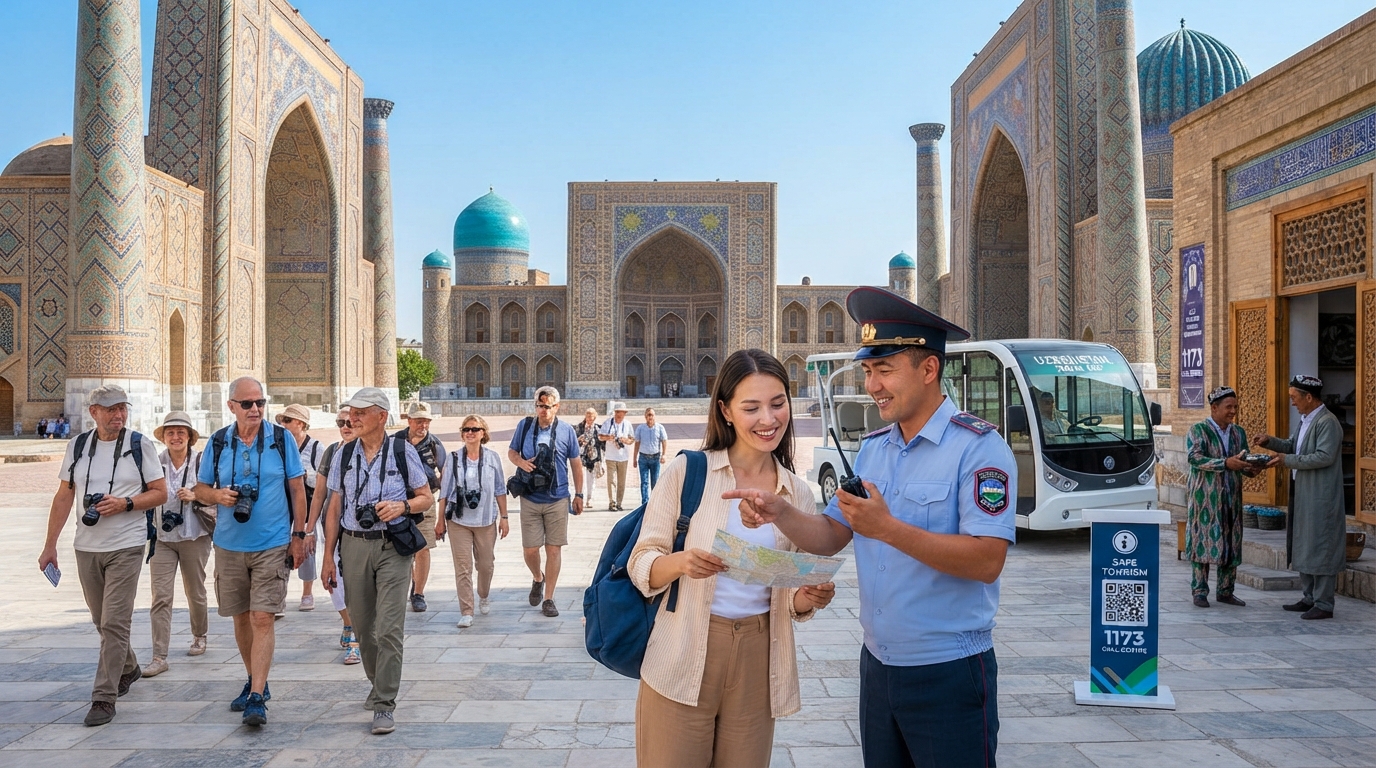
**Uzbekistan: A Tourist Destination of Safety and Hospitality**
In today's international tourism market, along with the country's historical monuments, unique nature and national cuisine, the criterion of "safety" is becoming increasingly important. Tourists want to feel free, calm and protected wherever they go.
It has been 35 years since Uzbekistan gained independence. Unfortunately, most of these years - 25 years - were spent in a closed environment for tourism. The situation has deteriorated so much that until 2016, Uzbekistan was considered one of the most closed countries in the world. However, in the last 10 years, the situation has changed radically; now tourism is not only developing in Uzbekistan, but has become one of the main drivers of the economy.
These changes did not happen by themselves. After a series of reforms and initiatives, the name of Uzbekistan began to be recognized by the world again. The country's development experience in recent years shows that the tourist image of Uzbekistan is being formed not only with historical cities such as Samarkand, Bukhara and Khiva, but also as a safe, convenient and hospitable destination.
The practical result of these changes is clearly visible in the flow of tourists. At the end of 2025, 11.7 million foreign tourists visited Uzbekistan, which is an increase of 116.1% compared to 2024. Exports of tourist services reached $ 4.8 billion.
It is noteworthy that the growth dynamics were maintained in the first quarter of 2026. According to preliminary data, in January-March, 2.87 million foreign citizens from 164 countries visited Uzbekistan for tourist purposes. This is 36.6% more than in the same period last year.
In tourism, safety is understood not only as a low level of crime, but also as a tourist's feeling of protection throughout the process, from entering the country to settling in a hotel, moving around the city, visiting historical sites and natural areas.
In Uzbekistan, this issue is being addressed on the basis of a systematic approach. In particular, in February 2025, the country joined the International Code of Tourist Protection. A "Roadmap" has been developed to implement its provisions in national tourism policy and service practice. More than 70 tourism entities have improved the provisions on the rights and safety of tourists in their contracts.
At first glance, this may seem like a legal and technical process. However, from the point of view of international tourism, its importance is great. Because for a tourist, safety is not only a real situation, but also a matter of "trust". If a tourist knows that his rights are protected and that there is a mechanism for getting help in case of a problem, his positive perception of the country will be further strengthened.
A specialized system for ensuring the safety of tourists is also actively operating in Uzbekistan. The security units of the internal affairs bodies at tourist and transport facilities are implementing preventive measures at airports, train stations, railways and in areas with a high tourist density. In January-July 2025, the safety of more than 12 million passengers was ensured on more than 76 thousand flights operated through airports.
The tourist image of the country is determined not only by internal statistics, but also by official recommendations of foreign countries and the attention of the international media. For example, the US State Department's updated travel advisory on January 26, 2026 set the level of "usual precautions" for Uzbekistan and generally assessed the country as a safe destination for American tourists. At the same time, Uzbekistan has a 24-hour “Safe Tourism” Call Center – 1173, which provides assistance in Uzbek, Russian and English.
The new tourist image of Uzbekistan cannot be explained only by security. The culture of hospitality formed over the centuries remains an important factor here. Historical sites such as the Registan in Samarkand, Labi Khovuz in Bukhara, and Ichan Kala in Khiva tell the tourist about the great past of Uzbekistan, while the behavior of the local population, national cuisine, crafts and family guest houses reflect the current image of the country.
Most importantly, tourism is no longer just about traveling to historical cities. Areas such as ecological, gastronomic, ethno and rural tourism are also increasingly developing. In 2025, 1,023 new accommodation facilities were launched in the republic, and the number of hotels, family guest houses and hostels has increased significantly. This allows tourists to travel beyond major cities, get to know the lifestyle of the local population, and discover Uzbekistan more broadly.
If security and hospitality are not complemented by modern infrastructure, the tourist image will not be sustainable. Therefore, in recent years, special attention has been paid to simplifying visa processing processes, expanding the electronic visa system, the geography of visa-free travel, increasing transport routes, and introducing digital services. According to official data, Uzbekistan has created the possibility of visa-free travel for citizens of more than 90 countries. The development of the Tourist Map interactive portal and mobile application for tourists was also one of the important steps aimed at increasing digital convenience. All this serves one goal - to make each stage of a tourist's stay in the country as easy and understandable as possible.
The attention of international media also confirms that the tourist image of Uzbekistan is changing. In 2025, BBC Travel included Uzbekistan in the top 25 travel destinations. The New York Times included Bukhara in its list of the best places to visit. National Geographic listed Khiva as one of the recommended tourist destinations.
These recognitions are not accidental. Because the country's tourism policy is no longer limited to attracting tourists. One of the main tasks is to keep them in the country longer, ensure that they use more services, and most importantly, return from Uzbekistan with a positive impression.
Based on the decisions taken in November 2025, it is aimed to increase the share of tourism in the country's GDP to 7 percent by 2030, increase the number of foreign tourists to 20 million, and increase the export of tourist services to more than $ 6 billion. Behind these figures is a greater goal than simple statistics. Uzbekistan seeks to present itself not only as the historical center of Central Asia, but also as a modern, open, safe and hospitable tourist destination.
Today, competition between countries in the tourism market is not only based on historical monuments, natural landscapes or prices. One of the most important points of competition is "trust". When a tourist comes to Uzbekistan, he is greeted by traces of ancient civilization, Eastern architecture, national cuisine and hospitable people. But at the same time, he should also see modern airports, comfortable hotels, digital services, a system for protecting tourists' rights and a security infrastructure. Then history and modernity, national values and modern service, hospitality and security will become a single tourist product.
The new tourist image of Uzbekistan is being formed precisely on the basis of this harmony. The country is now becoming known to the world not only as a "heritage of the Great Silk Road", but also as a "modern tourist destination that is convenient to travel, pays attention to security and values the guest." Further strengthening this image is important not only for the international prestige of the tourism industry, but also for the entire country, its economic attractiveness, and the future of the "Uzbekistan brand."