

Uzbek language is so rich that hearing these words will amaze you!
Uzoqovoz, oqtelpak, badinjon, ... Do we know the Uzbek alternatives to the words we use in our daily lives? Let's see how much of our native language we
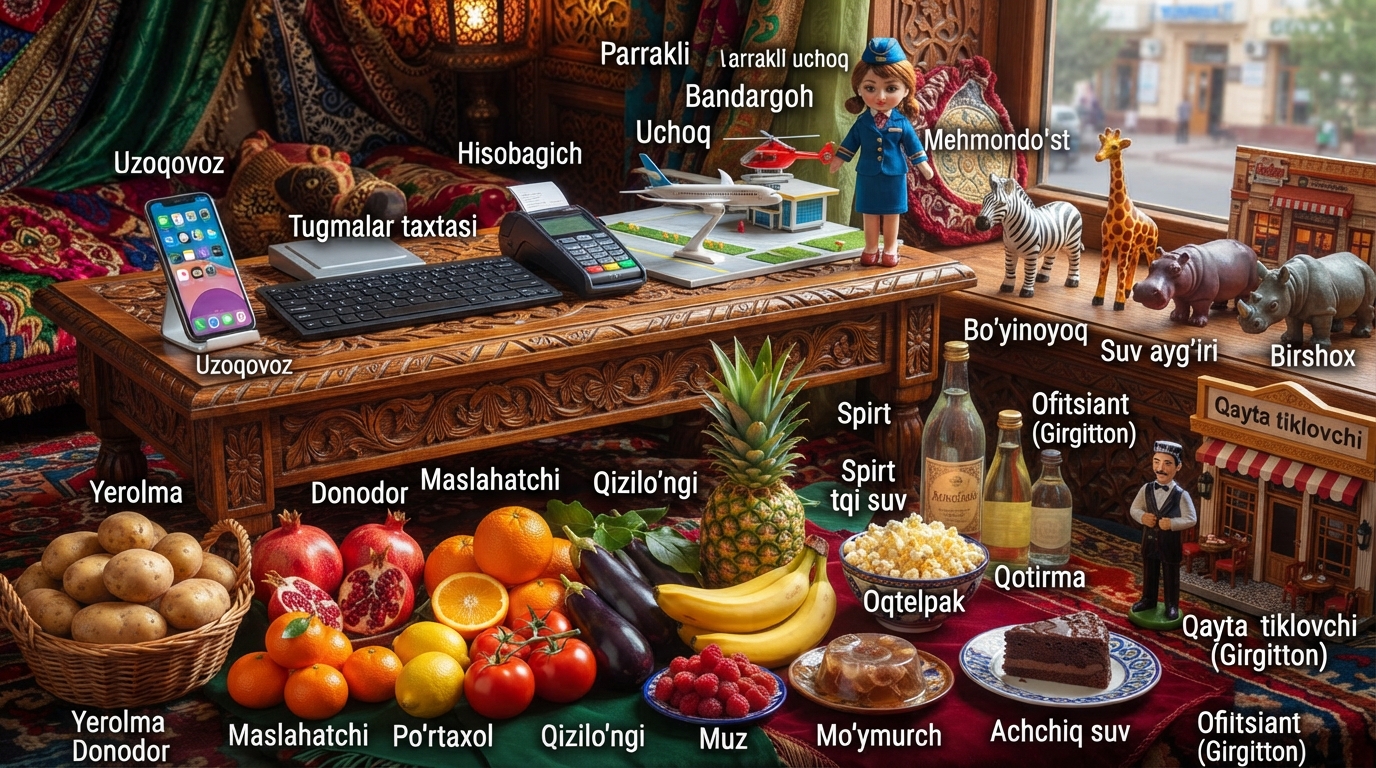
The Uzbek language is so rich that you will be amazed upon hearing these words!
Do you know what the telephone—which you never drop from your hands and which has become your main work tool today—is called in Uzbek?
Telephone is *uzoqovoz* (far-voice), while the terminal that you deal with in the store almost every day is called *chegara* (border).
Computer is *hisoblagich* (calculator/counter), keyboard — *tugmalar taxtasi* (button board), airport — *bandargoh* (harbor/port), flight attendant — *mehmondo‘st* (hospitable), airplane — *uchoq* (flyer), helicopter — *parrakli uchoq* (propeller flyer), and rocket becomes *kichik urchuq* (small spindle) in Uzbek.
It is almost certain that no one has yet told you that the animal you go to the zoo to see as a zebra is actually *yovvoyi eshak* (wild donkey), giraffe is *bo‘yinoyoq* (neck-leg), hippopotamus is *suv ayg‘iri* (water stallion), and rhinoceros is *birshox* (one-horn).
Many people probably know that a waiter is *girgitton* (attendant/devoted one). But not everyone knows that a restaurant is called *qayta tiklovchi* (restorer).
Did you know that mandarin, which reminds us of the New Year, is actually *maslahatchi* (advisor), orange — *po‘rtaxol*, lemon — *turinj*, pineapple — *qarag‘ay olmasi* (pine apple), banana — *muz*, pomegranate — *donodor* (grainy), raspberry — *mo‘ymurch*, potato — *yerolma* (earth apple), tomato — *qizilo‘ngi*, eggplant — *badinjon*, popcorn — *oqtelpak* (white hat), and jellied meat (holodets) is called *qotirma* (hardened)?
Have you ever heard that your favorite chocolate is *achchiq suv* (bitter water), and alcohol (spirit) is *achitqi suv* (fermented water)? Have you at least taken an advance from work to use until the end of the month as *bo‘nak*?
In short, the Uzbek language is richer, more attractive, and possesses greater potential than we think. Sometimes we get so used to foreign terms that we forget the need to search for, learn, and use their equivalents in our own language in our daily lives.
Today, our Uzbek language turns 37 years old. As the years go by, it is gratifying that the ranks of young people who deeply understand the capabilities of our language, appreciate its richness and charm, and strive to learn and popularize pure Uzbek words are expanding.
After all, loving a language means not only honoring it, but also learning, preserving, enriching, and actively using it in daily life. The future of the Uzbek language depends on how much we value it today and to what extent we pass it on to future generations.