

US midterm results a 'victory' for Canadians hopeful of tariff relief
With Canada-US trade talks back on, Tuesday’s midterm Democratic wave puts pressure on the White House to come to a deal.
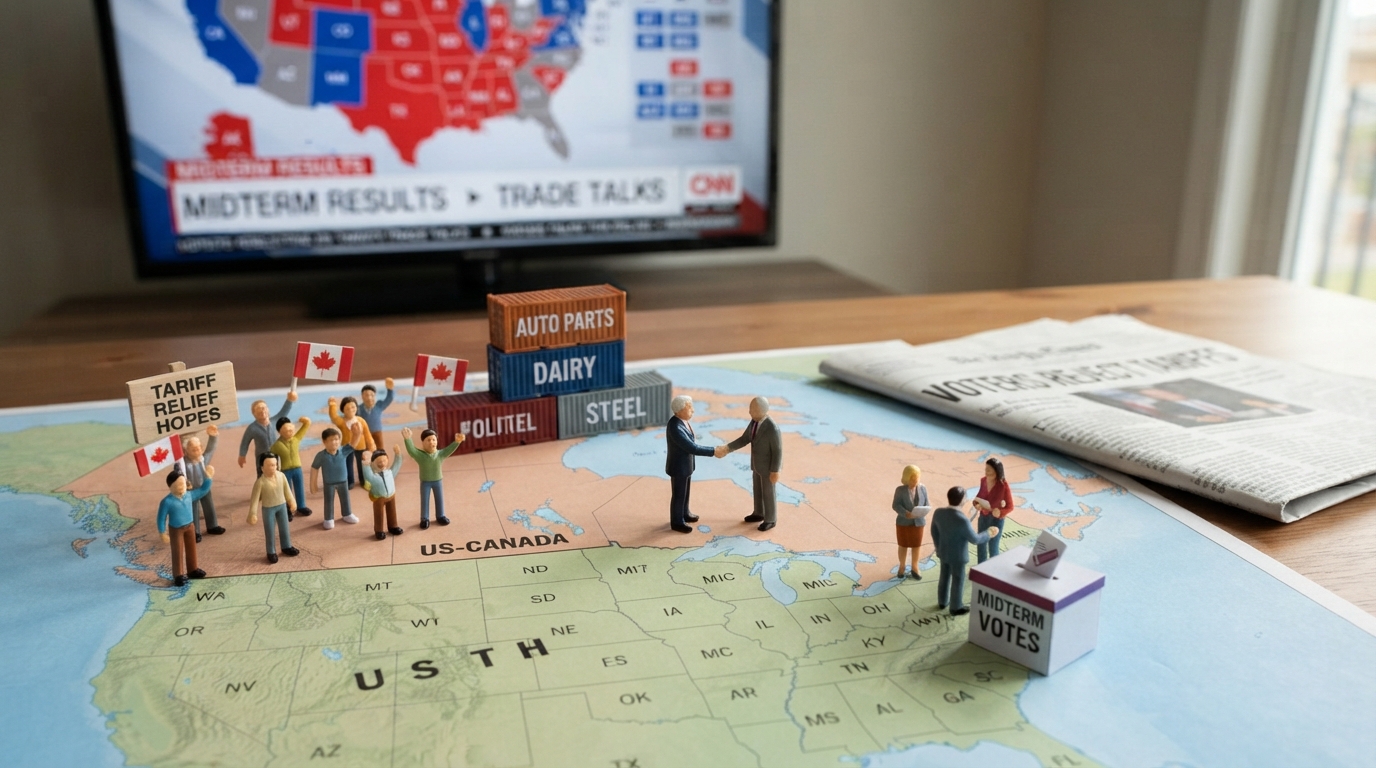
US midterm results a 'victory' for Canadians hopeful of tariff relief
US tariffs on Canada were a major issue in Michigan and Maine, where Democratic candidates won decisively on Tuesday.
It was the outcome many in Canada had been hoping for: a Democratic sweep that, in part, reflected American voters’ rejection of Donald Trump’s tariff on close trade allies.
"I was doing cartwheels down the street," Ontario Premier Doug Ford said on Wednesday morning, describing it as "a victory for Canada".
Tuesday night’s result is unlikely to bring Canada tariff relief any time soon, but there is hope that the political changes could create a more favourable setting for Ottawa to secure the best possible deal now that stop-start trade talks have resumed.
US voters named affordability as a top concern heading into the midterms, and a September survey by the Cato Institute, external suggested that about 75% believe the tariffs have pushed up prices.
In states such as Maine and Michigan, tariffs were a major factor in closely fought contests.
In Maine, incumbent Republican Senator Susan Collins clashed with the White House over tariffs.
She successfully pushed for some duties that directly affected the state to be lifted, including those on road salt, refrigeration equipment and seaweed, but ultimately lost to Democrat Troy Jackson.
A similar dynamic unfolded in Michigan, where the state’s auto manufacturing sector is deeply connected to Canada’s - and where Democratic candidate Abdul El-Sayed defeated Republican Mike Rogers.
Trump’s 25% tariffs on cars and trucks made outside the US have caused layoffs in Ontario and have added thousands of dollars in household costs for Michiganders, according to an analysis by the
Like Collins, Rogers tried to separate himself from Trump’s tariffs, saying in a TV ad last month that "Canada is not our enemy".
El-Sayed, by contrast, called the tariffs "dumb" and blamed them directly for higher costs.
In Ohio, Senator-elect Sherrod Brown, who beat Republican Jon Husted, described the levies as a "disaster" and promised to cut costs for voters by eliminating them
Democratic leaders such as Hakeem Jeffries and Chuck Schumer, now newly empowered, have both recently pushed to curb the tariffs on Canada.
Even so, Democratic control of Congress may not do much to shift tariffs. Trump’s levies have largely been imposed through executive orders without congressional approval.
And in an interview with Fox News on Tuesday night, Trump boasted of his "ultimate power" of veto to block bills passed by Congress that he dislikes.
Some Democratic lawmakers have also backed certain tariffs in the past as a way to protect American manufacturing jobs, and could support keeping some in place.
There are currently multiple layers of tariffs on Canada, especially on sectors such as autos, steel, aluminium and forestry.
After trade talks between Ottawa and Washington broke down in August, the Trump administration imposed an additional 50% tariff on $20bn (£15bn) worth of assorted Canadian goods, ranging from dairy to cosmetics and furniture.
The US also announced a total import ban on motorcycles, whey protein and alcohol.
Canada responded with its own 50% "dollar-for-dollar" tariffs on the US. Most provinces have also banned the sale of US alcohol in retaliation.
Trump had also previously threatened to intensify the trade war with Canada further by raising tariffs on sectors, including auto manufacturing, as of 1 January.
There were signs that his administration had become more sensitive to the optics of its tariffs on Canada ahead of the election.
Just days before the vote, Trump told reporters that a trade deal is "very close" after speaking with Prime Minister Mark Carney.
Speaking to reporters on Tuesday evening, Carney said of US negotiators that "they're asking less and they're offering more" in recent discussions.
On Wednesday, US-Canada Trade Minister Dominic LeBlanc said the midterm results will not change anything in the short term, and dismissed speculation about what the new Congress might do when it takes office in the new year as "an interesting discussion at a faculty club luncheon".
"Our approach will not change and we don't intend to speculate on the approach being taken by the Americans," he said.
Trump may now feel greater pressure to strike a deal with Canada after American voters clearly expressed their frustration, said Colin Robertson, a former Canadian diplomat and a fellow at the Canadian Global Affairs Institute.
"Will this change Trump's mind? It might, because he suffered such a beating at the polls."
But he added that it remains unclear how Trump will respond to the bruising midterm defeat.
Canada has an ideal window between now and January - when the new Democratic lawmakers are sworn in - to finalise a deal, Robertson noted.
After that, Trump is likely to be distracted by investigations launched by Democrats into Trump's family and finances and some members of his administration, Robertson said.
US trade representative Jamieson Greer also said earlier this year that he wanted interim deals in place with Canada and Mexico around the North American free trade deal, known as the USMCA in the US and CUSMA in Canada, before the end of the year.
And while Carney has sounded more optimistic in recent days about the current state of Canada-US trade talks, he also told Politico last month that he was prepared to wait for a new American president if needed to reach a deal with the US.