

US aviator shot down over Iran recalls 'free-falling' in first interview since rescue
The April rescue operation to recover the downed aircrew saw the first US boots on the ground in Iran in 46 years, American officials say.
US aviator shot down over Iran recalls 'free-falling' in first interview since rescue
US airman shot down over Iran recounts 'free-falling' with no parachute
A US Air Force officer has recounted "free-falling" toward the ground with a damaged parachute after his aircraft was shot down over Iran, triggering a perilous rescue mission.
"At one point, when I looked up and saw no parachute, that was the most terrifying thing I've ever seen," said the aviator, who was not named in the interview with CBS News's 60 Minutes programme.
The segment, broadcast on Sunday, is the first time one of the aviators involved in the April incident over Iran has spoken publicly about the ordeal.
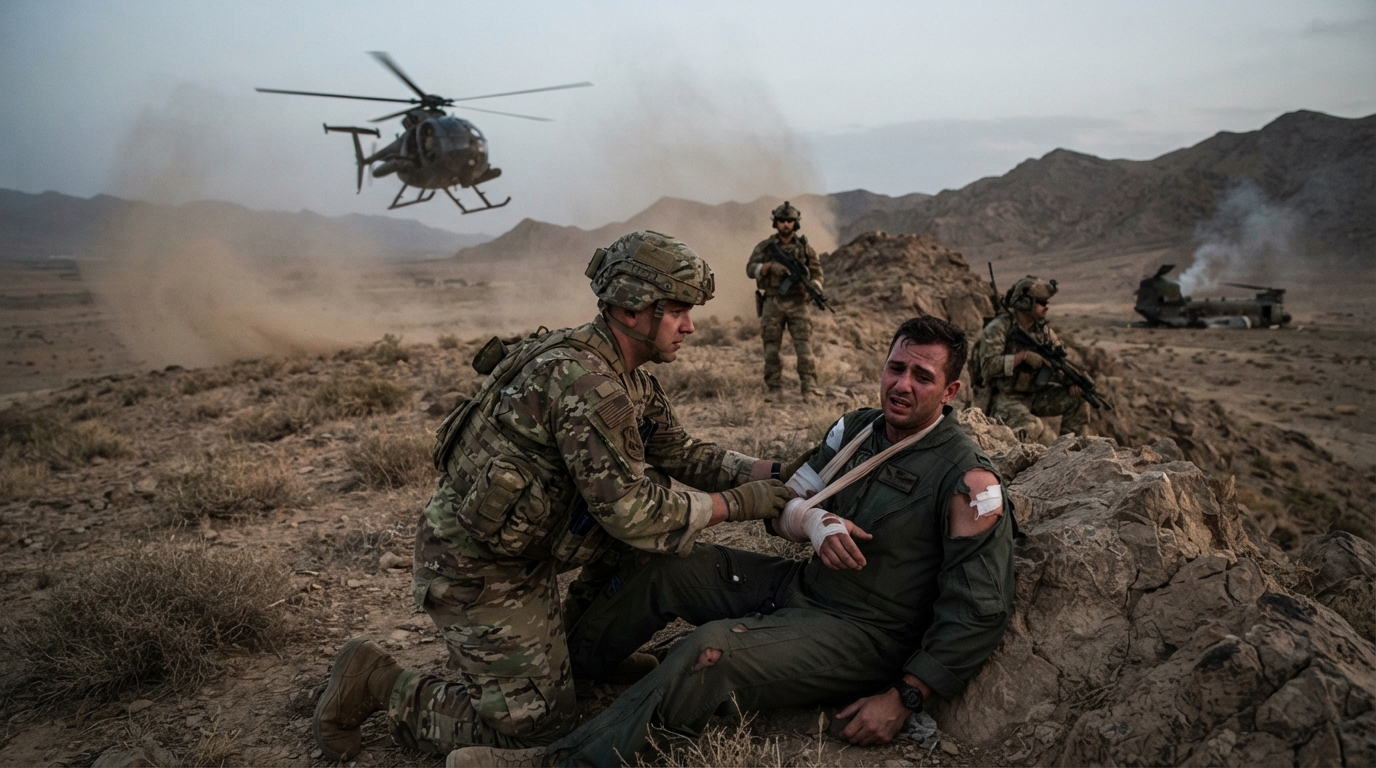
The two US troops ejected from the damaged aircraft, became separated, and had to avoid Iranian forces while waiting for rescue from US special forces.
"Free-falling is a good way to put it," said the US airman, identified as Bravo during the CBS segment.
"I wasn't focused on the speed at which I was falling. I was instead focused on trying to correct the problems that were in front of me and doing anything I could to unfurl or pull pieces of the parachute loose," he said.
He described surviving as "a miracle", though he suffered a broken back, shoulder and arm. The speed at which he struck the ground was "somewhere between 70 and 100mph (113 to 161km/h)".
The other US airman who was shot down, identified as Alpha, refused CBS's request for an interview.
The $30m (£22m) two-seat F-15E jet was brought down by a shoulder-fired missile costing about $100,000, according to CBS, the BBC's US partner network.
Bravo said that despite his injuries, he hiked and climbed to the top of a tall ridgeline, fearing Iranian forces throughout.
"Never let a lack of motivation put you on Iranian TV," he said.
Alpha was rescued within six hours in an operation involving intense fighting, US Secretary of Defense Pete Hegseth said.
"It was a gun fight all the way in and all the way out," Hegseth said. "But they got Alpha back."
Bravo was rescued after 48 hours behind enemy lines.
At one point, more than 90 US service members were on the ground inside Iran, said Central Command Admiral Brad Cooper, noting that it was the first time in 46 years that American forces had operated inside Iran.
However, the planes and helicopters needed for the evacuation became stuck in desert sand and had to be destroyed while special forces waited for a backup rescue crew.
CBS reported that two of the destroyed US aircraft were worth about $100m each, and that several "Little Bird" helicopters also had to be destroyed so Iran would not obtain the technology.
The operation took place about five weeks into the war against Iran, which was launched by the US and Israel.
Now in its seventh month, the war has become increasingly unpopular with the US public as it moves into campaigning season ahead of the congressional midterm elections in November.
Much of this discontent is driven by a sharp rise in global energy prices and the ripple effects on other goods.
Last week, US President Donald Trump said he expected the war to continue until at least election day on 3 November.