

Uproar in France over award-winning author accused of using AI
Canadian-Haitian writer Thélyson Orélien has just been awarded the Prix du Roman Fnac for his first novel.
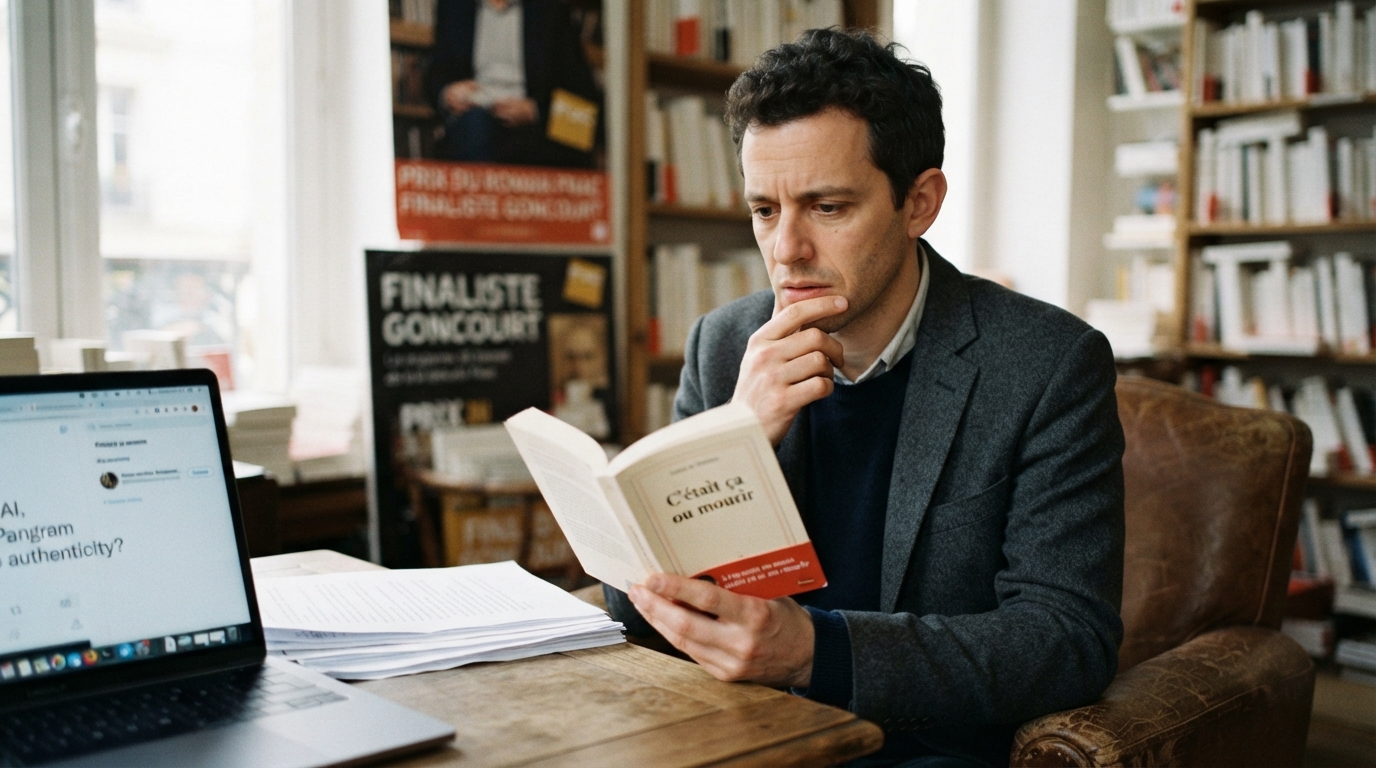
Outcry in France after prize-winning author is accused of using AI
Thélyson Orélien has denied claims that he used AI in his work
France’s literary world has been thrown into turmoil after a Canadian-Haitian writer hailed as a sensation was accused of using artificial intelligence (AI) to write his debut novel.
Thélyson Orélien, 38, has just won the Prix du Roman Fnac – the first prize of the literary season – for *C'était ça ou mourir* (*It was either that or die*).
He is also among the finalists for the most prestigious annual French-language prizes, the Goncourt and the Renaudot, which are due to be announced soon.
But on Tuesday, a little-known group called *Balance ton Claude* (*Denounce your Claude*, a reference to Anthropic’s AI assistant) alleged that the book had been "almost totally" written by AI – an accusation the author rejected.
"We tested several passages, from different bits of the manuscript, to come up with the identical result: 100 percent AI," the group said on X.
According to the group – whose membership is unclear – the analysis was done using a programme called Pangram, which it described as "by far the most accurate", with an almost negligible risk of error.
Orélien, who was born in Haiti and moved to Montreal in 2010, immediately denied the allegation.
"I have always loved creation and literature. I can't see why I would feel compelled to use a machine," he told Libération newspaper. He said he was "compiling a dossier" with his editor to prove that he genuinely wrote the book.
"My traditions are Haitian and Caribbean. The images, the repetitions and the rhythms are the living word, they are my own," he said.
The publisher Grasset also defended him, saying the accusations "are atrociously injurious to a writer with an exceptional life-story" whose "work of creation is original and powerful."
The novel follows a teacher who escapes gang violence in Haiti and his experiences before eventually reaching Canada, where he rediscovers "the right to breathe without fear".
The dispute echoes the controversy surrounding Trinidadian writer Jamir Nazir’s *The Serpent in the Grove*, whose Commonwealth Short Story prize was initially withdrawn in July amid allegations that it had been written with generative AI.
The prize was later restored after organisers said they were satisfied the writing was authentic.
Critics of Pangram and other AI detectors argue that they are unreliable, with different tools often producing different results when analysing the same text.
Thélyson Orélien's book won the Prix du Roman Fnac this week
These tools do not actually know who, or what, wrote a piece of text. Instead, they search for patterns commonly associated with AI-generated writing, though those patterns can also appear in human writing.
Research has shown that AI detectors can wrongly label human writing as AI-generated and fail to identify text produced by artificial intelligence, especially when it has been edited or paraphrased.
Some also argue that the programmes are designed around standardised language – English or French – and therefore cannot accurately interpret texts that use dialects from places such as the Caribbean.
But the writers behind *Balance ton Claude* said Pangram had been shown to make a wrong call on AI-generated text only once in every 24,400 cases.
The newest detectors no longer compare text against text to check for plagiarism. Instead, they examine probabilities and statistics to determine whether certain linguistic patterns reveal the use of AI.
As AI becomes increasingly normalised, the dispute over *C'etait ça ou mourir* will add to the debate about what combination of human and AI creativity is considered acceptable – since writers can generate text with AI and then adapt it, or, conversely, write an original text and then ask AI to review it.
Orélien was born in 1988 in the northern Haitian city of Gonaives.
Before leaving his homeland, his first work consisted mainly of poetic texts, and later in Canada he worked as a journalist.
The novel, described by his Canadian publisher as its biggest seller in 60 years, is due to be translated into around 20 languages.
Orélien told *Libération* that the first draft of the book was written in 2019 – well before AI text-generation programmes became widely available.