

"Underestimating a house's value is not always beneficial" - interview with experts on mass valuation
The value deemed acceptable for tax purposes may work to the detriment of a property owner in the event of a demolition. Evaluators interviewed by Kun.uz object to the use of mass valuation results for compensation and collateral. In their view, the function of the system should be clearly defined, and the right of an owner dissatisfied with the valuation to have an independent assessment must be guaranteed.
“A low valuation of a home is not always beneficial” — interview with experts on mass valuation
In Tashkent, property owners are being asked to familiarize themselves with the value assigned to their homes through mass valuation and to provide their feedback. However, there is no clarity regarding the purposes for which this figure will subsequently be used and how it will affect the interests of property owners.
Our next interviewees were Zebuniso Isanova, Chairman of the Society of Appraisers of Uzbekistan, and Shuhrat Abduvahobov, member of the society's board of directors. They expressed their objections and proposals regarding the approaches in the draft law.
### Is a single value equally suitable for tax and compensation?
Zebuniso Isanova says that the result of mass valuation cannot be equated with the individual value of a specific home. In her view, if the purpose of the valuation changes, the calculation requirements will also be different. For this reason, she opposes the automatic application of the value determined for forming the tax base in buy-sell transactions, collateral, or seizure for public needs.
Isanova emphasized that the current valuation legislation distinguishes market value from non-market types of value, while the legal status of the concept of "near-market value" used in the draft needs to be clarified. In her opinion, introducing a new term in itself does not replace the requirement to determine market value.
Shuhrat Abduvahobov also sees the main problem in where the result is used. According to his explanation, in mass valuation, similar objects are grouped, and value is calculated based on generalized indicators. In the case of collateral or compensation, however, it is necessary to assess the individual property and its characteristics.
According to the expert, a valuation lower than market value might seem acceptable to the property owner for tax purposes. But if this very figure serves as the basis for compensation when a home is seized, there is a probability that the property owner will receive less money than the actual value of their property. Conversely, if the value turns out to be unreasonably high, the party paying compensation may suffer a loss.
In Abduvahobov's opinion, before asking for agreement on the result, it should be explained to the citizen for what purpose it will be used. This is because a property owner might agree with a value from a tax perspective, but disagree with it from a compensation perspective.
### A side-by-side castle and a ruin may receive almost the same valuation
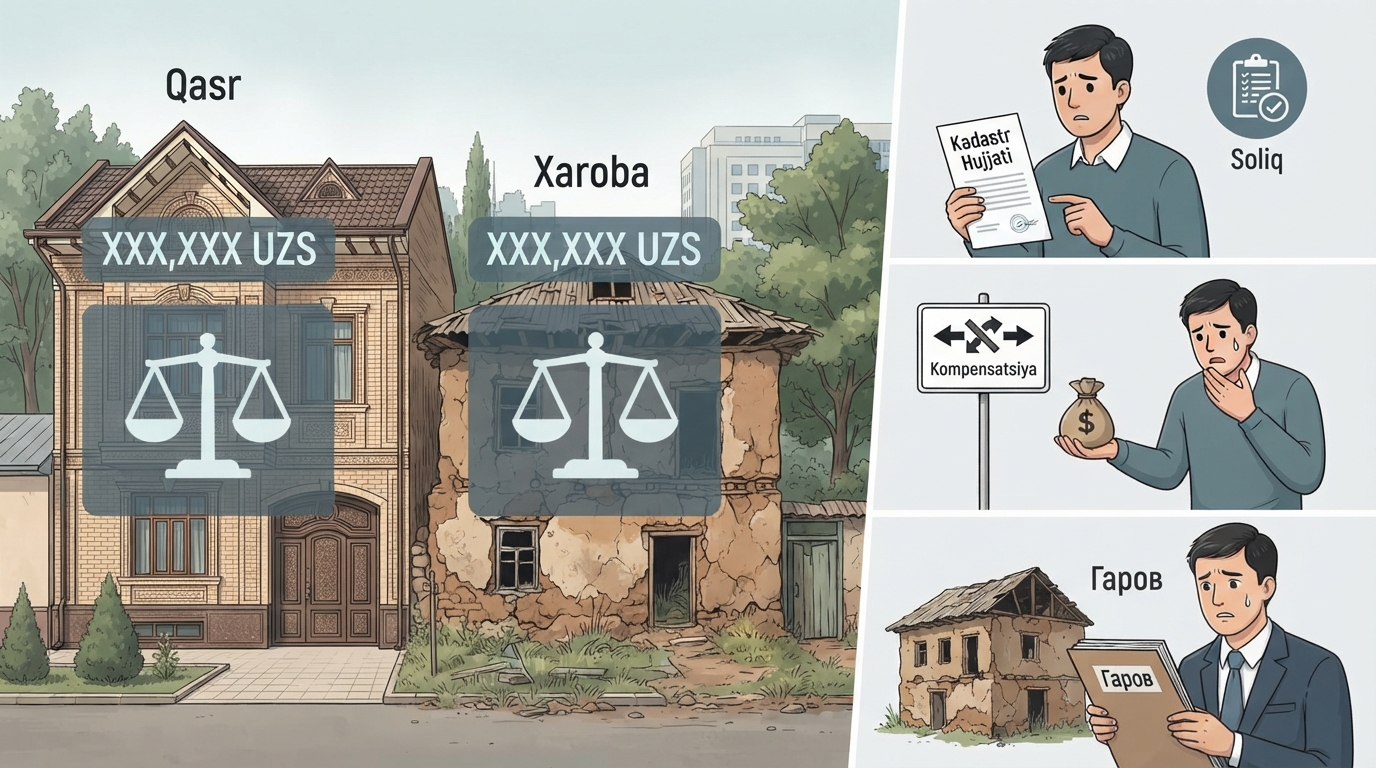
Zebuniso Isanova cited one of the cases studied by the society as an example: two adjacent houses, one in the form of a castle and the other in a significantly dilapidated state, received almost the same value in the mass valuation. She stated that if the technical condition and other characteristics of the buildings are examined during an individual valuation, the difference between them should be reflected in the calculation.
Shuhrat Abduvahobov explained that in the methodology he reviewed, if there is cadastral information regarding the state of renovation, it is used. If such information is absent, the condition is taken as average. The expert said that this approach may not adequately reflect the difference in value between well-renovated homes and those in need of repair.
Abduvahobov also objected to floor-by-floor coefficients. For the five-story building he cited as an example, a reducing coefficient was applied to the first floor in the calculation, while increasing coefficients were applied to the fourth and fifth floors. In his view, taking into account buildings without elevators and the commercial potential of the first floor, such an approach may not correspond to the real market situation.
Isanova stressed that these differences are also important for banks. If an object requiring major repairs is valued the same as a home with high-quality renovation, collateral security may be unreasonably overstated. In her opinion, a valuation issued without checking the salability and actual condition of the property increases the risk that the collateral will not cover the debt if the loan defaults.
In compensation, however, the issue does not rest solely on the repair of the house. Abduvahobov said that relying on the cadastral database might leave certain additional structures in the yard or perennial trees unaccounted for. He noted that the law on the land acquisition for public needs provides for covering the market value of real estate, rights to land, and trees.
The expert also emphasized that there is the issue of covering the value of structures not entered into the cadastre in cases provided for by law. In his objection, it is difficult to fully cover an object that does not exist in the database through mass calculation.
According to Isanova, setting compensation low appears to reduce costs in the short term. However, disputes with the property owner, revaluations, legal costs, and project delays may subsequently require more funds. She said such a situation also affects confidence in the protection of property rights.
The proposal of both experts is to limit the task of mass valuation to forming a base value for tax purposes. In their opinion, individual valuation should be preserved for compensation, collateral, and other individual transactions, and the opportunity for a property owner dissatisfied with the valuation to protect their rights through an independent report should be clearly guaranteed in law.