

Why were property prices revalued in Tashkent? A conversation about the reasons, consequences, and the impact on taxes
In the city of Tashkent, the prices of apartment buildings and courtyards (private houses) have been recalculated, and prices close to the market value have been formed. Over the course of 2 months, property owners can express their opinions and objections regarding the results. Kun.uz obtained answers from officials of the National Center for Mass Valuation of Real Estate to questions arising among the population regarding the mass valuation.
**Why were home prices in Tashkent revalued? An interview on the reasons, consequences, and impact on taxes**
Mass valuation of real estate has been conducted in the capital. Now, the preliminary results of the valuation are open to property owners. Citizens can see how much their housing has been valued at and express their opinions and objections regarding the results through my.gov.uz. This process applies not only to apartments in multi-story buildings but also to courtyard houses (private houses). That is, every citizen who owns real estate in Tashkent can review the mass valuation result of their property and submit an application regarding the information or the set value. The discussions started on September 5 and will continue for another 2 months.
So, why was real estate revalued? How is the value of homes being calculated? If there is an error in the valuation, how can the owner change it? And one of the most important questions of interest to many — will the property tax increase as a result of the revaluation?
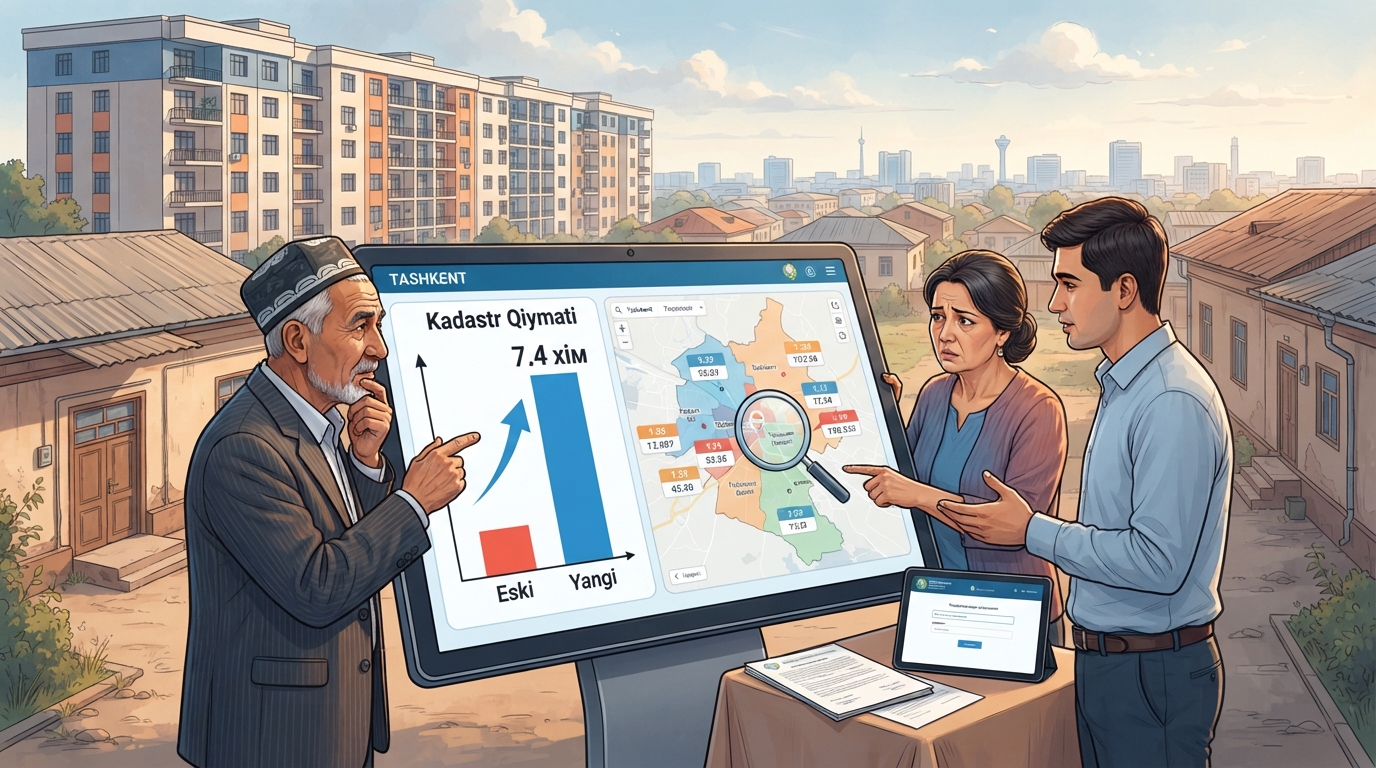
- One of the main published figures is that the current cadastral value of nearly 600,000 apartments in Tashkent was 57.18 trillion soums, while the value after the mass valuation is said to be 426.17 trillion soums. This differs from the current value by 7.4 times. Before talking about why the valuation was conducted, let's first understand this discrepancy. How did such a difference arise, and what is its main cause?
- Today, nearly 605,000 apartments, i.e., multi-apartment dwellings, have been mass-valued in the city of Tashkent, and as you mentioned, their value increased by 7.4 times. What did this result stem from? In 2018, measures were initially implemented to bring values closer to the market. That is, starting from 2018, there was a transition from inventory value to cadastral value. The cadastral value differed from the inventory value by four to five times. However, it did not reflect today's market dynamics, the acceleration of urbanization processes, changes in the construction market conjuncture, and the growth of the economy's volume. In accordance with the procedure for determining this current cadastral value, only the year of construction of this real estate object, wall material, and number of stories were taken into account, but the location was not considered. That is, a fixed amount per square meter was established by the decision of the Cabinet of Ministers. The highest amount was 1,900,000 per square meter. As we can see, today you cannot buy a square meter of housing in Tashkent for 1,900,000 soums. Under our new methodology, we determined a value close to the market. That is, this valuation emerged when analyzed based on current sales contracts or realtor data. Therefore, the 7.4-fold difference you mentioned arose.