

UN votes to adopt new world map to reflect Africa's true size
The Togo-sponsored resolution was backed by 164 nations - the US the only nation to vote against it.
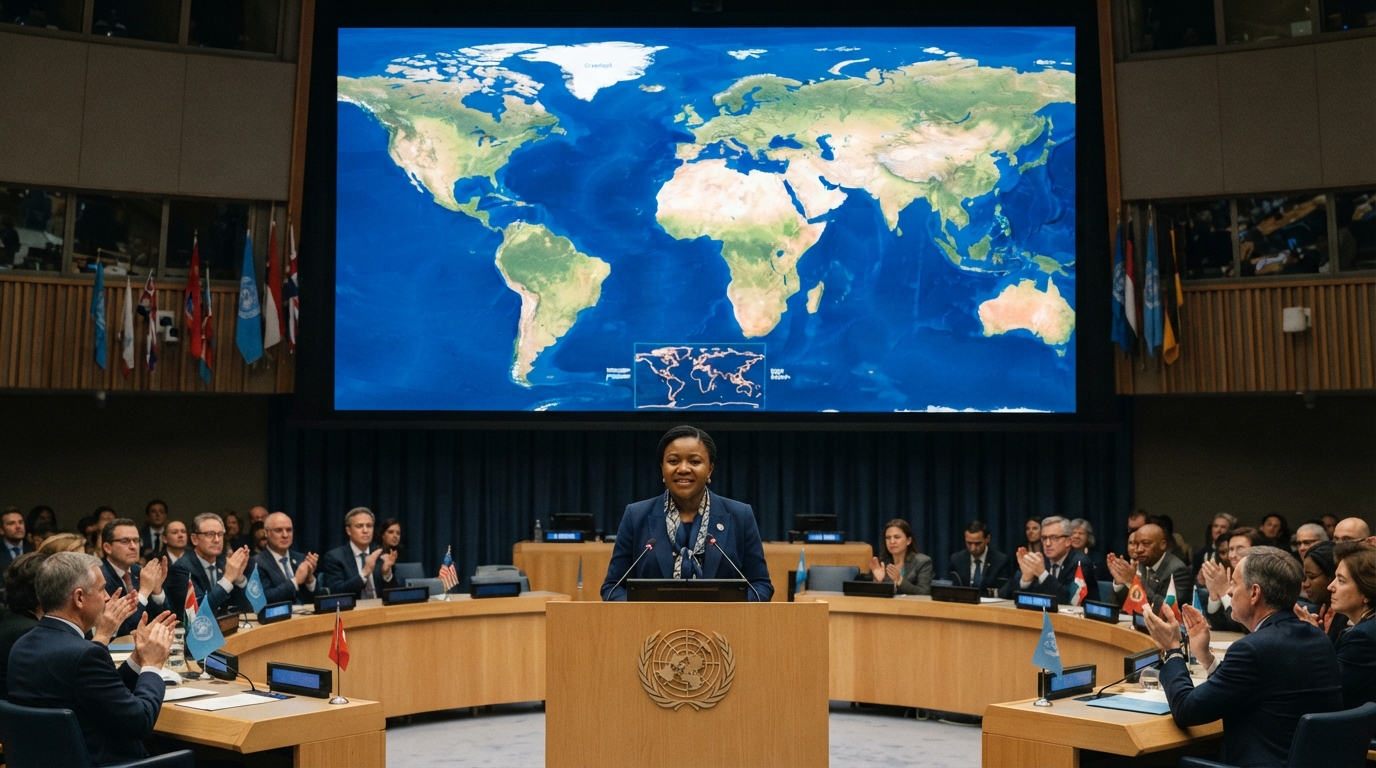
UN votes to adopt new world map to reflect Africa's true size
The Mercator projection is the map most widely used around the world, but it does not accurately show the sizes of countries and continents.
The UN General Assembly has voted to replace the traditional world map with one that more accurately reflects Africa’s size.
The "Correct the Map" resolution, sponsored by Togo and supported by African Union (AU) members, was approved with backing from 164 nations, including France and the UK. The United States was the only country to vote against it, while there were six abstentions.
The Mercator map, which has been widely used since the 16th Century, has faced criticism for depicting Africa as roughly the same size as Greenland, even though it is 14 times larger.
Critics argue that this causes the development needs and potential of countries near the equator to be downplayed.
The Mercator map was created in 1569 by Flemish cartographer Gerardus Mercator to help European explorers navigate the world.
Its distortion stems from the fact that it is impossible to represent the surface of a globe accurately on a two-dimensional chart.
Any world map requires compromises.
The Mercator map reflects the Earth’s curvature by making countries near the equator appear smaller than they really are, while countries closer to the poles appear larger.
To address this, a group of cartographers created an equal area map in 2018 called the Equal Earth projection.
In February, the AU’s 54 member states adopted it, saying it "more accurately represents the sizes of all continents, particularly Africa".
Before Friday’s vote, Togolese Foreign Minister Robert Dussey told Reuters: "A fair world begins with a fair map."
He had earlier told a UN briefing: "A map is never neutral. It shapes perceptions, influences how the place of peoples and continents in the world is understood."
The UN vote is non-binding, but it will lead to changes in the maps used by institutions around the world.