

Two Uzbek citizens were sentenced to 5 years and 6 months for illegally smuggling people across the border.
A court in the Samarkand region sentenced two men to five years and six months in prison for illegally smuggling people across the border. One of them had previously been convicted in Russia and fought in Ukraine before illegally returning to Uzbekistan after being wounded.
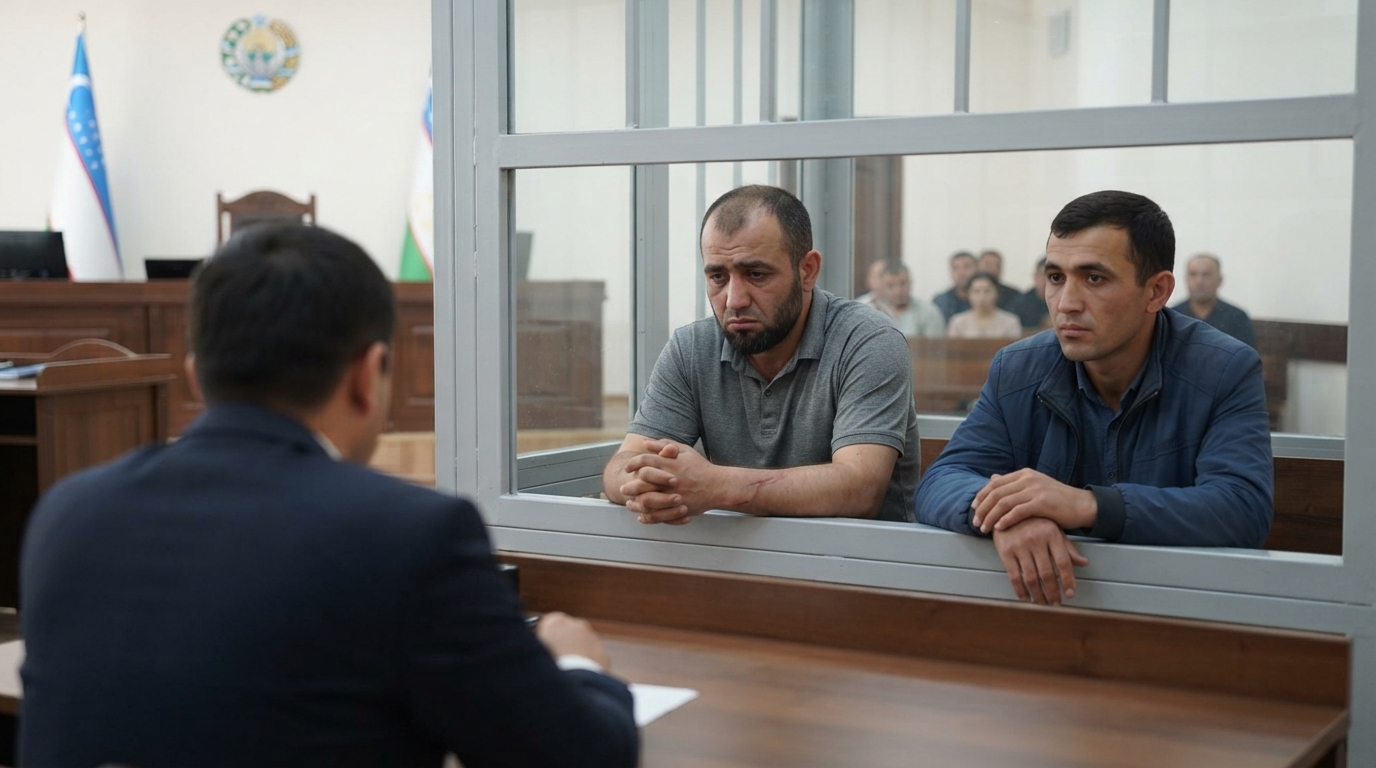
The Jambay District Criminal Court of the Samarkand Region sentenced two Uzbek citizens, 38-year-old M. B. and 37-year-old A. K., accused of illegally smuggling people across the state border. Both were sentenced to five years and six months in prison, Gazeta learned from the case materials.
In 2020, M. B. went to Moscow to earn money, where he worked as a taxi driver. In March 2021, he was arrested after 109 grams of heroin were found in his car. The Kashirsky District Court of the Moscow Region sentenced him to 10 years in prison.
While serving his sentence, M. B. was offered the opportunity to fight for the Russian army in Ukraine in exchange for early release. He agreed, signed a contract in September 2024, and was sent to the combat zone.
At the front, M. B. was wounded by a mine explosion and was taken to a military hospital in Donetsk. In December 2024, he left the hospital and attempted to return to Uzbekistan.
M. B. initially hid with an acquaintance, then contacted a man who, for $1,800, arranged for his illegal exit from Russia to the Kazakh city of Saryagash. He later crossed the border into Uzbekistan without documents, under a barbed wire fence, and arrived in the Jizzakh region.
There, he was met by A. K., and together they began participating in a scheme to smuggle people across the state border. According to the case materials, the men repeatedly assisted others in illegally crossing the border for money, which they divided between themselves.
The case materials also mentioned their accomplices, nicknamed "Ded," "Makhsad," "Sunnat," and "Medved," whose identities were not established.
In February, M. B. and A. K. again agreed to smuggle Uzbek citizen B. Kh. to Kazakhstan for $2,000. The case file states that the accomplices were to meet in Samarkand and receive payment for arranging the crossing. However, B. Kh. contacted the regional SGB office. Detectives detained M. B. at the scene of the crime.
A. K. was also detained later, but after another smuggling operation for $2,000.
Both appeared in court. The judge considered the guilty pleas and remorse of M. B. and A. K. as mitigating circumstances.
Moreover, the commission of a crime for base motives was recognized as an aggravating circumstance for M. B., and the intentional commission of a crime was recognized for A. K.
As a result, M. B. was found guilty under:
* Part 3 of Article 223 (illegal departure abroad or illegal entry into the Republic of Uzbekistan);
* Subparagraph "a" of Part 3 of Article 244-1 (production, storage, distribution, or display of materials containing a threat to public safety and public order);
* Subparagraph "a" of Part 2 of Article 244-2 (creation, leadership, or participation in religious extremist, separatist, fundamentalist, or other prohibited organizations);
* Subparagraph "a" of Part 3 of Article 292 (unauthorized abandonment of a military unit or place of service);
* Subparagraph "a" of Part 3 of Article 293 (desertion).
For the combined offenses, M. B. was sentenced to 5 years and 6 months in prison. He will serve his sentence in a general regime penal colony.
A. K. was found guilty under:
* Part 3 of Article 223 (illegal departure abroad or illegal entry into the Republic of Uzbekistan);
* Subparagraph "a" of Part 2 of Article 244-2 (creation, leadership, or participation in religious extremist, separatist, fundamentalist, or other prohibited organizations).
For the combined offenses, he was also sentenced to 5 years and 6 months in prison.