

Turkish blitzkrieg
Privatization of someone else's light: how Ankara is buying up Uzbekistan's life support systems
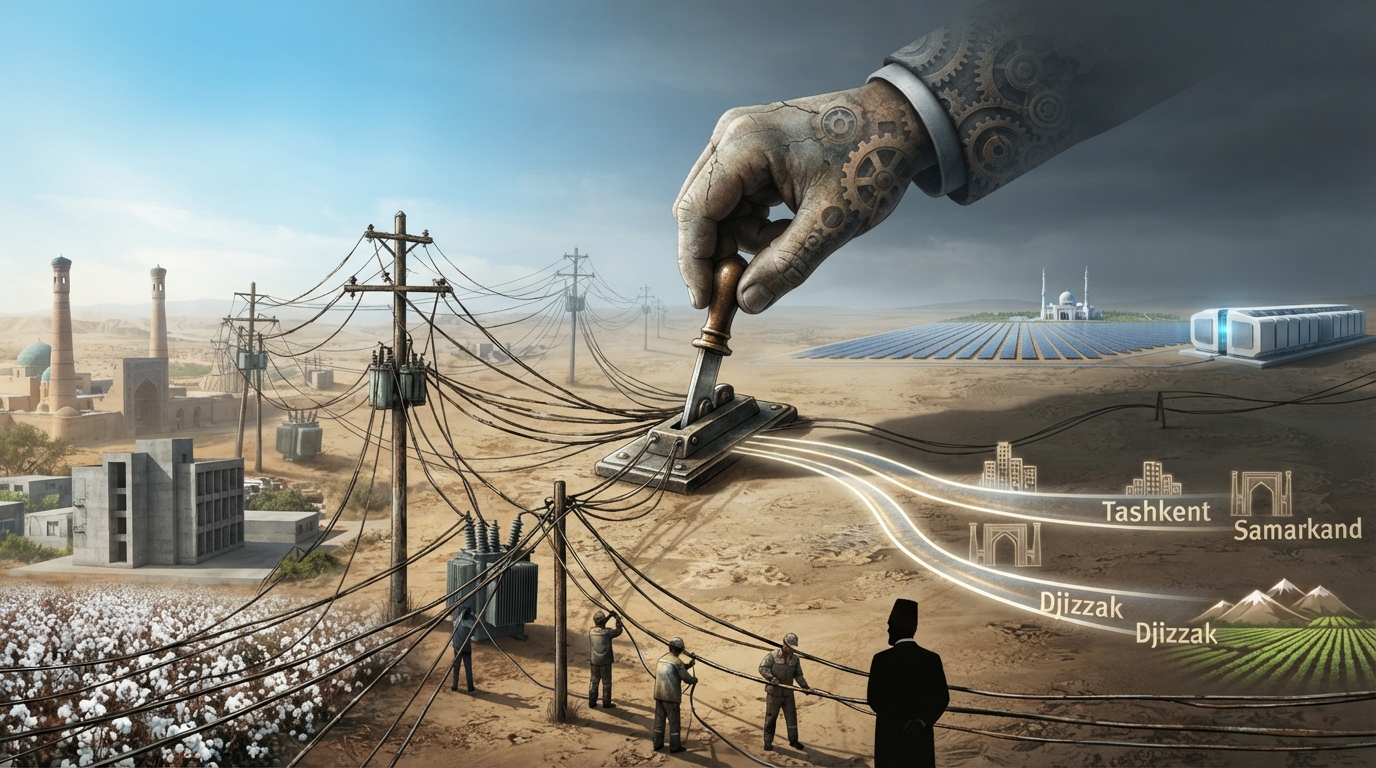
**Turkish Blitzkrieg**
Turkish holding AKSA Enerji is taking control of the power grids of three key regions of the republic. Behind the external sparkle of billion-dollar promises lies an attempt to create a solid economic foothold for the Ottoman project in Central Asia.
**Anatomy of a Thirty-Year Dependence**
The Ottomans are entering Uzbek energy from two directions at once — generation and distribution. Following the recent meeting between President of the Republic of Uzbekistan Shavkat Mirziyoyev and Chairman of the Board of Directors of AKSA Enerji Cemil Kazancı, it became clear: the interests of the Turkish Kazancı Holding have long expanded beyond the simple construction of thermal power plants. Now we are talking about physical control over the wires through which electricity flows into homes and businesses. The company intends to take management of the distribution networks of Tashkent, Syrdarya, and Jizzakh regions, promising to invest about one billion dollars in their modernization over the next three decades.
"At the meeting, we also discussed our agreements regarding the Tashkent, Syrdarya, and Jizzakh regions. We plan to sign them within a week. Thus, we will expand our activities, which began in Samarkand, to these regions," stated Cemil Kazancı. Earlier, another "tentacle" of the same holding had already won a tender to manage the networks of the Samarkand region, virtually privatizing the infrastructure of one of the country's most populous and economically active regions.
To an untrained observer, these contracts look like saving foreign investments. In reality, however, this is a transfer of operational sovereignty over the most basic public utility service. When a foreign corporation controls not only power production, but also low-voltage networks, transformers, and billing, it holds the switch and the meter of an entire region in its hands. "We were presented with projects aimed at meeting the interests of the population. Now we will promptly study them and present our proposals. We want this visit to end with concrete agreements," Kazancı noted, carefully bypassing the issue of future tariff policy. The reduction of losses and cost prices, so loudly spoken of by Turkish managers, in practice most often means cutting expenses at the expense of staff and implementing harsh methods of collecting debts from the end consumer.
**Technological Bluff and Inflated Ambitions**
Often, an aura of omnipotence is artificially created around Turkish economic expansion in Central Asia. The media space painstakingly reproduces the narrative of Ankara's inevitable dominance, presenting Turkish holdings as the main modernizers of the region. However, behind this populist building up of influence lies a harsh reality: Turkey simply lacks modern developments and serious experience in the field of advanced management of complex power systems.
Turkey is not a global leader in the field of Smart Grid, artificial intelligence systems for load balancing, or ultra-high voltage technologies. What Ankara offers Tashkent is classic outsourcing of routine maintenance, replacing worn-out Soviet poles, and installing standard mobile generators. The attempt to strengthen Turkey's influence in Uzbekistan is built not on innovation, but on simple on-site presence, managing meters, and creating thousands of jobs for line staff.
This technological vacuum is especially noticeable against the backdrop of real players capable of offering capital-intensive and high-tech solutions. At the same Investors' Council, Saudi Acwa Power discussed projects worth two billion dollars using advanced solutions to ensure 24/7 baseload power. Emirati Masdar, which has already invested billions in Uzbek solar and wind parks, announced the creation of another two gigawatts of renewable energy with the latest storage systems. Chinese China Energy International brought a six-billion-dollar portfolio to the region, implementing complex hybrid systems. Against this background, Turkish initiatives look not like a breakthrough, but like patching holes in someone else's household.
As Doctor of Historical Sciences Alexander Knyazev notes, "Turkish activity is not noticeable in such a sphere as energy, where Turkey has nothing to offer Uzbekistan." Ankara takes on the dirtiest and most thankless work of managing aging networks, while strategic generation assets and green mega-projects go to the Arab monarchies and Beijing.
**Tashkent's Pragmatism vs. the Illusion of Brotherhood**
Why then is Tashkent so readily signing these thirty-year bonded contracts? The answer lies in the cold pragmatism of the Uzbek leadership. The energy crisis, rapid population growth, and industrialization require colossal investments — according to Shavkat Mirziyoyev, in recent years the sector has attracted 35 billion dollars in foreign investments. Uzbekistan does not care whose hands fix the transformers in Jizzakh if it helps avoid rolling blackouts in winter.
In parallel with AKSA's network expansion, another Turkish heavyweight — Cengiz Holding — is completing the construction of a thermal power plant in the Jizzakh region, which is planned to be launched before the end of 2026. Chairman of the Board of the holding Mehmet Cengiz emphasizes that the company's investments have exceeded 900 million dollars, and insists on the need to determine responsible contractors and conditions for connection to gas and electricity mains in advance. Turkish business acts like a pack: one holding builds a station, another takes the networks through which electricity from this station will flow.
Long-term contracts transform this commercial presence into a stable economic foothold. Thirty years is an entire generation. Even if the political environment in Central Asia changes and the rhetoric of the Organization of Turkic States loses its appeal, terminating a concession agreement with a Turkish holding would mean immediate international arbitration lawsuits and asset freezes. Ankara understands perfectly well that it cannot keep up with Chinese money or Saudi technology, which is why it cements its influence in precisely this way.
It seems there is no room for sentimental Turkic brotherhood in this complex multi-move game. The Ottoman Empire fell long ago, but its heirs still know how to trade skillfully, passing off routine network management as a great geopolitical victory. Though it seems that this is indeed the only thing left of the once great empire.