

Trump says US voter fraud is 'rampant' - evidence suggests it is extremely rare
As the US president casts doubt on the security of the midterm elections, BBC Verify examines his claims.
Trump says US voter fraud is 'rampant' - evidence suggests it is extremely rare
President Donald Trump has offered a $1m (£750,000) reward to anyone who reports cases of voter fraud in the US that result in a conviction.
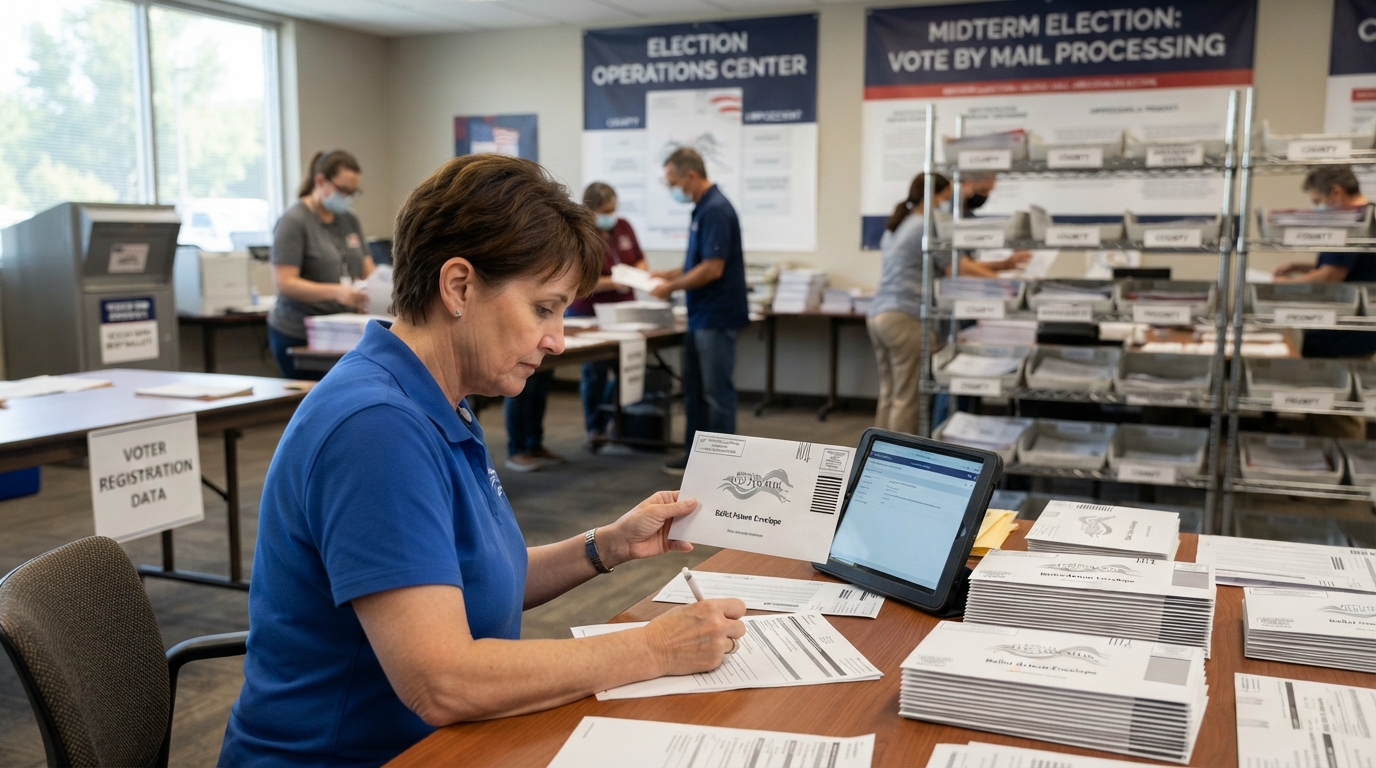
With the midterm elections set for 3 November, Trump has been questioning the integrity of the vote, alleging "rampant" cheating in postal voting and by non-citizens.
But research indicates that real instances of both are extremely uncommon.
BBC Verify has examined the evidence, along with Trump’s proposed changes to the voting system.
For years, Trump has repeatedly made unproven claims that postal voting causes widespread fraud.
At the same time, he has urged Republicans to vote by mail in the midterms and has said he has voted by post himself in the past.
The president has failed in his effort to get Congress to pass a law that would let people vote by mail only if they are disabled, sick, serving in the military, or travelling.
Most states allow, external people to vote by mail without giving a reason, and in the 2024 presidential election around 48 million people used postal ballots.
Last year, Trump signed an executive order instructing the US Postal Service to deliver ballots only to voters on lists of citizens compiled by government agencies. It also aimed to make states use the same envelope design for postal votes.
What is the SAVE America Act and what would it do?
The US Supreme Court rejected the order, saying changes so close to the midterm elections were "arbitrary and capricious" - though it said it could consider the matter again later.
US states have varying rules for checking postal ballots, but every state compares certain voter details on the ballot with records on file to confirm eligibility, and most also carry out signature checks.
Studies of several US elections indicate that postal vote fraud has been extremely rare.
, external examined the 2016, 2018, 2020 and 2022 elections and found an average of about four fraud cases for every 10 million postal votes.
The report relied on a database maintained by the Heritage Foundation - a think tank that has previously been aligned with Trump - which logs electoral fraud cases that ended in conviction.
For instance, the study says Oregon recorded 40 fraud cases from 2000 to 2020, after sending out more than 100 million postal ballots during that time.
Trump has said non-citizen voting is widespread, and before the 2024 election he claimed Democrats were letting millions of migrants into the US "so they can vote, vote, vote".
It is illegal for non-citizens to vote in US federal elections - penalties can include prison, fines, and deportation.
The voting law Trump wants Congress to pass would require voters to present a government-issued photo ID before voting, along with proof of citizenship when registering and continued citizenship verification.
Millions of people have already voted early in the US midterm elections
Opponents say tougher voter ID rules could reduce turnout because many people may not have a passport or the required government-issued photo ID.
"We don't have a national ID card that the government gives out, unlike a lot of countries. Drivers licence is most common but it doesn't identify your immigration status so the ID that most Americans carry around wouldn't be enough for you to vote," says Jonathan Diaz, a voting rights expert at the Campaign Legal Center.
Others, however, say existing voter ID laws have not had any clear effect.
"When scholars look at the effect of voter ID laws - either what the conservatives say on fraud or what progressive groups warn against about voter suppression - there doesn't seem to be a lot of proof that either has happened," says Walter Olson, an election expert at the conservative Cato Institute.
Several mostly Republican-led states have tightened voter ID rules in recent years. According to a study by the Brennan Center for Justice, 21 restrictive voting laws have been enacted since the 2024 election to impose stricter ID requirements.
Multiple studies show that confirmed cases of non-citizens voting in past US elections have been very few.
The Heritage Foundation's database found 24 cases of non-citizens being convicted for voting between 2005 and 2025.
"The fact that it's illegal for non-citizens to vote is a pretty strong deterrent in the first place as many worry about their immigration status and it would be an extremely risky move to vote," says Darrell West, a senior fellow at the Brookings Institute.
"There's never been any evidence that there are many people who have done that, certainly not enough to influence an election."
Trump has also urged states to use a federal database - the Systematic Alien Verification for Entitlements (Save) database - to identify voters suspected of being non-citizens and remove them from voter rolls.
The system contains information on naturalised citizens and non-citizens who have previously contacted the federal government. It was created in the 1980s to help agencies verify whether people were eligible for government benefits based on immigration status.
Critics say using the data to purge voter rolls is unreliable because it may be outdated and may include people who have since become US citizens - but the US Supreme Court has removed restrictions on the Trump administration using it in this way.
Every US state allows some postal voting and 29% of voters cast a ballot that way in the 2024 presidential election
"Federal databases can be invaluable to states trying to update their voter rolls so long as their limitations are understood," says Olson. "So part of the Trump plan which requires the sharing of information is positive, even if the second part to require states to treat the database contents as reliable despite their continuing evident gaps and inaccuracies is bad."
Use of the programme by individual states is voluntary, and in the states that have used it recently, the number of non-citizens found has been small.
In Georgia, after an audit of the state's voter rolls,
432 possible non-citizens were identified
The Department of Homeland Security gave Nevada a list of 185 names that it said showed non-citizens had been wrongly allowed to register to vote, but state officials found that all of them were in fact citizens.
The White House has cited a case in New Jersey, where this summer a software glitch in the state's drivers licensing department registered about 6,600 non-citizens to vote between June 2023 and June 2024. State officials said fewer than 400 cast ballots and that all have now been removed from the system.
The US Justice Department asked California not to count 20,000 postal ballots ahead of the midterms from people it says are "likely non-citizen registrants" - but an appeals court rejected that request.
Out of that 20,000, it has charged 28 people
, external who the department says are non-citizens who had illegally registered to vote.