

Tragedy of Ulugbek
The assassination of Mirzo Ulugh Beg is one of those historical dramas in which personal tragedy dissolves into the mechanics of power. His death was the result of a struggle within his own dynasty, with his eldest son being the main protagonist.
The Tragedy of Ulugh Beg: Power, Kinship, and Death in the Timurid Empire
The assassination of Mirzo Ulugh Beg is one of those historical dramas where personal tragedy merges with the ruthless mechanics of power. It is not simply the death of a prominent scholar, ruler, and grandson of Tamerlane, but the collapse of an entire political system. In this system, kinship with the ruler granted the right to inheritance, but simultaneously became a source of mortal danger. Ulugh Beg died not at the hands of a foreign conqueror, not at the hands of a rebellious people, nor at the hands of a nameless conspirator. His death was the result of an intra-dynastic struggle, in which his eldest son, Abd al-Latif, played a key role.
However, reducing this story to the simple formula "son killed father" would be too simplistic. This formula, though effective, does not explain the son's motives, the political conditions that facilitated the crime, the reasons for the alienation of a significant portion of the military nobility from Ulugh Beg, or why Abd al-Latif himself was assassinated by conspirators just a few months after his father's death. This chain of events reveals a pattern more significant than the sensational details: in the Timurid state, a ruler's closest relatives often simultaneously served as his potential heirs, political rivals, and mortal enemies.
To understand Ulugh Beg's death, we must abandon the modern notion of family as a space of unconditional loyalty. In Timurid political culture, the family was a fully-fledged political institution. A ruler's son was not just a son, but a contender for power. A brother was not only a brother, but also a potential sultan. A grandson was not just a member of the family, but a potential founder of his own branch of the dynasty. Kinship conferred the right to the throne, thus creating a pretext for a struggle for it.
This became especially evident after the death of Amir Temur. The state he founded lacked a succession mechanism that automatically transferred supreme power to the eldest son. During his lifetime, Timur himself distributed territories and powers among his descendants, but this did not solve the main problem: any sufficiently influential member of the dynasty could consider themselves entitled to participate in the struggle for supremacy.
After Timur's death in 1405, infighting among his descendants became a virtually constant feature of political life. Ultimately, power was concentrated in the hands of Shah Rukh, Timur's son and Ulugh Beg's father. Even after this, family conflicts did not disappear; on the contrary, they continued to determine the fate of the state.
Ulug Beg, born in 1394, was one of the many princes of the vast Timurid house. Unlike many of his relatives, he went down in history not so much as a conqueror as as a scholar and patron of science. Under his rule, Samarkand became one of the greatest intellectual centers of the Islamic world. Madrassas were built here, mathematicians and astronomers worked, and a famous observatory was established. Ulugh Beg's star catalog became a remarkable achievement of medieval astronomy.
However, a great scholar and an effective political ruler are far from always the same thing. Ulugh Beg possessed enormous cultural authority, but his political position was considerably weaker than it might seem to a modern observer of his figure from the 21st century. The state demanded more than just knowledge and patronage of the sciences from a ruler. It required the ability to retain military nobility, distribute revenues, maintain balance between numerous relatives, and satisfy the ambitions of influential emirs.
It was here that the conflict arose that directly led to Ulugh Beg's downfall.
After the death of Shah Rukh in 1447, the Timurid Empire entered a new period of dynastic struggle. Ulugh Beg himself emerged as a contender for the role of his father's primary heir, but Khorasan and other possessions became an arena of confrontation between numerous representatives of the dynasty. In this struggle, his son Abd al-Latif initially sided with his father.
This is where the tragic part of the story begins.
Abd al-Latif was Ulugh Beg's eldest son. According to the traditional logic of a medieval dynasty, this circumstance should have given him a special position. But it also made him a potential rival to his father. In the 1440s, serious disagreements arose between them. The issue was not just personal. It was about the distribution of power, territory, and revenue.
Ulugh Beg appointed his son ruler of Balkh. For Ulugh Beg himself, this may have seemed quite natural: the prince would receive a vital appanage, gain administrative experience, and maintain his affiliation with his father's political system. But for Abd al-Latif, Balkh could have been perceived as a dislocation from the true center of power. He saw his father laying claim to supremacy, while other princes circled the throne, each with their own ambitions.
What was particularly painful for Abd al-Latif was that Ulugh Beg did not grant him the role he likely expected. Sources contain information about his dissatisfaction with his father, accusations of neglect, and disputes over finances and taxes. It's impossible to claim that one specific offense was the cause of the future crime. Rather, history reveals a cumulative pattern of contradictions.
Here, an important digression is necessary.
When discussing Ulugh Beg's death, it often seems as if the great scholar fell victim to religious fanaticism. To a certain extent, this interpretation is justified: Ulugh Beg's attitude toward religious authorities, his scholarly interests, and the peculiarities of his court politics did create adversaries. However, reducing the murder solely to a confrontation between science and religion would be historically inaccurate.
The main mechanism of the conflict was the struggle for power.
This is why the fact that, under Ulugh Beg, a group of military aristocrats dissatisfied with his policies gradually formed is particularly significant. According to some later accounts, the ruler preferred to direct a significant portion of state funds not to the maintenance and enrichment of the military elite, but to social and scientific projects. In a political system where the loyalty of the emirs depended largely on material rewards, this was extremely risky.
A medieval ruler could not afford to be merely an enlightened monarch. He had to remain a political manager of wealth.
Ulug Beg built madrassas and observatories. But his military commanders needed land, revenue, and privileges. Scholars needed means for observation and calculation. The emirs needed compensation for their service. There was an objective conflict between these needs.
Abd al-Latif found himself in a position capable of exploiting the discontent of the nobility for his own gain. He became not just a son resentful of his father, but the center of an alternative political coalition.
In 1449, the confrontation escalated into open war.
Ulug Beg opposed his son, but his position proved significantly weaker than he expected. Abd al-Latif gained a significant number of supporters, while defections began from Ulugh Beg's army. In a decisive clash near Samarkand, Ulugh Beg's forces were defeated. Power in the city effectively passed to Abd al-Latif. And here an event occurred that would shape the final weeks of the great ruler's life. Ulugh Beg found himself a prisoner of his own son.
It might have been assumed that Abd al-Latif would limit himself to removing his father from power. Moreover, according to some accounts, he initially permitted Ulugh Beg to make a pilgrimage to Mecca. For a medieval Muslim ruler, this could have been a convenient solution: the father retired from political life, the son assumed the throne, and the dynasty avoided open assassination.
But this is where the question arises: why was Ulugh Beg killed?
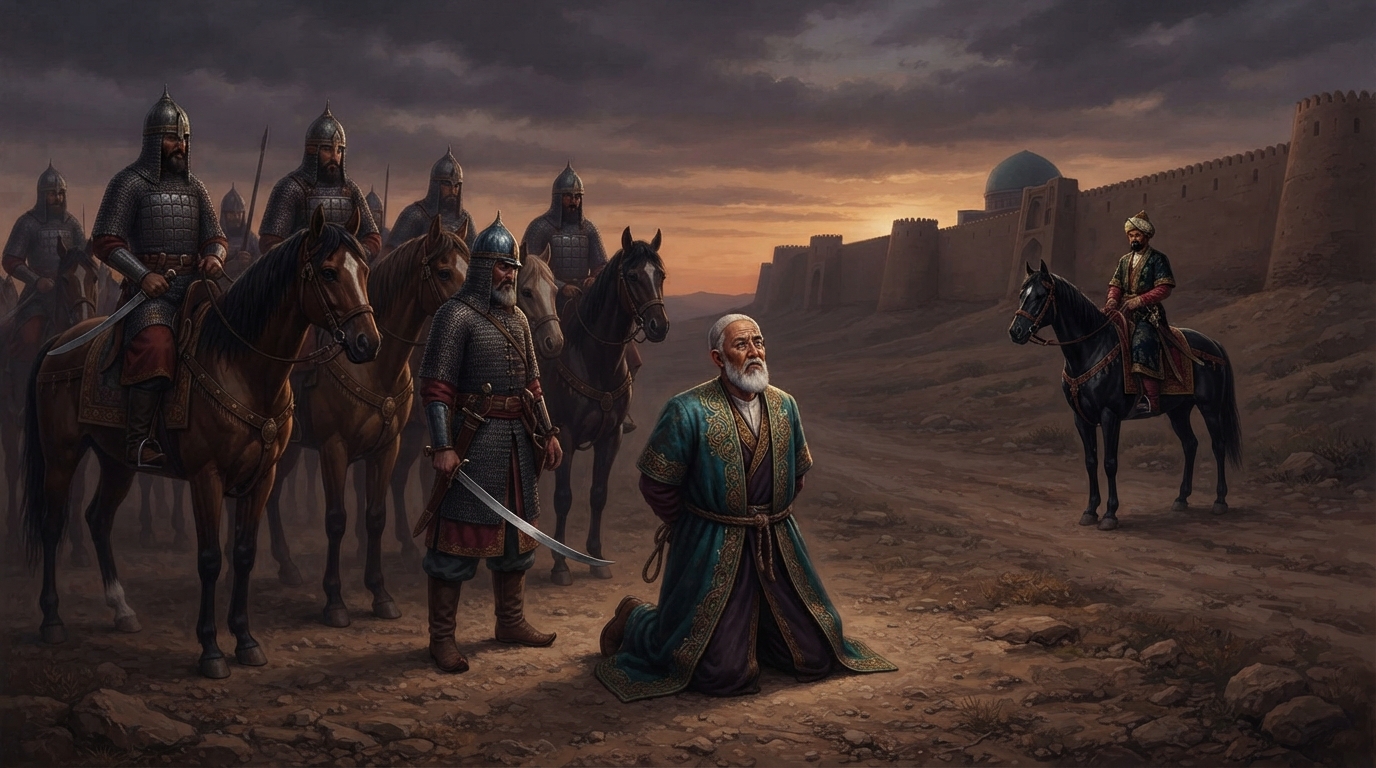
The most widespread version of historical tradition holds that the decision to kill him was made by Abd al-Latif, and the assassination was carried out by his envoys. According to surviving accounts, a court case was organized against Ulugh Beg, after which he was sent on a journey, then overtaken near Samarkand and killed.
The date varies slightly among sources: usually, it is October 25, 1449, while the inscription on his tombstone gives a different date. But there is virtually no doubt about the main point: Ulugh Beg died in the autumn of 1449, shortly after his defeat, and historical tradition attributes responsibility for his death to Abd al-Latif.
However, the formula "Abd al-Latif killed his father" again proves insufficient. Why did the victorious son need to physically eliminate his father, already dethroned?
The answer lies in the political culture of the Timurids. Ulugh Beg, even after losing the throne, remained Ulugh Beg. He was the son of Shah Rukh, the grandson of Timur, wielded enormous authority, had his own supporters, and could have become the standard-bearer for a new rebellion. As long as he remained alive, Abd al-Latif could not be certain of his victory.
In modern states, a retired politician might join the opposition, write his memoirs, or live a quiet retirement. In a dynastic state of the 15th century, a deposed ruler posed a threat. His name could become the banner of armed rebellion. His relatives could declare themselves his avengers. Emirs could defect to his banner. Therefore, political defeat often automatically turned into mortal danger.
This is where the main pattern of Timurid history emerges: a ruler's most dangerous opponents were often his relatives. The reason was simple. An outsider could seize power, but he did not always possess legitimacy. A relative possessed legitimacy, access to court factions, and knowledge of the internal power system. Therefore, he was the most convenient candidate.
In this sense, Ulugh Beg's assassination cannot be seen as an exception. It was part of a much broader tradition of dynastic politics in Central Asia.
But the fate of Abd al-Latif himself demonstrates this pattern with almost mathematical precision. He killed his father to eliminate the threat to his throne. A few months later, he himself was assassinated by conspirators. And this is perhaps the most telling detail of the entire story.
The story of Ulugh Beg's death remains contemporary in its inner meaning. It reminds us that a state can appear powerful, possess vast territories, rich cities, an army, and a renowned dynasty—and yet remain politically fragile if the rules for the succession of power depend not on institutions, but on the balance of power within the ruling house.