

Tragedy in Nizhnekamsk, blackout, and mounting debt for Uzbeks – news of the week
From grid upgrades to widespread blackouts: what's happening to the region's energy sector? Household debt to banks has more than quintupled in six years. Ruslanbek Davletov has been dismissed as presidential adviser, replaced by Olim Davlatov. Eight Uzbek citizens were killed after a drone attack on the Russian city of Nizhnekamsk. A dispute over the rights of Uzbek migrants has erupted in Korea. Meanwhile, Khiva has set a Guinness World Record. Kun.uz summarizes the week's key findings.
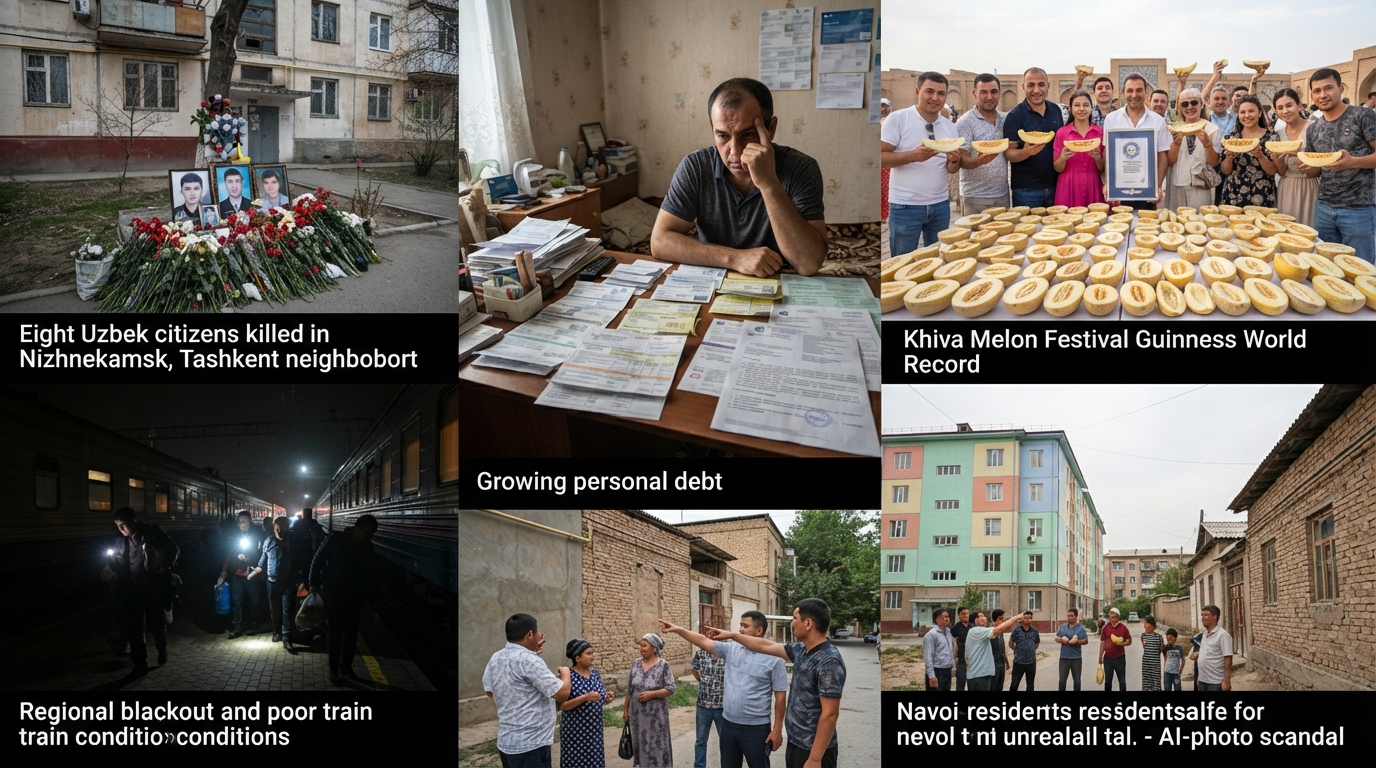
The tragedy in Nizhnekamsk, the blackout, and the mounting debt of Uzbeks are the main news of the week.
From power grid modernization to large-scale outages: what's happening with the region's energy sector? Over the past six years, household debt to banks has increased more than fivefold.
Ruslanbek Davletov has been dismissed from his post as presidential adviser and replaced by Olim Davlatov. Eight Uzbek citizens were killed in a drone attack on the Russian city of Nizhnekamsk. A dispute over the rights of Uzbek migrants has erupted in Korea. Meanwhile, Khiva sets a Guinness World Record. Kun.uz summarizes the week's key findings.
Energy: From Every Mahalla to Gas Shortages
Uzbekistan has decided to tighten control over energy supplies: electricity and gas problems will be analyzed at the level of each mahalla, while the country is seeking ways to reduce its dependence on scarce gas. The "Yangiyul experience" demonstrated that the situation across the regions is uneven: some places lack capacity, while others have reserves. Therefore, over the next five years, plans are in place to upgrade more than 2,200 transformers and 7,400 kilometers of power grids, as well as modernize the gas infrastructure.
However, the scale of the upgrades also points to another problem: the power grid is under increasing strain, and gas supplies are becoming scarce. Deputy Prime Minister Jamshid Khodjayev stated bluntly: "There's not enough gas—not for the population, not for anyone," proposing a more active transition to solar power generation.
The situation with the Khorezm power plant, Odas Enerji CA, is indicative: with a capacity of 174 MW, it receives orders for only 50-60 MW due to the growth of solar power generation.
Thus, the country is simultaneously faced with two challenges: updating outdated infrastructure and seeking new energy sources. The end result for people will be simple: stable electricity and gas in their homes. A power grid failure in Central Asia caused widespread outages.
On August 14, a regional outage left consumers without power in several Central Asian countries.
In Uzbekistan, outages were reported in the Surkhandarya and several other regions.
The Ministry of Energy of Uzbekistan reported that an outage in one of the countries in the region affected the unified power grid of Central Asia.
In Kazakhstan, 10 districts of Almaty and the Almaty region were temporarily without power due to this outage, and metro service in Almaty was suspended. Widespread outages also occurred in Kyrgyzstan and Tajikistan.
A failure occurred at 2:38 PM, but Uzbekistan's automatic protection systems prevented the outage from spreading throughout the country. The rapid connection of energy storage devices helped compensate for the power deficit and maintain grid stability.
The situation was more complex in the Surkhandarya region, which relies primarily on two 500 kV lines. One of them was undergoing scheduled maintenance, and problems in the neighboring country's power grid further complicated the restoration of power. Ultimately, the backup line was quickly restored, and power was gradually restored.
For our country, this incident served as yet another reminder of the need to improve the reliability of the power grid and reduce the risks associated with regional outages.
Loans are growing, and the Central Bank is concerned.
The Central Bank of Uzbekistan is increasingly concerned not about the number of loans issued, but about citizens' ability to repay them.
Over the past six years, household debt to banks has increased more than fivefold, reaching 231 trillion soums. In the past year alone, consumer lending increased by 21.2%, and the debt burden, according to the data provided, has reached 78%.
The regulator has already limited payment amounts and loan amounts relative to the borrower's income. Now, they plan to require financial risk warnings in loan and microloan advertisements.
However, the regulator itself acknowledges that warnings alone will not stop indebtedness. Ultimately, the question comes down to how well the population's income matches their growing liabilities. Trains Can't Withstand Criticism
The governor of the Surkhandarya region sharply criticized the condition of trains and airfare, calling the transportation situation unacceptable.
According to Ulugbek Kosimov, the trains lack air conditioning and other necessary amenities, and some trains are unsuitable for long-distance travel. He demanded that intercity transportation be brought up to standard within a week.
The governor also criticized airfare and its availability, demanding a review of prices and transparent sales.
The problem, it seems, has already spread beyond isolated passenger complaints. The question now is whether these harsh statements will lead to real change or whether it will be limited to yet another inspection.
Newport: Oversight in Question
The Ministry of Construction stated that violations during the construction of the Newport complex were not ignored, but history shows that oversight was not perfect.
Of the nine blocks, three were built with the necessary permits, while work on six blocks, according to the ministry, was carried out without registration. The developer was repeatedly issued notices, but the requirements were not met.
Ultimately, the officials were held accountable, and the materials were handed over to law enforcement. The ministry emphasizes that it is incorrect to claim complete inaction on the part of regulatory authorities.
But the main question remains: if violations were identified and notices were issued, why did construction continue? For buyers, the mere fact of a subsequent inspection is not as important as the ability of the regulatory authorities to stop the problem in time.
Hotel and High-Profile Accusations
Former Migration Agency employee Aziz Tashtemirov, who is on the international wanted list, claimed that an expensive hotel in Tashkent belongs to the family of the agency's head, Bekhzod Musayev.
According to Tashtemirov, the Consti Hotel in the Yakkasaray district is worth $3-4 million and is registered to Musayev's relatives. State registry data confirms that the founders of the hotel business are Munisahon Karimova and Abdulbositkhon Musayev, and that Dildora Musayev is the director. However, this information alone does not prove illegal ownership.
The law does not prohibit relatives of civil servants from owning property, but large assets must have a legal source of funds and comply with declaration requirements. Musayev himself has not yet commented on the allegations.
The Presidential Administration has received legal status.
What was previously perceived primarily as a working mechanism under the president is now enshrined in a separate constitutional law: the powers and role of the Presidential Administration have received a clear legal basis.
The Administration reports directly to the president and is responsible for the organizational, legal, and analytical support of his work. It also coordinates the activities of government agencies and oversees the implementation of presidential decrees, resolutions, and instructions.
Its responsibilities include supporting reforms, analyzing the country's development, personnel policy, and interacting with citizens and businesses.
Essentially, the new law delineates the contours of one of the key centers of state administration—its functions and responsibilities are now enshrined not only in practice but also in law. New presidential adviser
There has been another personnel reshuffle in the presidential team: Ruslanbek Davletov has been relieved of his position as adviser and replaced by Olim Davlatov.
Davletov was responsible for issues related to representative bodies, NGOs, and youth. This important role has now been transferred to a new adviser. Official reasons for the change have not been disclosed.
This area of responsibility is quite significant: it affects the state's interactions with public organizations, youth, and representative bodies. The new adviser's future work will determine how the approach to these issues will change.
Khiva has been included in the Guinness Book of Records
The Kovun Sayli festival in Khiva culminated in a world record—the largest melon tasting.
On August 9, 259 people simultaneously sampled more than 10 varieties, which was officially documented by Guinness World Records. The festival itself attracted 186,000 guests, including 36,000 foreign tourists. Dozens of melon varieties and local produce were showcased at the Ichan Kala and Arda Khiva sites.
For Khorezm, this isn't just a gastronomic record, but another way to attract tourists and showcase the region through its culture, traditions, and agricultural heritage.
Improvements that weren't in the photo
The Navoi Khokimiyat apologized for using AI in a photo report on the improvement of the Hayot mahalla.
Users noticed that the dilapidated walls and abandoned areas in the photos looked too perfect. An investigation revealed signs of AI processing. The Khokimiyat acknowledged the error and issued warnings to the responsible employees.
Later, the agency published unprocessed photos and videos, confirming that the work had indeed been carried out.
But history has demonstrated the main point: when it comes to official reports, even "harmless" processing can create a credibility issue. More beautiful doesn't mean more truthful. Where corruption is most prevalent
In 2025, 7,517 people were prosecuted for corruption-related offenses in Uzbekistan, with damage to the state exceeding 2.9 trillion soums.
The sectors with the highest number of violations included preschool and school education, healthcare, khokimiyats, and commercial banks. Violations amounting to 12.6 trillion soums were identified in public procurement alone.
Another significant fact: every fourth draft regulatory act contained corruption-promoting factors.
It turns out that the problem is not limited to individual officials—corruption risks persist within the very mechanisms of decision-making and the distribution of public funds. And this is precisely what makes combating them significantly more difficult.
Eight Uzbek citizens killed in Nizhnekamsk
Eight Uzbek citizens were killed and several others injured in a drone attack in the Russian city of Nizhnekamsk.
All of them were construction workers and lived in a dormitory in the city's industrial zone. During the nighttime attack, one of the drones hit the building. Two Tajik citizens were also killed.
The bodies of the deceased Uzbeks have been returned to their homeland. At the direction of Shavkat Mirziyoyev, a government commission continues to coordinate assistance to the victims and their families.
The tragedy once again exposed the vulnerability of migrant workers, who can fall victim to military attacks even without connection to the ongoing conflict.
Migrants and a $2,000 Monthly Fine
The working conditions of Uzbek migrants in South Korea have been called into question following the death of a 26-year-old worker and reports of strict restrictions on changing employers.
According to Korean media, migrants on E-9 visas are signing statements stating that changing jobs without approval can result in a $2,000 fine per month, with no upper limit. Human rights activists believe this is a form of economic and psychological pressure. The issue became particularly pressing after the death of an Uzbek man at a Hyundai Heavy Industries plant. Colleagues claim he wanted to leave due to dangerous conditions and low wages, but was unable to do so due to fines.
Korean authorities launched an investigation, and the relevant ministry identified possible signs of human trafficking. This creates a paradoxical situation: a program designed to employ migrants can itself become a source of addiction if the individual has no real opportunity to leave dangerous work.
Terrorist trap via social media: Uzbek citizen sentenced to 10 years
An Uzbek citizen who fell under the influence of terrorist propaganda via Instagram and Telegram has been sentenced to 10 years in prison.
According to the State Security Service, while studying in South Korea, he began viewing materials promoting "jihad" and "hijra," then contacted members of terrorist organizations operating in Syria and distributed their materials. He later transferred money to someone associated with the organization and attempted to travel to Turkey to join the militants. He was arrested in July 2024.
This story demonstrates how online propaganda can gradually lead from viewing prohibited content to funding and attempting to participate in terrorist organizations—with serious criminal consequences.
Bashar al-Assad sentenced to death in absentia
Former Syrian President Bashar al-Assad has been sentenced to death in absentia after being found guilty of crimes against humanity.
The same sentence was handed down to his cousin, Atif Najib. Assad, who was overthrown in December 2024, is currently in Russia, where he has received asylum.
The sentence marks the latest stage in the persecution of the former Syrian leadership following the regime's fall. However, executing it against a politician who is outside the country will be extremely difficult.