

Traded retirement for exams: A grandfather of twenty grandchildren from Shahrisabz proved that age is no barrier to being a student
Traded retirement for exams. A grandfather of twenty grandchildren from Shakhrisabz proved that age is no barrier to learning
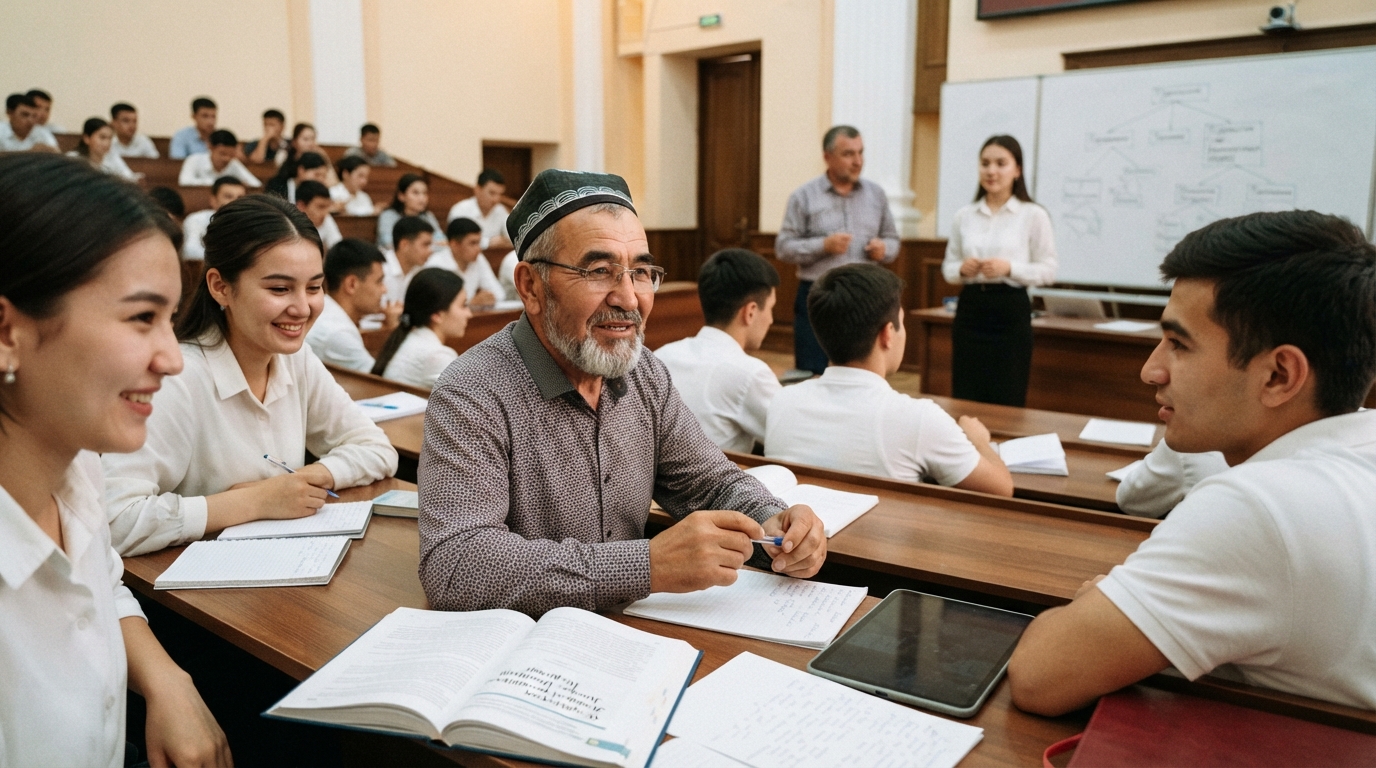
Tirkash Pardaev could easily be mistaken for a lecturer in a student auditorium. But the 72-year-old beloved grandfather of 20 grandchildren is, on the contrary, preparing for classes and taking exams himself. Today, he is a third-year law student at Bukhara State University.
Tirkash aka's story is clear proof that the thirst for knowledge does not depend on age, and education can become a new goal at any stage of life. He was born and raised in Shakhrisabz. His childhood was spent in a simple family: his father was a shepherd, and labor from an early age was a natural part of daily life. Perhaps it is this habit of constantly being busy and not fearing difficulties that he still considers one of the secrets of his physical activity and vigor today.
According to him, longevity is also not uncommon in the Pardaev family. Both his father and mother lived for over a hundred years. The student himself has almost no health complaints. He attends classes on an equal footing with his classmates and even participates in physical education classes along with everyone else.
Before entering the university, he had already had contact with the legal field. For about thirty years, he worked as an advisor to a criminal court judge. This experience strengthened his interest in law, but over time he concluded that practical life experience alone is not enough — systematic professional knowledge is needed.
It was this desire to develop and study law more deeply that became one of the main reasons for his enrollment in the university.
For Pardaev, obtaining a diploma is not an end in itself. He would like to use the knowledge he is receiving today in the future to help people, particularly young families. He is especially concerned about disagreements between young spouses and the social problems faced by modern youth.
According to his observations, not only living conditions are changing, but also the attitude of young people towards work, education, and family values. He believes that some young people are gradually moving away from traditional values, striving to achieve material well-being faster, and do not always connect success with long-term work and acquiring knowledge.
At the same time, in the student's opinion, the responsibility lies not only on the youth themselves. The lifestyle of many families has also changed. Due to busy schedules and other circumstances, parents have begun to spend less time on joint activities with their children, introducing them to work and cultural family leisure. He attaches particular importance to constant dialogue between parents and children.
"You have to talk to your children, no matter what happens. Communication is very important," he is convinced.
Another problem that, in his opinion, modern society should think about is information hygiene. The huge flow of information from social networks does not always help a young person correctly assess real life.
Tirkash Pardaev points out that excessive fascination with social networks can even affect relations between young spouses. Beautiful photos, demonstrations of a wealthy and carefree life, as well as an unfiltered information flow can create a distorted perception of everyday reality. As a result, young people sometimes form inflated expectations of family and of each other.
In his opinion, it is important for young people to learn to separate real life from the picture created on social networks, and for society to look for effective mechanisms to form a culture of information consumption.
In the university environment, Tirkash aka's age has not become an obstacle to communication. He has developed warm relations with his classmates. Young students often turn to their older classmate for advice, and the questions are by no means always related to studies. His extensive life experience makes him a kind of mentor for many.
He does not demand special treatment, and the age difference with his classmates does not bother him. On the contrary, constant communication with young people gives him additional energy. According to him, this "makes a person younger."
The professors do not make allowances for the student's age either. The requirements for him are the same as for everyone else: he needs to attend classes, prepare, complete assignments, and demonstrate knowledge. Pardaev himself considers this approach correct and tries to meet the general academic requirements.
His decision to become a student again was also supported by his family. Tirkash Pardaev says that he managed to raise decent children who showed understanding toward their father's decision to obtain a higher legal education. They continue to support him, including financially, so that he can focus on his studies.
The 72-year-old student does not intend to stop after receiving his bachelor's degree. His plans include a master's degree. He does not rule out further scientific activity either.
Pardaev calls having a goal the main principle of his life. Age, circumstances, or difficulties, he believes, should not become a reason to give up what a person considers important.
His story makes us look at the very concept of being a student in a new way. The university turns out to be a space where completely different generations can meet: some are just starting their independent lives, while others come with decades of accumulated experience. And such interaction provides an opportunity to learn not only from textbooks, but also from each other. By his example, he confirms a simple thought: as long as a person has a goal and a desire to move forward, age is not the limit.