

To space by elevator and without rockets
The first space elevator for launching a spacecraft into orbit could become a reality thanks to a new, ultra-strong material: graphene. According to the New York Post, the elevator's ultra-strong cable will be anchored near the equator and extended far beyond geostationary orbit to a counterweight in space that will keep it taut. Special cabins will then ascend the cable, […]
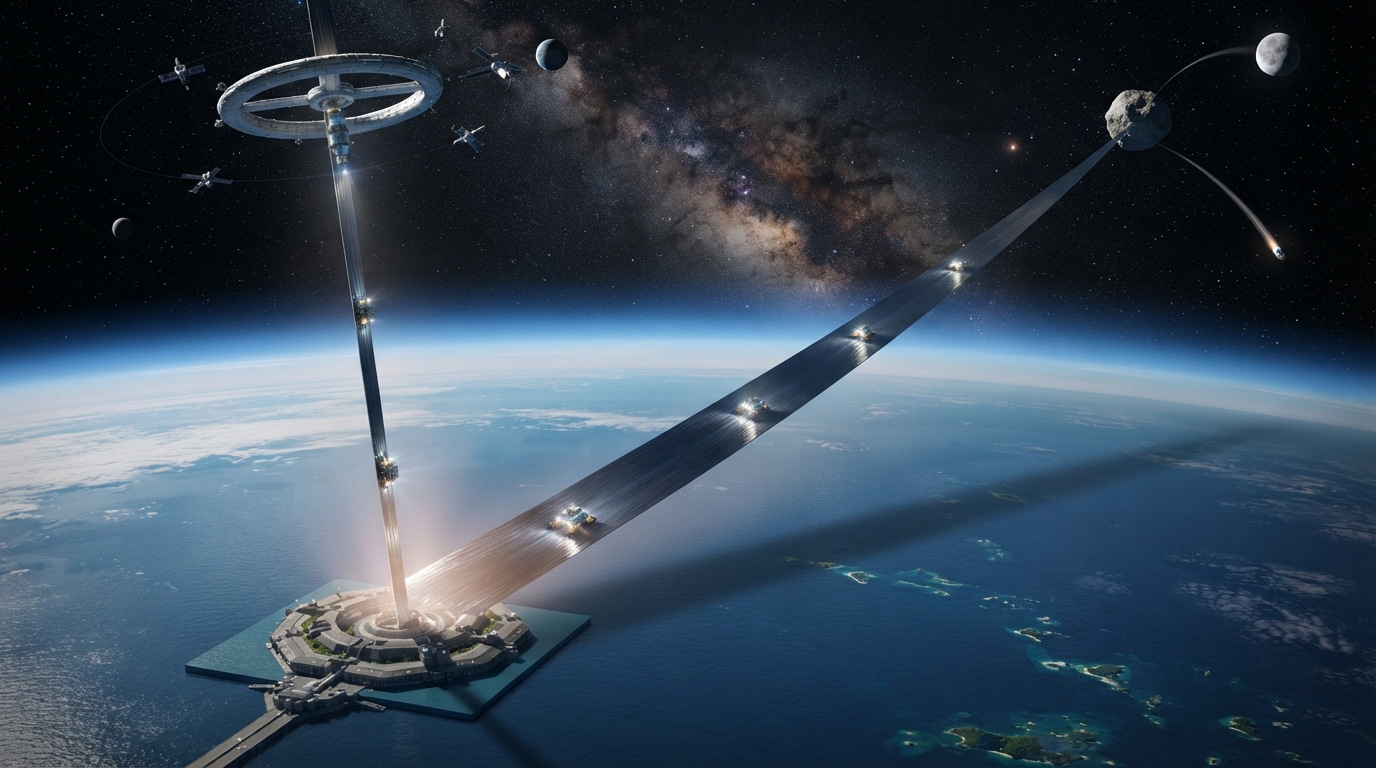
For the first time in human history, thanks to the development of a new, ultra-strong material—graphene—a space elevator capable of launching spacecraft into orbit without the use of rockets could become a reality.
According to the New York Post, the concept of a space elevator, once thought the stuff of science fiction, is now closer than ever to reality. Researchers claim they are close to realizing the idea of a 66,000-mile elevator stretching from Earth into space.
The elevator's operating principle is remarkably simple: a super-strong cable would be anchored near the equator and extended far beyond geostationary orbit to a counterweight in space, which would maintain its tension. Special cabins would ascend the cable, delivering people, cargo, and equipment into space.
"The beauty of electrically powered lift is that it protects our atmosphere from pollution, leaves no debris behind, and will become a routine, daily, inexpensive, and safe procedure. It will be a bridge to space," the researchers told The Post.
Proponents of the project claim that such a system would make space travel cheaper, greener, and far more widespread than rocket launches.
The main challenge has always been finding a material strong and lightweight enough to manufacture the cable. Researchers say the cable would need to be approximately 100 times stronger than steel, while remaining lightweight and suitable for large-scale production.
The International Space Elevator Consortium (ISEC) claims to have found its best candidate to date: polycrystalline graphene, an ultra-strong two-dimensional material already used in electronics and other industries. Graphene consists of carbon atoms arranged in a thin, continuous structure. The "polycrystalline" version consists of many small crystalline fragments, which the researchers believe could simplify its large-scale production.
Steven Cohen, a prominent space elevator researcher, stated that significant progress has been made in the field in recent months and that researchers are increasingly confident in the material's properties.
The idea of a space elevator has been around for over a century. It gained widespread popularity in modern science fiction thanks to British writer Arthur C. Clarke, who explored the concept in his 1979 novel The Fountains of Paradise. Clarke famously quipped that a space elevator would be built "about fifty years after everyone stops laughing."
The proposed design would be enormous. Each strand of the cable would be essentially a single molecule, just one atom thick, about one meter wide, and approximately 100,000 kilometers (62,000 miles) long. It would stretch from a spaceport on Earth's equator to a support point far beyond geostationary orbit.
The ISEC concept envisions using thousands of such sheets to create a massive cable. From the ground, the cable would be virtually invisible, although it would reflect sunlight and occasionally appear in the sky as a thin strip.
Some progress has already been made in large-scale graphene production. According to ISEC, engineers in South Korea have created a polycrystalline graphene structure approximately 1,000 meters long and half a meter wide, producing it at a rate of approximately two meters per minute.
Space debris remains one of the biggest threats. Objects moving in low Earth orbit could damage the tether, so the researchers proposed using multiple cables for redundancy and creating a restricted area around the elevator to prevent satellites from being hit.
Once operational, cargo ships would slowly ascend the tether to geostationary orbit, approximately 22,000 miles above Earth. The journey to this point could take about two weeks. Beyond geostationary orbit, the rotating Earth would provide the necessary centrifugal force. The cargo would then continue along the remaining section of the tether and would eventually be released into space at approximately 16,000 miles per hour.
This could dramatically change the approach to solar system exploration.
ISEC researchers calculated that a payload launched from above could reach the Moon in just 14 hours, compared to approximately three days using current spacecraft. Flights to Mars could potentially take between 61 and 120 days, depending on the planet's position. Conventional missions could last about seven months and are limited by launch windows that occur approximately every 26 months.
However, a functioning space elevator is still far from reality. "It's not a guaranteed success," noted Armen Papazian, professor of space economics at the American University of Dubai. "Even if someone were to start building a space elevator tomorrow, assuming venture capital were available, it would take a decade or two to complete the project, assuming all goes well."