

"To show the region through our eyes." What artists from Central Asian countries presented at the ORALIK exhibition in Zanmakon
The ORALIK exhibition is taking place in Tashkent, bringing together the works of eight artists from Uzbekistan, Kazakhstan, Kyrgyzstan, and Tajikistan who participated in an art residency at Lake Iskanderkul. The project aims to establish connections within the region's contemporary art scene. Gazeta reports on how the exhibition turned out.
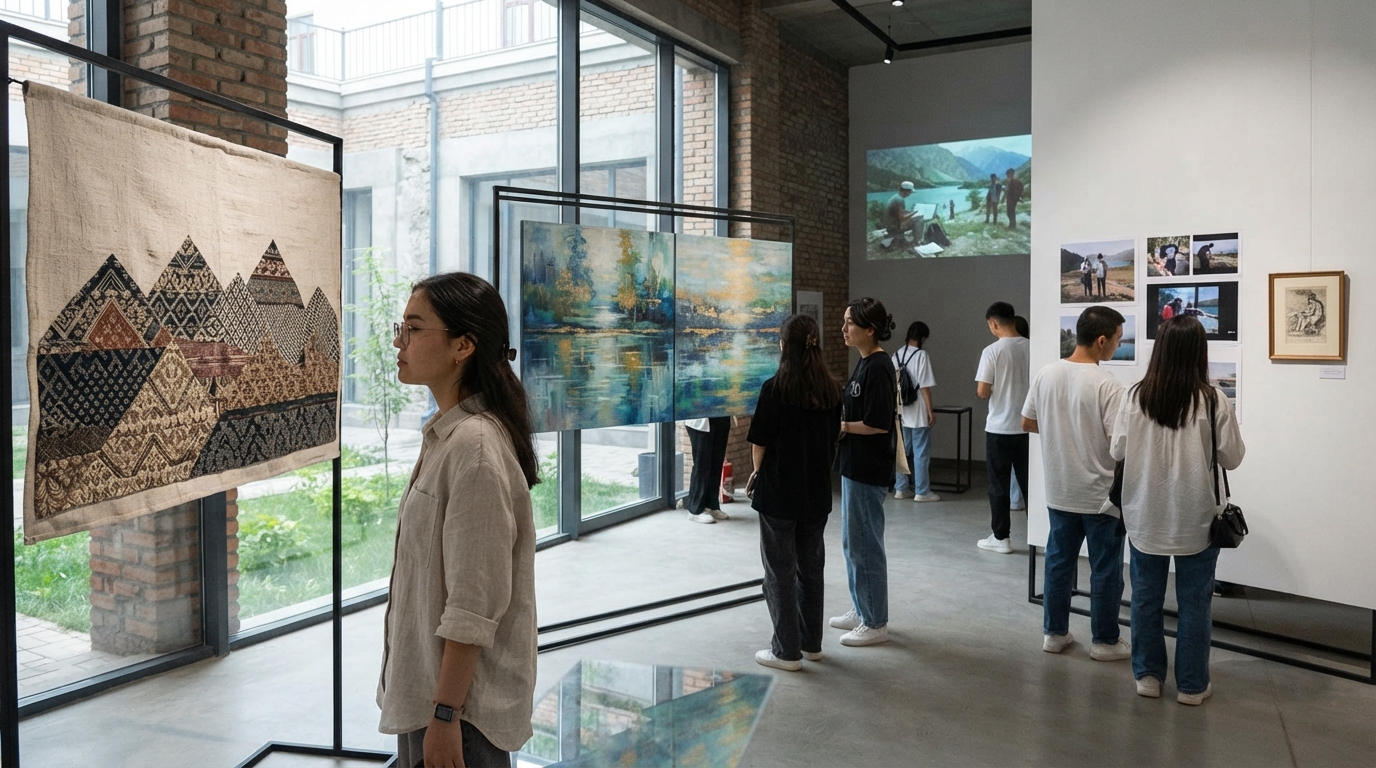
"To show the region through our eyes." What Central Asian artists showed at the ORALIK exhibition in Zanmakon
Following Dushanbe, the Zanmakon cultural hub in Tashkent presented the exhibition ORALIK / "Space". It was the result of a year-long educational and residency program that brought together more than 50 artists from Central Asian countries. The project was implemented as part of the regional project Art for Social Changes — Central Asia Lab of Cultural Leaders by the "Kuduk" Cultural Center Public Fund, with the support of the Government of Switzerland.
The exhibition features paintings, photo and video installations created by eight finalists of the program from Uzbekistan, Kazakhstan, Tajikistan, and Kyrgyzstan — two from each country — during a five-day art residency held in April at Lake Iskanderkul in Tajikistan.
The art residency was preceded by an online educational program. Since January, 55 artists from four countries participated in lectures, masterclasses, and discussions, completed assignments, and exchanged experiences. The classes were led by curators, art historians, and artists.
The ORALIK team emphasizes that the project arose from a desire to restore connections between young artists of Central Asia. As the project curator and researcher Alexandra Filatova said, artists of the older generation from different countries of the region often met and collaborated. In Soviet times, the Union of Artists organized exhibitions and creative trips for them. Over time, these contacts weakened.
"The new generation of artists, who are roughly between 20 and 30 years old, have almost no idea who is working next door and how they can interact. We thought we needed to create a residency where they could get to know each other and work together. We wanted this communication to help them build new connections," Filatova said.
Art historian and project curator Aziza Sharopova also noted that the project's goal was to bring together participants with different levels of experience: those who are just starting their journey and those who have already made a name for themselves.
The remoteness from capital art centers was part of the design — the organizers wanted to choose a place with its own history and environment, which even residents of the region rarely reach.
"People from outside our region often write and film about Central Asia. We wanted to show it through our eyes, to tell about it ourselves. Iskanderkul has its own history, mythology, and folklore, which often go unnoticed. We wanted them to be reflected in the works as well," Filatova explained.
According to the curators, an important part of the project was the artists' actual acquaintance with the location: observations, walks, conversations, and working directly in the environment. This also influenced the participants' initial ideas.
"Until the artists saw Iskanderkul, they imagined their projects differently. But after arriving, when they lived among the mountains and by the lake, worked on site, and heard the stories of the residents, their ideas began to transform," Sharopova added.
Thus, Begimay Isaeva from Kyrgyzstan changed the format of her work after getting to know the area. During walks near Iskanderkul, the artist observed the play of light and reflections on the water and made sketches. The result was an elongated diptych "Mirror. Kuzgu", in which she conveyed her impression of the lake and its changing landscape.
Kazakhstani artist Nazira Sadvakasova presented the work "I am from here", created from fragments of used fabrics in the palette of Iskanderkul. The scuffs and different textures serve as a reminder that the material already has its own history. Some patches repeat the outlines of the mountains surrounding the lake. The artist also included in the textile collage a fragment with an ornament from the facade of her parents' house, created by her father. Through these details, Sadvakasova addresses the memory of a place — it can remain the same, but over time, circumstances and a person's perspective on it change.
Sarvinoz Melikuzieva from Uzbekistan created a diptych based on local legends. In the first work, she turned to Lake Koli Moron (Snake Lake), located near Iskanderkul and named so because of the water snakes living there. White birds and a paper boat in the composition symbolize movement and inner light.
In the second work, the artist reinterprets the legend of Iskanderkul. According to legend, the lake was named after the horse of Alexander the Great, which drowned in its waters. Melikuzieva does not depict the landscape literally, but works with images and impressions associated with these stories.
There are plans to continue ORALIK in other countries of the region. The organizers want to hold the next residency in Uzbekistan in the spring of 2027, and then in Kyrgyzstan. According to Alexandra Filatova, the project is conceived as nomadic: the meeting place will change, and with it, the environment with which the artists can work.
The exhibition at Zanmakon is open until October 15, daily from 10:00 to 19:00. Admission is free.