

'Tirana teeth': Albania hopes to be the new Turkey for dental work
The Balkan nation is aiming to become a new centre for medical tourism.
‘Tirana teeth’: Albania hopes to become the new Turkey for dental work
Anthony Hook travelled from the UK to Albania to get a new set of teeth
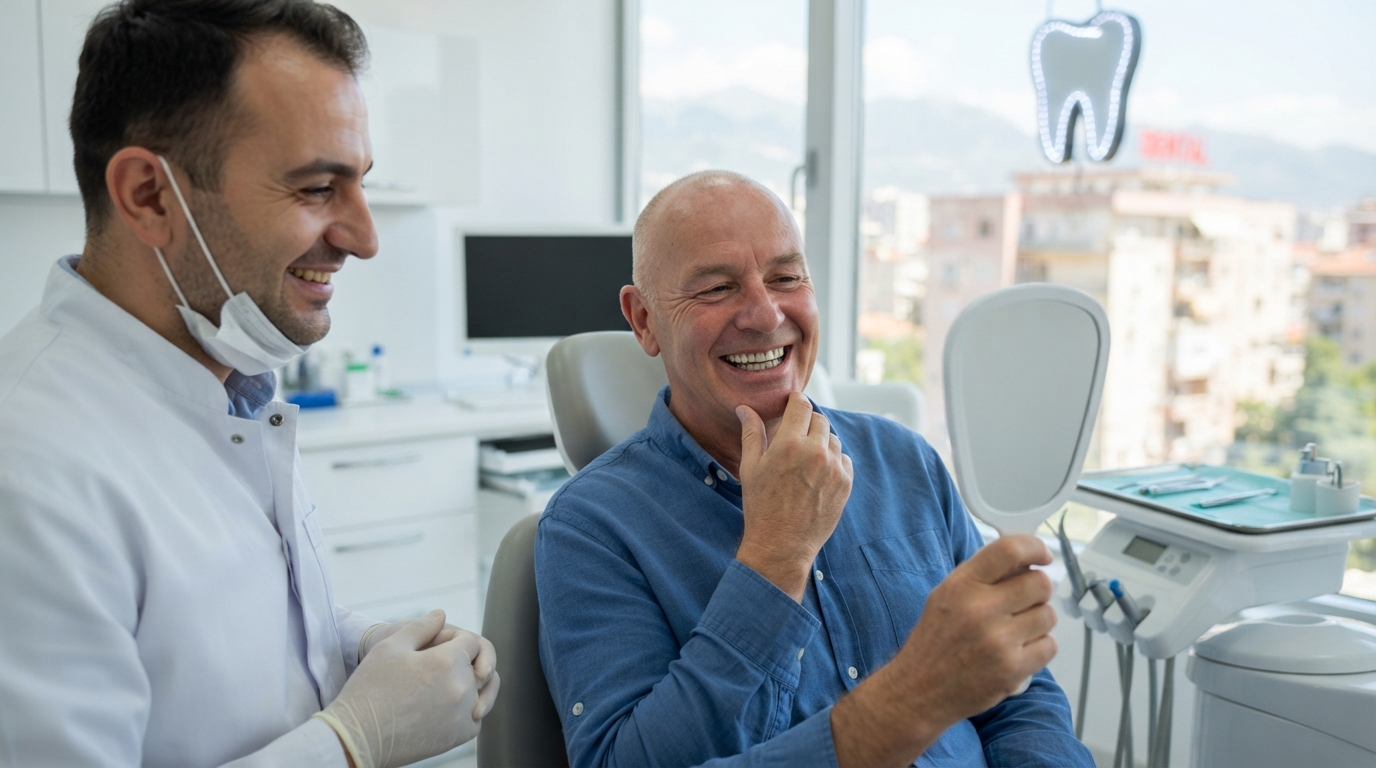
Anthony Hook is seated in a dentist’s chair, beaming toothily into a handheld mirror. He has been asked to pose for photographs showing off his new smile – and he is more than happy to do so.
The 58-year-old window cleaner from Bolton, in Greater Manchester, is now the proud owner of a gleaming new set of “Tirana teeth”.
That is not a brand name – at least, not yet. But it would be a fitting slogan as Albania makes a determined push into the medical tourism market.
Tirana, the capital, is where much of the activity is concentrated. And once you notice the first tooth, you begin spotting them everywhere. They appear to be scattered across the city centre.
Be assured, these are not the remains of a night out that ended in a fight. Instead, they are the oversized illuminated molars that, in these parts at least, signal that a dental clinic is nearby.
In Tirana’s metropolitan area alone, there are nearly 400 dental clinics – and most are in the city centre. That is more than enough for a population of about 600,000.
So it is hardly surprising that dozens of dentists are now aiming at customers from farther away. They have created websites and signs in English and Italian, as well as Albanian.
Hook, who is being treated here, was drawn by the low price of dental work in Albania
Dental implants in Albania usually cost about €600 ($700; £516) per tooth, roughly the same as in Turkey, which has long been the main overseas destination for people in western Europe looking for much cheaper dental work than they can afford at home.
The same treatment in the UK, France or Germany can easily cost four times as much.
For Hook, the attraction was impossible to resist. He first visited Tirana last year to watch England’s footballers play Albania – but then became intrigued by all the dentist signs. That prompted him to do something about his missing teeth.
He decided to choose Albania rather than Turkey because he was worried by media reports of dental or hair transplant procedures in Turkey going wrong.
In fact, even the UK Foreign Office warns that it is
“aware of seven British nationals having died in Turkey in 2025 following medical procedures”.
It adds that “some British nationals have also experienced complications [after surgery in Turkey], and needed further treatment or surgery following their procedure.”
Hook says he would not go to Turkey “because I have heard so many bad things”, adding that he researched carefully before taking the plunge in Tirana.
“I went onto the internet and looked into it properly. It took me two days to research it because I’m not one for jumping into anything.”
After several return visits, Anthony now has a mouthful of striking implants – and, unsurprisingly, he is all smiles. “I’d come here once a month for a holiday if I could,” he laughs.
Elite Dental is one of the largest clinics in Tirana. It is fully licensed by the Albanian health authorities – and all 15 of its resident dentists are too.
The man in charge, Ardtur Dema, says he is “not in favour of damaging proper teeth for aesthetics”. Instead, he says the aim is “changing people’s lives” by restoring their ability to chew and, indeed, to smile.
Dema believes that as long as Albania stays outside the EU, treatment prices are likely to remain low. At the same time, low-cost airlines have greatly expanded their routes to and from Tirana, meaning he is just as likely to see a patient from Turin as from Tirana.
But Dema worries that the boom in tourism could allow less scrupulous operators to damage the business for everyone. He is a member of the newly established Albanian Medical Tourism Association – but many others are not, at least not yet.
Albania’s Prime Minister, Edi Rama, tells the BBC that the government is catching up after five years in which overall international arrivals to Albania have more than doubled. Some kind of official seal of approval for medical tourism facilities is possible – but the government has not yet worked out the details.
“It’s a new industry that is within the tourism industry umbrella that is showing a big potential and where there are very good people,” says Rama.
He adds that the government wants to help all reputable providers “survive”, and to protect against any informal “bad competition”.
Albania is also moving into hair transplants
Alongside dental treatments, some visitors to Albania are beginning to think about “hairline” as well as “coastline”.
Some transplant clinics employ Turkish specialists – others are actually branches of businesses based in Turkey.
Vatanmed, in Tirana, is one of the latter. Sales specialist and health consultant Ayşe Mina Kasemi describes it as a “global brand”, with 15 clinics across several countries. That scale, she says, makes it “a safe place to trust” for international patients arriving for treatment.
Beyond that, Ayşe says, Albania has its own appeal.
“When people decide to have a hair transplant operation here in Albania, they also want to have a holiday here, because Albania is a very beautiful place,” she says, while adding a warning for hair transplant patients. “For the first two or three days, they have to be careful – they are not allowed to be exposed to the sun.”
That is not a concern for Anthony Hook. He happily wears a shaved head – and has no intention of following his dental treatment with a dramatic hair rethink. So enjoying Albania’s beaches and scenery was very much part of the appeal of getting his teeth fixed here.
“There’s a lot to do in Tirana… there’s a lot to do along the coast there, it’s absolutely stunning,” he says. “I want to do it now before it gets too popular and it’s ruined like everywhere else.”
With his new teeth, enjoying Albania’s food will no doubt also be part of Anthony’s plans. And beyond that, the smile is going to shine in the holiday photos.
Why wait?