

Time bomb: How does the Rogun HPP threaten Central Asia?
On October 22, a serious incident occurred at the Rogun Hydroelectric Power Plant under construction in Tajikistan. On the right bank of the Vakhsh River, a powerful mud and stone flow mixed with water, sand, and crushed stone suddenly descended. Workers on the slope managed to escape from the rushing mass in the final seconds.
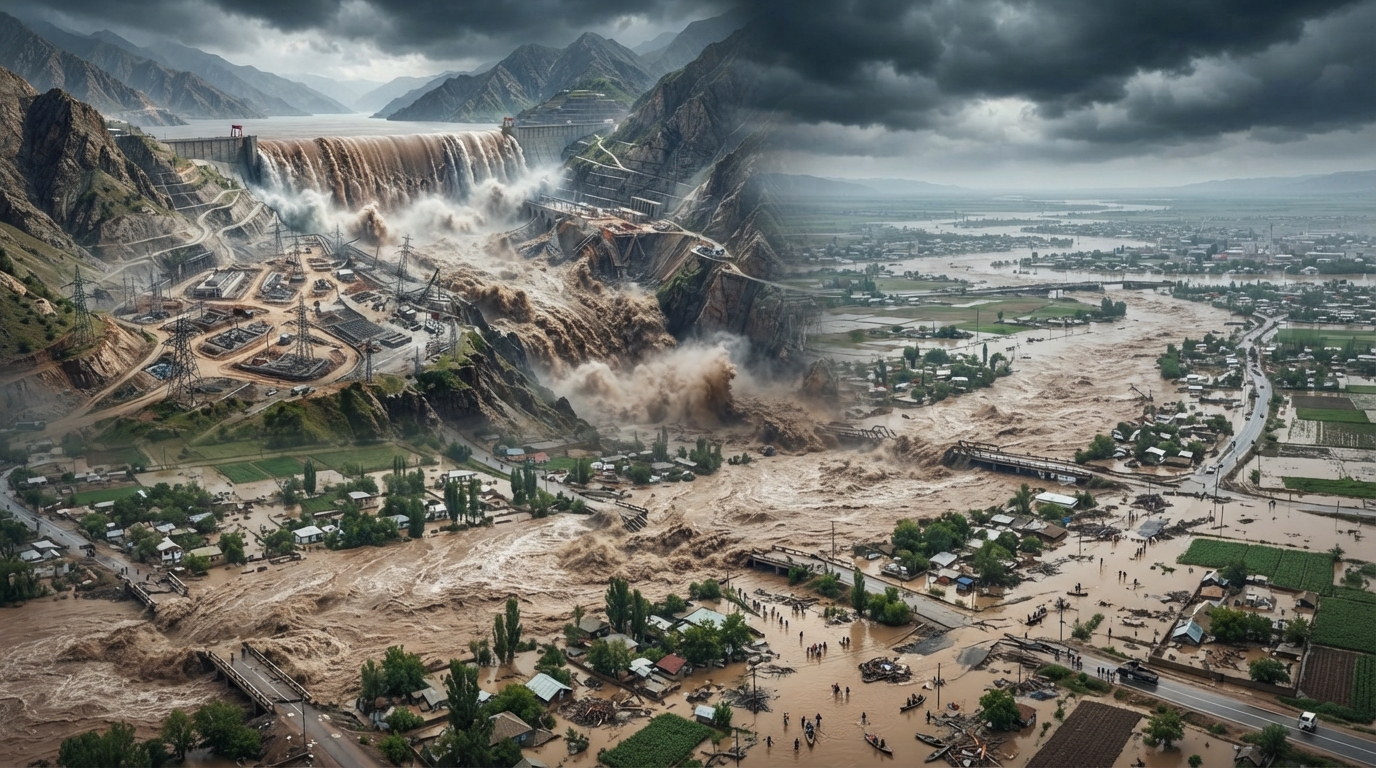
Time Bomb: How the Rogun HPP threatens Central Asia?
According to the official version, the cause of the incident was the rupture of a technical water tank during grouting work. The authorities claim that there are no serious injuries. However, Radio Ozodi, citing eyewitnesses, writes that as a result of the incident, more than five workers were injured.
CHRONICLE OF THE EMERGENCY AND TWO SCENARIOS FOR THE DOWNSTREAM
Statistics of incidents at the construction site of the Rogun HPP cause serious concern. In 2024, three workers died and another was injured when a heavy platform collapsed. In 2025, eight accidents were officially recorded. And in the first half of 2026, three foreign specialists died at the site — two citizens of China and one of Iran.
The new incident in October again raised the question of the construction safety of the region's largest hydropower project. But the risks may extend far beyond the site itself. In today's issue, we will analyze two possible catastrophic scenarios associated with the Rogun dam and their consequences for Uzbekistan, Afghanistan, and Turkmenistan.
Scenario One: Dam Breach
The Rogun HPP is designed as the highest dam in the world — 335 meters, with a reservoir volume of more than 13 cubic kilometers. Its potential destruction is capable of causing a large-scale flood, the consequences of which will affect Tajikistan, Uzbekistan, Afghanistan, and Turkmenistan.
In a breach scenario, water will rush down the Vakhsh riverbed, forming a powerful torrent that could damage downstream hydro developments and infrastructure. After the confluence of the Vakhsh with the Pyanj and the formation of the Amu Darya, the border territories of Uzbekistan and Afghanistan, including the Surkhandarya Region, Termez, and the northern provinces of Afghanistan, will be threatened.
Then the consequences could spread to Turkmenistan, as well as the Bukhara, Navoiy, and Khorezm Regions and Karakalpakstan. Among the main risks are the flooding of populated areas, the destruction of bridges, roads, power lines, gas pipelines, and irrigation systems.
In addition to human casualties and economic damage, such a disaster could trigger a large-scale environmental crisis: contamination of drinking water, destruction of agricultural land, and the spread of infectious diseases. At the same time, the real scale of potential flooding and the consequences of dam destruction require separate engineering calculations and modeling.