

Three books for children that teach how to protect nature and its inhabitants
Caring for the world around us begins with a sincere interest in its inhabitants. Interesting facts, kind humor, and colorful illustrations help to spark and support this interest in a child. Designer and reading father Azamat Shamuzafarov has selected books that will teach children mindfulness, empathy, and a caring attitude toward all living things on Earth.
Three books for children that teach how to protect nature and its inhabitants
American writer and illustrator Brooke Barker lives in Portland, Oregon, USA. She gained widespread fame through her Instagram account sadanimalfacts, featuring drawings that later turned into a book of the same name. "Sad Animal Facts" was released 10 years ago and became a New York Times bestseller. The stories, which showed that the lives of furry, tailed, and other representatives of the fauna are just as complex and unfair as ours, made readers weep over the pages of the collection — sometimes from sadness, and sometimes from laughter.
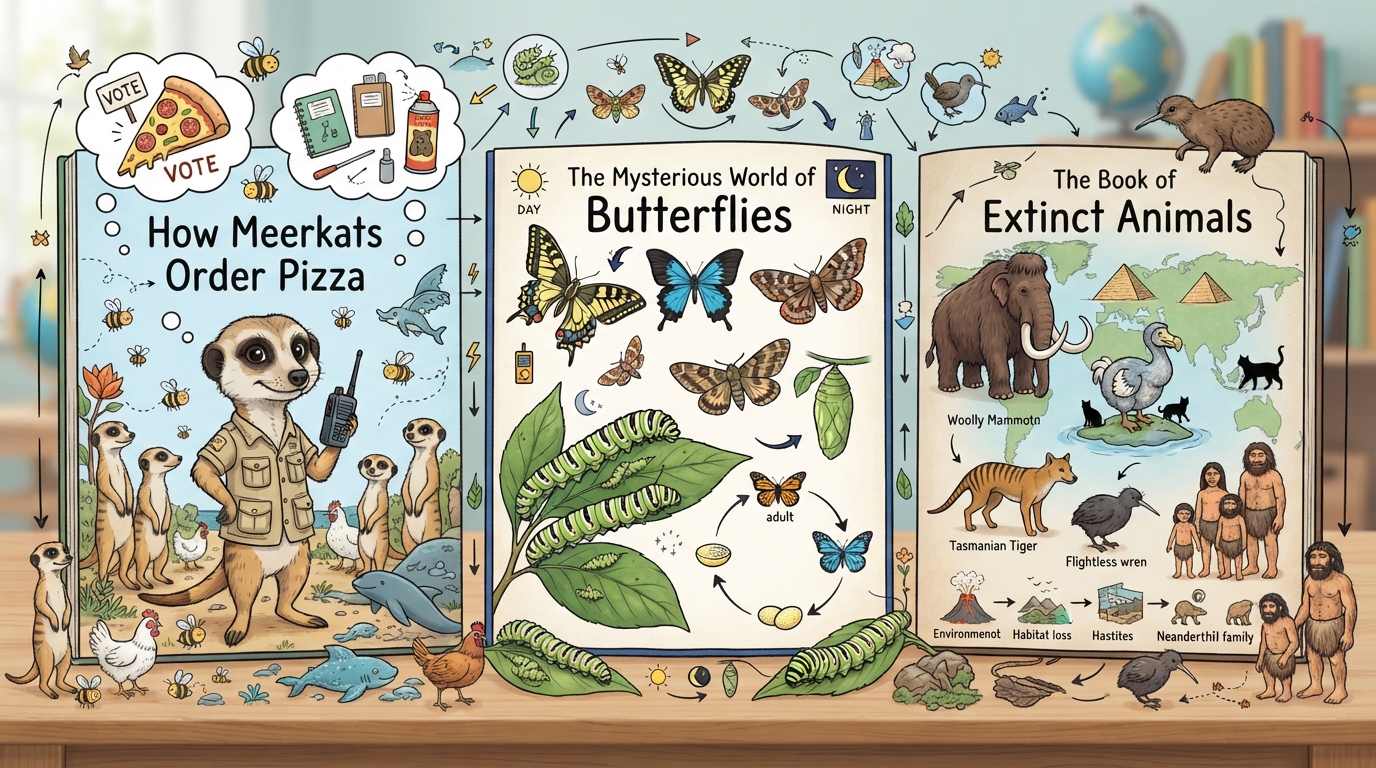
The popular science book for children and teenagers "How Meerkat Groups Order Pizza" was released a few years ago and proved to be no less fascinating. The style is the same: cute drawings and a bit of irony. But this time, in addition to animal facts, Barker also talks about the work of real scientists. Each spread not only introduces the work of zoologists and biologists but also shows what tools they use in their research. Among them are carnival masks, waterproof notebooks, bear sprays, fake poop, and jars for collecting real poop.
Studying animals in forests and seas can inspire children to dedicate themselves to the natural world.
One of the first spreads of the book features a world map marking the animals that will be discussed. Barker does not limit herself to exotic fauna, so in addition to jaguars, Japanese macaques, alligator gars, and dinosaurs, children will learn about the lives — and unusual facts from them — of quite familiar bees, chickens, dogs, and crows.
Dr. Marta Manser studies meerkats. She and her team members have been observing the same colony for 20 years. Scientists know a lot about how the animals interact with each other. For example, how they order pizza. In reality, of course, they do not order any pizza. But when making decisions, the animals hold a vote. This resembles "office workers" who decide what to order for lunch in a similar way.
The internet-famous "fluffy" yeti crabs, which live at great ocean depths among geothermal vents, were discovered by Dr. Cindy Van Dover. She found out that the crabs feed on bacteria that grow right on their claws. This is as if you had hands with pilaf on demand.
Dr. Nicholas Teets found a fascinating occupation — studying the Antarctic midge. Having reached Chile by plane, he and his team travel by ship to Palmer Station, which takes 3–4 days. All this just to learn more about the only insect living in Antarctica. It must feel very proud to tell new acquaintances that your job is researching flies at the South Pole.
There are so many pictures in the book that its format is closer to a comic book. Because of this, the stories are very easy to read. You are constantly jumping between a couple of sentences and funny comments coming from the meerkats on the cover and the cutest mollusks. And when the author talks about bees and crows, they join in the entertainment of the readers as well.
It is not only these animals that speak on the pages. Practically every animal discussed has something to say about itself and its life. They all "know" they are on the pages of the collection. Thus, the book itself addresses the reader directly, "understanding" that someone is reading it right now.
The book does not provide a detailed account of the animals, so do not expect in-depth explanations. Some jokes may be incomprehensible to toddlers, and to adults, they may seem naive. Overall, this is not a problem if you are prepared for it. On the other hand, such dialogues can be read with expression, imitating an otter, seals, chickens, or a horse.
Despite its small format, the book has almost 200 pages, and all of them are filled with interesting stories.
A child will read enough and then torment you with facts from it, as if they had watched too many YouTube Shorts and were eager to surprise you with something you don't know yet.
Brace yourselves.
For shared reading, the book is suitable for children from 7 years old — some terms will have to be explained, although the language itself is very simple. Younger children will likely find it difficult to perceive the information due to the large number of small pictures and text. For independent reading, "Meerkats" can be recommended for children from 9 years old. This is just the age when short and surprising information is well absorbed.
Ben Rothery is a British wildlife artist and author of several books about animals. He is known for his "obsession with detail" in his works, drawing with the finest elaboration of patterns and color. You can see this for yourself, because in the colorful children's encyclopedia-album "The Hidden World of Butterflies," the images are sometimes indistinguishable from photographs.
It is symbolic that the book was published by the "Machaon" publishing house, whose symbol is the swallowtail butterfly (Papilio machaon) — one of the largest and most recognizable representatives of the species: yellow with black and blue borders, with two red "eye" patterns on the wings.
The encyclopedia will tell children about the most interesting butterflies. And it will start without long introductions. It immediately explains that there are butterflies and moths. They differ from each other in their antennae, which in butterflies usually end in a club-like thickening, while in moths they are more often thread-like or feathery. They also hold their wings differently during rest: butterflies fold them tightly vertically over the body, while moths spread them or fold them like a tent. If you pay attention to this, you can quickly tell the former from the latter.
Interestingly, the clothes moth also belongs to butterflies — lower heteroneurans, which are considered among the most ancient lepidopterans on the planet. By the way, we are used to killing moths because they eat our woolen clothes. A funny and at the same time sad fact: the moth cannot do this because it has no mouth — only a proboscis. The damage to clothes is caused by its larvae, which are the ones that need to be eradicated.
Among the nocturnal "furry" representatives, there are amazing creatures — hawkmoths. Some species reach speeds of up to 50 km/h, which is only 10 km less than the speed limit for cars in the city. They look very much like hummingbirds and can drink nectar on the fly. Once, in a courtyard in Tashkent, I saw this for myself. I couldn't believe my eyes when right in front of my nose "hummingbirds" — hummingbird hawk-moths — were collecting nectar.
I was sure they had escaped from the zoo.
General information for all species in the book is interspersed with stories about a specific butterfly species: where it lives, what it feeds on, how big it is, how it stands out from others, etc.
At first glance, it may seem that butterflies differ only in the design of their wings, but there are many more differences between them. Some gather in colonies and migrate over long distances. Others live for only a week and do not even waste time on food because they are urgently looking for a mate.
The difference in the size of butterflies can also be huge: from 3 mm to 28 cm in wingspan for Queen Alexandra's birdwing. For convenience, some pages of the book have a ruler to visually represent the sizes of the insects.
Most of the drawings show butterflies in an enlarged view, and personally, I missed having at least outline images in life size, especially since the large format of the book allows for this.
Butterflies spend half of their life cycle in the caterpillar stage. The latter deserve special attention. The book gives it, but not enough.
Everyone knows that caterpillars form a chrysalis and "turn" into a butterfly inside it. It sounds magical, but in reality, it is a nightmare. The caterpillar begins to digest itself and turns into something like soup. Only the imaginal discs remain, which begin to divide and feed on the surrounding broth — this is how the butterfly reassembles itself almost from scratch. This is even crazier than a chicken "stuffed" with its own chicks.
But that's not all. Caterpillars are almost blind, distinguishing only patches of light and shadow, which does not prevent them from feeding on things other than leaves, as they are usually depicted. The caterpillars of the Scarce Large Blue eat each other, and the survivors are carried by ants to their nest, where they switch to ant larvae. What on earth? The thing is, these butterflies use several ways to convince the naive, kind ants that they are the queen ant, whom they must care for. And these are your innocent fluttering butterflies!
Despite the fact that the insects are illustrated marvelously, I really missed seeing them in their native environment. In the book, Ben drew the butterflies against the background of pages or some plant, but only in pencil, so as not to distract attention to them. Because of this, I got the impression that I was looking at a collection of butterflies of an avid lepidopterist, without ever finding out what the wild world in which caterpillars and butterflies live looks like.
The book can be read from any section, as there is no direct connection between them. It is suitable for children from 10–12 years old because it is full of Latin names of insects, which even adults can get tired of. The text balances between a children's encyclopedia and something more serious, popular science. On the other hand, if a child is into drawing, the illustrations can be useful for them.
Toddlers from about 4 years old will already be able to appreciate the beauty and diversity of butterflies, and they will learn about their famous transformation process in kindergarten — the book has a clear diagram illustrating this.
Author:
Radek Malý
Illustrators:
Jiří Grbavčík, Pavel Dvorský
ISBN:
978-5-00116-466-1
Scientists identify five major mass extinctions of various biological species. All of them occurred tens and hundreds of millions of years ago, even before the appearance of humans. The largest was the Permian-Triassic extinction, 252 million years ago, when up to 90% of marine animals and about 70% of terrestrial vertebrates went extinct. It lasted 60,000 years. The main cause of the catastrophe was colossal volcanic eruptions in Siberia.
Some in the scientific world believe that a sixth mass extinction, caused by human activity, is currently underway. So far, we are only at its very beginning, but if the rate continues for another few hundred years, we will reach up to 75% destruction of life by the middle of the second millennium.
Radek Malý is a Czech writer and translator. In his award-winning children's books, the author tries to combine scientific accuracy with artistic narrative. That is, Malý is not a scientist, but that's fine, because the role of scientific editor was performed by the well-known science popularizer Alexander Tolmachev. True, he doesn't have a scientific degree either, but he gives many lectures on biology, zoology, evolution and has been awarded various scientific prizes for popularizing science among children.
The edition is of a large format, which is well suited for children. It is richly illustrated and perfectly designed. Each chapter of the book tells the story of one extinct animal — with a large full-page illustration and additional small drawings made in a different technique. On a world map, readers are shown the former habitat of the unfortunate creature. We learn what kind of animal it was and as a result of what it went extinct. Human activity was not always the direct cause — in some cases, an entire species disappeared from the face of the earth due to climate or new diseases.
Surprisingly, the author found something interesting to say about every mammal, bird, or insect, which you most likely have not heard of before.
For example, scientists have rejected the theory that ancient humans hunted mammoths by driving them into a large pit. And the fact that the last of the mammoths died out on Wrangel Island in 2000 BC means that they formally coexisted with the ancient Egyptians. At this time, the Minoan civilization was emerging in Crete, Babylon already existed, and the "British" continued to build Stonehenge.
And the book is full of such stories! For example, the cute lemurs, one of which — Megaladapis — passed away, got their name from the ancient Roman word used to denote the spirits of deceased people. If you have ever seen a lemur in a tree on a dark Madagascar night, you will understand why the name is very appropriate.
Or the story of the Dodo bird, with the stress on the second syllable, which lived on the small island of Mauritius. In the 16th century, it was discovered by the Portuguese. After them, the Dutch appeared on the island, who began to cut down forests for plantations and gradually deprived the naive bird of its natural habitat. Cats, rats, pigs, and dogs that arrived with humans on Mauritius were also involved in the disappearance of the dodo. They raided dodo nests located right on the ground. And the female laid only one egg per cycle. There was almost no chance of survival.
Another bird — the Lyall's wren — went extinct because a lighthouse keeper brought a single cat to the island, which turned out to be pregnant. It began hunting the birds, which did not really know how to fly because previously nothing had threatened their lives. And the feral descendants of the cat continued the extermination and finished it off.
But my favorite story is about the common locust. Everyone who believes that after a nuclear war only cockroaches will remain, and they will surely be commanded by locusts, is in for an unpleasant discovery. In 1902, the Rocky Mountain locust ceased to exist. Just over 20 years before that, "Albert's Swarm," almost 3,000 km long and 177 km wide — larger than the state of California — was moving across the US. There were about 3 trillion insects in it, like 20 GDPs of Uzbekistan in US dollars — real plagues of Egypt. As you might guess, such a number of locusts created some problems for farmers, and they set about eliminating them. They mostly destroyed egg pods, which led to a sharp decline in the population. No one thought that such a number of insects could ever be completely wiped out, so people did not hold back — and unexpectedly killed them all.
The last one in the "Book of Extinct Animals" is the Neanderthal. Representatives of this human species did not withstand the competition in the evolutionary race with Homo sapiens and gave way to the future to our ancestors.
One of the absolute merits of the book is its illustrations. They were created by wildlife artist Jiří Grbavčík, who specializes in reconstructions of animals, primarily extinct species, and collaborates with museums and children's literature publishers.
He has a very interesting style that is rarely seen: instead of the usual brushstrokes, stippling is used. Because of this, the illustrations, especially their background, seem to shimmer a little. This resembles the pointillism of Georges Seurat. Of course, today you can use the capabilities of three-dimensional graphics to depict anyone very realistically, but work done by human hands conveys completely different emotions.
The book is suitable for children of almost any age, because they can look at the pictures, and when they get older, they can also read the text. For independent reading, it can be recommended for children from about 9–10 years old, because the topic of extinction is related to death and mortality, including that of humans. It is desirable that by the beginning of reading, the child, if not fully realizing what it is, at least has some, even if "childish," idea about it.
In the meantime, do not let the habit of reading to children die, and captivate them with wonderful books and new stories.