

"Those who went to work and did not return alive." Dedicated to the memory of internal affairs officers who tragically died in the line of duty
Dedicated to the memory of internal affairs officers who tragically died in the line of duty
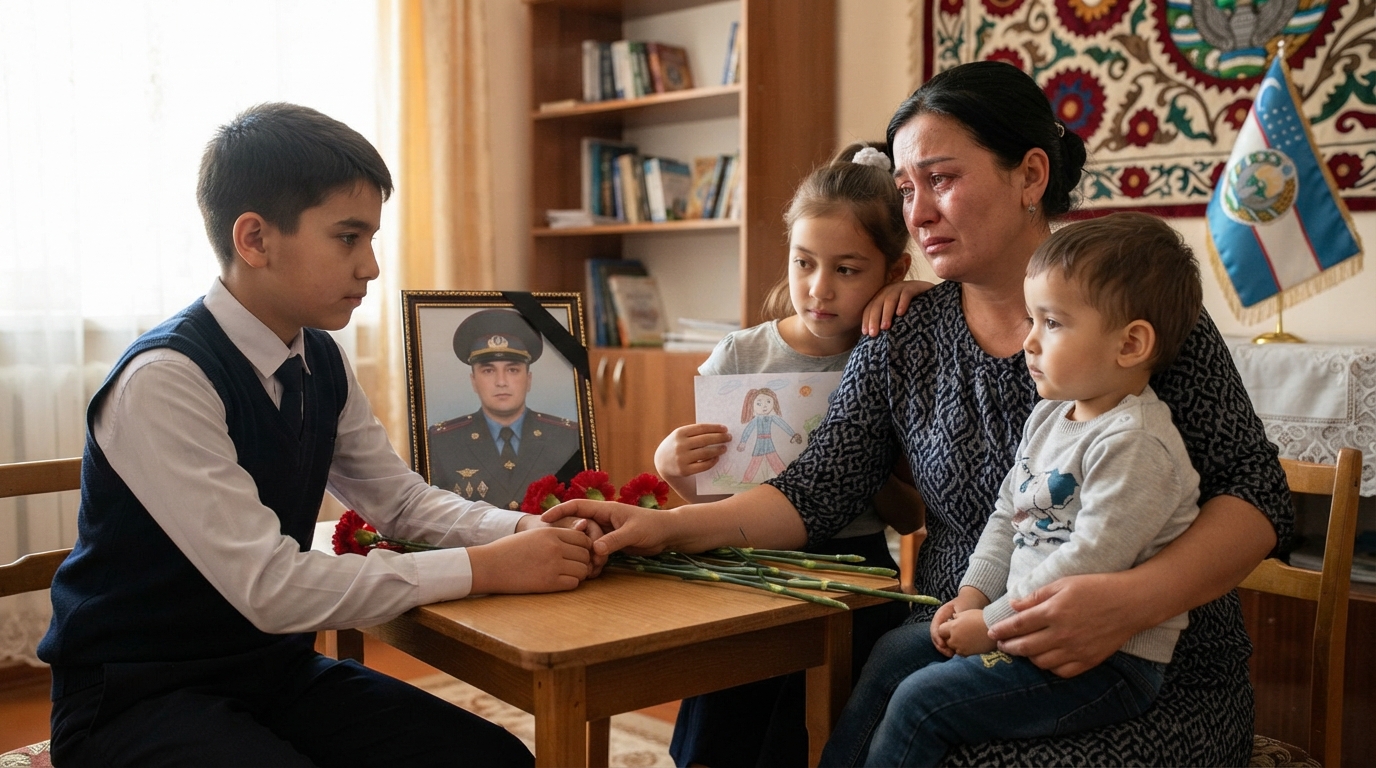
“Those who went to work and did not return alive.” Dedicated to the memory of internal affairs officers who tragically died in the line of duty
October 25 is Internal Affairs Officers’ Day. According to the Ministry of Internal Affairs, from independence to the present day, 127 internal affairs officers (IIO) have tragically died in the line of duty or in combat operations. Gazeta remembers 6 IIO officers who died between 2017 and 2025.
Among them are officers who lost their lives while putting out a fire, calming people arguing over water, stopping a high-speed drunk driver, and protecting a woman from her husband during a domestic dispute.
We remember the late senior lieutenant with his spouse, Dilbarxon Sotvoldiyeva.
The incident occurred at dusk on July 1, 2025. That day, I was at my mother’s house with the children. Around six in the evening, I spoke with my husband; he said, “I’ll pick you up on my way back from work, be ready.” I looked at the time, it was past eight, but there was no sign of him. At around nine, I called him myself. He didn’t pick up; I called many times, but there was no answer. My heart began to feel uneasy.
Usually, when I called my husband, if there was someone next to him, he would send a text message saying, “I’ll call back myself.” This time he neither picked up my phone nor wrote a text message. I panicked. As I was about to put the children to bed, my eldest son called. He was crying, saying “Mom.” When I asked what happened, is everything okay, he said,
“Mom, my father has died.”
I said, what are you saying, how could your father die, I spoke to him recently? He said, “I don’t know, someone killed him.”
I told my family, and my brother took me. My husband’s aunt called. She said, “Don’t panic, Dilraboxon, they took him to the emergency medical care center, he is still alive.” With those words I calmed down a bit, but my heart was still pounding, I wanted to get there faster. It is very hard both to tell and to imagine that state.
We hadn't reached the house yet when my brother said, “What shall we do, shall we pick up your mother-in-law too?” I replied, I don't know, we'll see according to the situation. When we arrived, the street was full of people, ambulances were standing there. “That's enough, stop, brother, let's go into the house,” I said. When I entered, my mother-in-law was wailing. Then I found out that my husband had already passed away.
It turns out there was a family. The husband came home drunk and caused a scandal at home, then the wife called the “neighborhood police officer.” At that moment, my husband’s shift was ending, he was coming off the night shift, and other officers on duty were supposed to go to the calls. But my husband had previously obtained a protection order for that woman and told her, “if there is any problem again, you call me.” That’s why she called my husband.
From what I heard, the argument started over 50 thousand soums. Either the husband or the wife asked for it, and they argued. The husband left saying, “I cannot kill you while I'm sober, I will come back drunk and kill you.” Meanwhile, the woman called the inspector, that is, my husband. He and the head of the mahalla set off together.
In the meantime, my mother-in-law called and asked, “are you coming for dinner?” He said, “Keep it poured, mom, there’s a quarrel, I’ll pass by there and come after that.” When they arrived, that man was walking behind his wife on the street.
My husband tried to stop him, going up to him saying “Brother, stop,” when he turned around and stabbed him in the heart area. A few seconds before this event, the mahalla head received a phone call and stepped slightly aside to answer it. Then my husband said, “uh, head!” When the head looked, my husband was on his knees.
Seeing him hunched over, thinking something had happened, or if he was kicked hard somewhere, he went up to him, and blood was gushing from his chest, from the heart area. While he was on his knees, the knife had moved upward, opening the heart area by five to ten centimeters.
Then the head screamed, and that man ran away. A young bride ran out and put a pillow, trying to stop the blood. A Nexia car came from somewhere. Before they could put him in it and reach the main road, he passed away smiling.
I went to the head. When I asked him to please tell me what his last words were, he said, “Honestly, daughter-in-law, when he plunged the knife in, he said ‘uh, head’. He didn’t say anything else besides that, but he passed away bravely, smiling.” The trial of that murderer took place, and he was sentenced to 19 years in prison.
Since the moment we buried my husband until now, it feels as if I hear his voice in my ear, as if he is calling me, as if he appears before my eyes. I keep asking my mother-in-law if someone called. She says no. I sit waiting as if he has gone on a long journey and is about to walk in.
I pamper my children and find a little comfort, but it is very difficult for my mother-in-law. She still hasn't recovered.
When she sees people in uniform on the street, she cannot control herself.
She is constantly falling ill, her blood pressure rises. A few days ago, we admitted her to the hospital. She had three daughters and one son; it is not easy to accept that she lost her only son.
My husband valued his parents very much. Our father passed away earlier; he never spoke loudly to our mother, never corrected her even if she said something wrong, always said yes when she asked him to do something, and never looked her straight in the eye.
He was also attentive to his sisters; even if he came home tired from work, he would sit and talk with them, and if they needed a ride, he would say, “Hurry up, get ready, I’ll take you myself.” He never said I’m tired, I need to rest.
We were classmates. We studied at the Faculty of Informatics and Information Technologies of Andijan State University. We loved each other for five years and got married. He never spoke harshly to me either, always calling me “mother of my children, mother of my children” and caring for my feelings.
Now our eldest child is 12, the middle one is 9, and the youngest is 2.5 years old. They know their father has passed away; as they are sensible enough, they don't ask. Sometimes when I can't bear it, hug his picture, and cry aloud, they come in saying,
“Don't cry, mom.”
When I ask my youngest how your father used to laugh, he imitates his laughter. When I ask where your father has gone, he says,
“My father is in heaven.”
Yesterday journalists came, and when I told my son that they were coming from your father’s workplace, he asked, “Grandpa, is my father coming?” When I said it's not your father, but his workplace, your father has left, he remarked, “Oh, my father is in heaven, isn't he?”
One day while we were sitting and eating, he said,
“Mom, let's go visit my father.”
Oh, where shall we go, I asked, and he said,
“Let's visit the cemetery.”
If we happen to drive past the cemetery in a car, he asks, “Let's get off and go inside to see my father.” My children grew up while still being infants.
My husband worked in the internal affairs sector for five years. If there were difficult situations, he wouldn't tell me. His phone was on 24 hours a day, whether at night or during the day, whatever time there was a call, he would leave. I am a teacher myself; in the morning he would drop me off at work first, and then leave himself.
We used to talk a lot. One day while chatting in the car, he laughed and said,
“Mother of my children, I will die soon, you will be rid of me.”
I also joked, “Why do you say rid of me? If you go into the ground, I will pull you down by your ears, and if you go to the sky, I will pull you down by your feet; don't think you'll be rid of me.” He had said something similar between laughs to my mother-in-law as well. I don't know whether a person senses their death or if one should be careful with every word.
Because we married for love, the two of us had many dreams. He fulfilled one big dream before he left. On May 8, taking my mother-in-law, the children, and our aunt, we visited Bukhara and Samarkand.
Wishing to “take my mother on a tour,” he had waited a long time for free time from work. Now I will fulfill the rest of our dreams myself.
We remember the late senior sergeant with his brother-in-law, Muzaffar Xolmurodov.
On July 8, 2024, my father was informed by the Traffic Safety Inspectorate (YHXB) that “Primov Elbek was brought to the Kashkadarya region emergency medical care with severe bodily injuries.” When we went to the hospital, he had been taken to the operating department. Two hours later, the doctors said “he didn't make it.”
When he stopped a drunk driver, the driver fled into the village; when my brother-in-law went after him to catch him, the driver severely injured him with a knife, first in the spleen, then in the heart area.
Photo: From the family's personal archive. Elbek Primov — first from the left.
It had not been long since they moved to a new yard in Karshi. The yard was not yet fully finished, and the street was also under repair. At around three o'clock, the heads of Kashkadarya YHXB and IIB, seeing that they had moved to a new yard, brought people for a community work day (hashar) to complete what was missing before the mourning. They worked until the funeral prayer the next morning. As for us, we came out of the morgue around six. The funeral prayer was read at nine.
Before YHXB, my brother-in-law worked in OMON (Special Purpose Police Unit).
He often participated in special operations. That is why he had the courage to go after a drunk man with a brave heart.
Also, the driver turned out to be a 58-year-old man. He probably didn't think that a person of this age would have a knife and cause harm.
The murderer was sentenced to 18 years and 5 months. According to senior officers, if they hadn't stopped the drunk driver, he might have run over the kindergarten children ahead at such a high speed.
He was my spoiled brother-in-law, a person with whom I could speak about anything freely. He was a very humble man. When he came home from work, if a neighbor on the street was digging in the field or repairing his house, he would change out of his uniform and immediately go out to help. He was always chatting, laughing, and making others laugh. His mother, brothers, and relatives say, “Until now, we imagine Elbek is at work.”
He has three sons. Currently, the eldest is in the 11th grade, the middle one is in the 6th grade, and the youngest is only 4 years old. He used to say, “I cannot see my children, being busy with work, I cannot get enough of seeing them.”
The youngest kept asking when my father would come, where he had gone. Finally, I took him to visit his grave and said, “Your father is here, he has passed away, now be children who do good deeds and bring prayers after him.” At that time, he shook me to the core, saying,
“Dad, I have come, I missed you. Come out, won't you see me? Otherwise, let me enter to you, so I can see you.”
For two years, I have been at my sister’s house every evening. The children fell ill, missed their father, and were hospitalized due to grief. My sister also experienced severe stress; there were no injections she didn't receive and no medicines she didn't take. In the end, even the doctors said to take her around the provinces so she would forget at least a little.
Elbek hated the concept of debt. According to my sister, leaving the house that morning, he did something he had never done before. He asked, “Do you owe anyone anything, from shops or anywhere?” When my sister said no, he reportedly said,
“Make sure, so that no one comes asking after I'm gone.”
At that time, my sister didn't even pay attention, but later she recalled and told it.
A day before he was stabbed, he spoke continuously with his children on Telegram. As if sensing it, he said, “My sons, whether I am there or not, you will be young men who walk beside the president, you will protect the president, you will protect the state. Never commit treason against the state, the president, or the people. Important people will come looking for you in the future.”
Elbek Primov's eldest son with former Minister of Internal Affairs Po‘lat Bobojonov.
Indeed, important people came looking for them. They came to his funeral; his sons met with former Minister of Internal Affairs Po‘lat Bobojonov. The current minister, Aziz Toshpo‘latov, also sent computers and gifts. They constantly check on them during every holiday.
Because his eldest son was tall, he used to tell him, “You will work in the State Security Service,” and he is currently working towards that. The middle one says he will be a prosecutor. He himself speaks distinctly and beautifully, just like prosecutors. The youngest says he will follow his father’s profession. Even now, he walks around wearing his father’s cap and holding his stick in his hand.
We remember the late private with his mother, Sanobar Shodmonova.
On December 19, 2017, I sent him off to work. That event happened during his night shift that day. He was the head of his team. As I was told, after the fire ended, he entered the house to inspect it; there was a hidden socket or extension cord near four folded mattresses piled in the corner, and without seeing it, his wet hand touched the mattress, and he was electrocuted.
He would run off saying, “Bless me, dear mother, so I can work well.” That day, he left taking such a blessing as well.
He went to the head of the street and came back again.
When I asked why he came back, he said, “Mother, I have little money, please bring me some money.” He used to bring his salary to me, saying, “You spend it yourself.” I gave him money, and then he left again, looking back repeatedly as he went.
All my relatives found out. My husband was in Russia; they told him too, and he set off at that time. Not knowing how to tell me, at one in the morning, my brothers-in-law and sisters-in-law took me away, saying “Alibek is not feeling well.” When I arrived, it was like that; my poor child had passed away on the road.
When they say he died bravely in defense of the Motherland, I say yes, fine, even if he lived a short life, he accomplished so much. But I still feel terrible; my child died young, he passed away before getting enough of his children. He had many dreams and intentions. He was the only son; there is no one to replace him. Here, even though ten years have passed, I suffer.
My Alibek grew up to be a very affectionate child; I used to hear only good things even from his school. After returning from service, he chose this path. When his father said we would educate him, we didn't want to send him away from us since he was our only son.
Even though we considered firefighting a difficult field, he wanted it himself. He admired his uncles and many of our relatives who worked as firefighters.
Because he drove a car well, his bosses would take him along on many calls. He worked for about 7 years.
His father worked abroad for about 25 years. Being the head of the family, the man, he took all the responsibility upon himself and fulfilled our needs. He was also very affectionate toward his three sisters.
He was a man of his word; he wouldn't leave a job he intended to do unfinished, and when work and other matters were on the scales, he would immediately dedicate himself to work. He always used to say, “I must not bring shame to my father, I must work well.” Before starting any difficult job, he would call once and say, “Don't worry about me, don't even call, I will do it and come out myself,” and then he would inform us himself saying, “I'm okay.”
In ten years, no one has forgotten him yet. His classmates and colleagues often check on us, they come in large numbers, and they haven't left us alone. Even though he is gone, I am still hearing words of gratitude to this day.
His daughter turned 13, and his son turned 10. They study at the school where their father studied. At that time, since his daughter was a bit older, when we told her, she understood. As for his son, he lived waiting, saying “my father will come,” and then after he fell ill from grieving, we taught him when he was 5 years old. We said, “Your father is not among us now, he sits looking at you from above, watching what you do.”
Thank God, they are sensible children, active in their studies. I hear only good things about them, just like about their father. They cry out of longing. We say, “You have your grandfathers, they are in your father’s place.” They understand. Both are studying English hard. His daughter says she will be a teacher, and his son says he will wear a uniform. Now whether we will have him wear a uniform or not, I don't know.
Sometimes I get upset with myself, thinking it would have been better if we had placed him in another job or if his father had taken him to Russia with himself. His little son looks just like him; I often think to myself that I am raising my child all over again.
May God grant that no brave son in service faces a situation like my child's; may their work prosper, and may they return safe and sound to the embrace of their families. May no parent go through what I went through. The grief of losing a child is truly terrible.
We remember the late senior lieutenant with his father, Inomjon Xaydarov.
On November 22, 2018, it was his younger brother’s birthday. In the evening at around six, he called and said, “Dad, did you buy a cake and stuff, or should I bring it?” I said, we bought it, my son, we prepared everything nicely, it's enough if you come. He said, “I am on duty today, don't wait for me, even if I come, I'll come late at night.” We waited until eleven, he didn't come, and thinking it was his usual duty shift, we went to sleep.
On the night of November 23, while performing their duties on a night raid, a group of five or six young men who had been drinking were standing together. It was past twelve o'clock, and when they told everyone to go home, they failed to comply and caused a fight. The young men were armed with solid iron objects, and they injured my son either with this iron or with a large stone.
When we got up for the morning prayer (Bomdod), my neighbor called, asking “Where is Ilhomjon?” I said he is on duty. When I called my son, his phone was turned off. About five minutes later, our neighbor called again.
“Brother, someone has hit Ilhomjon, I am currently in front of the police station, people have gathered, there are a lot of cars,” he said.
Then when we went out, they were interrogating those other young men who had hit him. One of their leaders came out and said, “His injury was severe, he has passed away, we apologize and wish you patience.”
He was extremely caring toward his relatives, always checking on them. He was quiet, listening more. His most distinguishing feature was that he was always smiling at people. Every time he left for work, he would hug his one-and-a-half-year-old daughter and play with her before leaving. I used to see him off to the street myself. Things that father and son wouldn't discuss at home, we would discuss on the street.
I would send him off with a blessing, saying, “Son, are you okay, are your affairs going well, take care of yourself.” My child left the world at the age of 29, in his most robust period. He had been practicing boxing since the eighth grade. After graduating from lyceum, he applied to the academy. Failing to enter in the first year, he went to the army. Serving in the border troops in Bukhara, he received a privilege and entered his studies the following year.
I worked in the tax field myself. Before he applied to study, I explained to him many times that working in the internal affairs sector, being an officer is not easy, that it is very hard, responsible, and dangerous work. He chose this field anyway, saying, “Dad, if dying is written on our forehead, then I will die serving the country.”
Even when he started working, I used to tell him, son, work honestly, walk straight, don't let a case (delo) linger in your hands; even if there is a single case to send to court, send it to court, and if there is a case for the prosecutor's office, send it there. He used to do so, and I was at peace.
I used to tell him to be careful when walking on the street, speak nicely to both a thief and an honest person; if someone has committed a crime, obtain the necessary information from them and send their material to the appropriate place, do not speak rudely, even if you speak nicely to a criminal, he will admit his own guilt. The phrase I said most often was probably “be careful.”
His classmates, colleagues, the regional department of internal affairs, and khokims often come to ask how we are doing. They always visit on holidays. His little daughter is also approaching 10 years old now.
In school, when she was called as Inomjonova Yasminaxon, daughter of Ilhomjon, one day she came, looked at me, and asked,
“Is my father dead?”
I said no, he isn't dead, your father’s name was previously Ilhomjon, now it is Dilyorbek. Her mother remarried, and my grandchild is with them. We haven't told the truth yet so that she doesn't lose affection for her father at home. But still, one day we will tell her.
We remember the late lieutenant with his mother, Mahbuba Ortiqova.
On Monday, August 14, 2017, I sent him to work. In the village, two people started a fight arguing over water, and his colleague couldn't handle it himself and called Doniyorjon for help. My son held one of them by the hand and said, “Come, brother, let's go outside, everyone is looking at you,” and as he was taking him out, that young man took a knife out from inside his sleeve and plunged it into my son’s heart. Over a trivial matter, over a bit of water, my son was gone.
The incident occurred around eleven o'clock in the morning. My husband had gone to the mosque for the noon prayer. Sometime later, I looked and saw him standing at the door around twelve o'clock. Good heavens, I wondered if he went to the mosque and came back without praying the noon prayer, and my brother-in-law’s son was also sitting in the courtyard. When I asked, “Oh, are you alright, is everything okay, what happened?”, they told me the news. I don't know what happened after that; suddenly I saw the street was full of people…
It is very hard when they bring back your strong child on a stretcher, lifeless, who walked out on his own in the morning. That day, taking a blessing as usual, he left for work. His daughter came out behind him and said, “Okay, dad, have a good trip,” and until he reached the turn, his daughter kept looking.
My poor child went away, waving his hand repeatedly to his daughter.
My eldest son also died at the hands of three such scoundrels when he turned eighteen. It has been 32 years since that too. For the second time, I experienced the grief of losing a child. Now you have no choice; they didn't say in vain that good people face days, but bad people face no death, so what could we do.
The man who stabbed him was young, had two children, had committed many crimes, and had been convicted about four times. He was sentenced to 18.5 years. Now, if his soul remains inside him, he will walk out one day. Mine is gone, mixed with the earth.
They buried my child who had turned 29. His daughter was 2 years old then, and now she is studying in the fifth grade. Her mother remarried, and my grandchild went with her. From time to time she comes to check on us. When neighbors ask, “Oh, whose daughter is this little girl?”, she says,
“First of all, I am Doniyorjon’s daughter, and then the others'.”
My child’s drive was extremely strong. Seeing his father and me struggling working on the collective farm to raise seven children, he constantly strived, saying, “We will compensate from this end for the struggles you faced,” and entered TATU to study.
I used to hear praise from his teachers as well. After graduating, he taught at a school for three years. Dreaming of joining the internal affairs, he was interested in it. Then he moved into that field.
Now whomever I run into, they fondly remember him saying, oh, my brother so-and-so. Even the old men in Oltiariq where he served came to our home, said many good things about him, and left after praying.
Doniyor Ortiqov's daughter. Photo: From the family's personal archive.
He never brought home difficulties or bad news from his work.
My poor child only brought good news, saying,
“Mother, look, here taxi drivers offer free rides until noon on Fridays,”
such-and-such good thing happened in such-and-such place.
May God grant health to the young men and women working in this field, and grant abundance to their lives and sustenance. May what they earn be blessed for weddings and good days. May He protect them from bad accidents!
We remember the late major with his spouse, Zahro Mardonqulova.
My husband came home for lunch on August 26, 2024. He was always in a hurry, ate his food hurriedly, and left quickly.
For some reason, that day he did not rush.
I was washing clothes in the yard. Seeing that the apples and pears he had grafted himself in the spring had turned into trees, he spoke happily about it.
“We will make our eldest son a pilot, educate him in the aviation field, transfer Javohirjon to a private school, it provides strong knowledge, over 90 percent of its students get into university,” he said. I was also happy thinking my child would study in an even better school. Usually, we couldn't sit and talk so freely and calmly. Then he left, saying, “I am on duty today.”
Whenever he found time, he always ate at home and did not eat street food. Since he was on duty, wanting to prepare for dinner, I cooked bean pilaf, which he liked. My mother-in-law and I sat waiting. He arrived and said, “I'm in a hurry, I'll eat quickly and return.”
In a moment, a call came. He got into the service car and left. Every time I said goodbye, I would quickly go inside, but this time, as if my heart sensed it, I think I stood looking after him until he disappeared from view.
Doniyor Mardonqulov with his spouse. Photo: Family's personal archive.
Around ten or eleven in the evening, after putting the children to sleep, when I went out into the yard, my uncle and sisters-in-law walked in.
They said,
“Get dressed and come out, we are going somewhere.”
My heart sank. I understood that something had happened to my husband. Even then, not wanting to think of the most terrifying thing, I thought if there was a car accident, his arms or legs might be bruised.
We were on the road, no one was telling us where we were going, and I was crying continuously. We stopped at a place, the people in the car got out and entered a building. I also got out slowly, and when I read the sign on the building, it was written:
Kokand City Forensic Medical Examination.
Even then I thought that if his injury was deep, they might have brought him for examination. Again they didn't say anything, and then we returned. When I came home, seeing my uncles wearing robes and tying waist scarves, I was devastated.
Then we heard what actually happened. He was supposed to check if a person serving a sentence not related to deprivation of liberty was complying with the sentence procedure. When he went, that man was out.
When he asked his family “where is he?”, they said he went out to the field. While he was asking, “He was supposed to sit at home at this time, why did he leave?”, the man himself walked in. They started shouting, “Why are you checking us?”
It turned out that man was drunk or had smoked some kind of weed. He came out of the kitchen carrying a knife and stabbed my husband. Trying to defend himself, when he tried to get his baton from his car, the man struck his chest with the knife, this time hitting the heart.
They searched for an ambulance, but there was no ambulance in the village. The youth leader beside him put him in his own car and drove away. He was saying something to the leader on the way when suddenly his voice fell silent, and his phone dropped limply from his hand. At that moment, he passed away.
He was serious and quiet among people, but an open person in the circle of his close ones. I say this not because I was his spouse, but because I truly admired him: he was a very honest man.
He always rejected cases involving bribes or money.
Never using his position or name, he chose to live simply. Seeing everyone as equal, he treated everyone the same.
He was a very orderly person who demanded cleanliness. He would arrive at the stated place at the stated time, neatly stack his work documents at home, and complete his unfinished work even if it meant setting aside food and sleep.
A policeman's wife is also a soldier. You stand ready for any situation. If a “trevoga” (alarm) is sounded, you jump up immediately like a soldier, prepare things, and wait without sleeping. No matter how arduous it was, my husband’s profession became my profession too, a part of my life.
He used to express his wish, saying, “When I retire, I will walk around as a super granddad.” He was very affectionate toward his siblings. He left without hurting his mother’s heart, and I live with peace of mind about that. He was also my mother’s favorite son-in-law.
We have three children. My eldest son is 15, my daughter is 12, and my youngest son is 10 years old. He viewed all of them equally, and because he had only one daughter, he pampered her a lot. Whenever he had free time, we would take the children and go for a drive to the riverbank or the mountains.
He used to say, “When I retire, I will take you on wonderful trips, take you to many places.” If he had one day off a month, he would spend even that with the children. When our children were small, they saw their father very little. He would leave when they were sleeping, and walk in when they were sleeping again.
My older ones try not to show their crying so I don't get distressed. But when their hearts are full, arguing with each other, even finding an excuse to throw themselves this way and that, they cry saying,
“I miss you, dear dad.”
I let them be, saying let them release what's inside them. His absence is felt every moment.
The day before the funeral, in my imagination, it felt as if life had ended. Even when they said, “Go in, say goodbye and come out,” I cried saying I won't go in, take me up to the mountains and rocks. As if if I didn't recognize his funeral ceremonies, my husband wouldn't be dead either, and the thought passed that he would walk in. I thought if I saw his body, I would believe he was dead. But still, I said goodbye in the morning.
For a long time, I was unwell and received treatment. Azizbek Ikromov, who is currently the Minister of Emergency Situations, was then the head of the Fergana Region IIB. One day he came to our home and said, “Your husband died for the peace of this country. Now do not think you are alone; behind you stands the Ministry of Internal Affairs, the whole of Uzbekistan, and we will always support you.” That statement gave me considerable strength and encouragement, and I tried to pull myself together.
Both our house and car were bought on credit. I was consumed with anxiety thinking my husband had so many debts behind him, how his accounting would be, and that I needed to close them quickly. Azizbek Ikromov also handed me the document showing that the loans for the car and house were paid off. Thank God his debt did not remain on his shoulders.
Former MIA head Po‘lat Bobojonov, minister's advisor Zokirjon Almatov, and IIO officers with the family of the late Nodirbek Mardonqulov.
Whatever happens, one has to continue for the children. I moved into the house my husband bought and opened a small clothing manufacturing enterprise. We also export our products abroad. I will try my best to fulfill my husband’s intentions, striving to raise our children into the kind of people he wanted to see them as.
We were companions to each other for nearly 15 years. In my Quran recitations and prayers, I often ask Almighty Allah to count my husband among the martyrs. May his afterlife be prosperous!