

Why don't internal affairs officers who violate the law apologize in public? MIA explanation
In 9 months, 18 cases spread on networks regarding the activities of internal affairs officers were confirmed. At an event involving the leadership of the Ministry of Internal Affairs, a question was asked as to why officers who broke the law do not apologize in public. "Publicly apologizing is not included as a type of punishment," a representative of the ministry said.
Why don't internal affairs officers who break the law apologize publicly? MIA's explanation
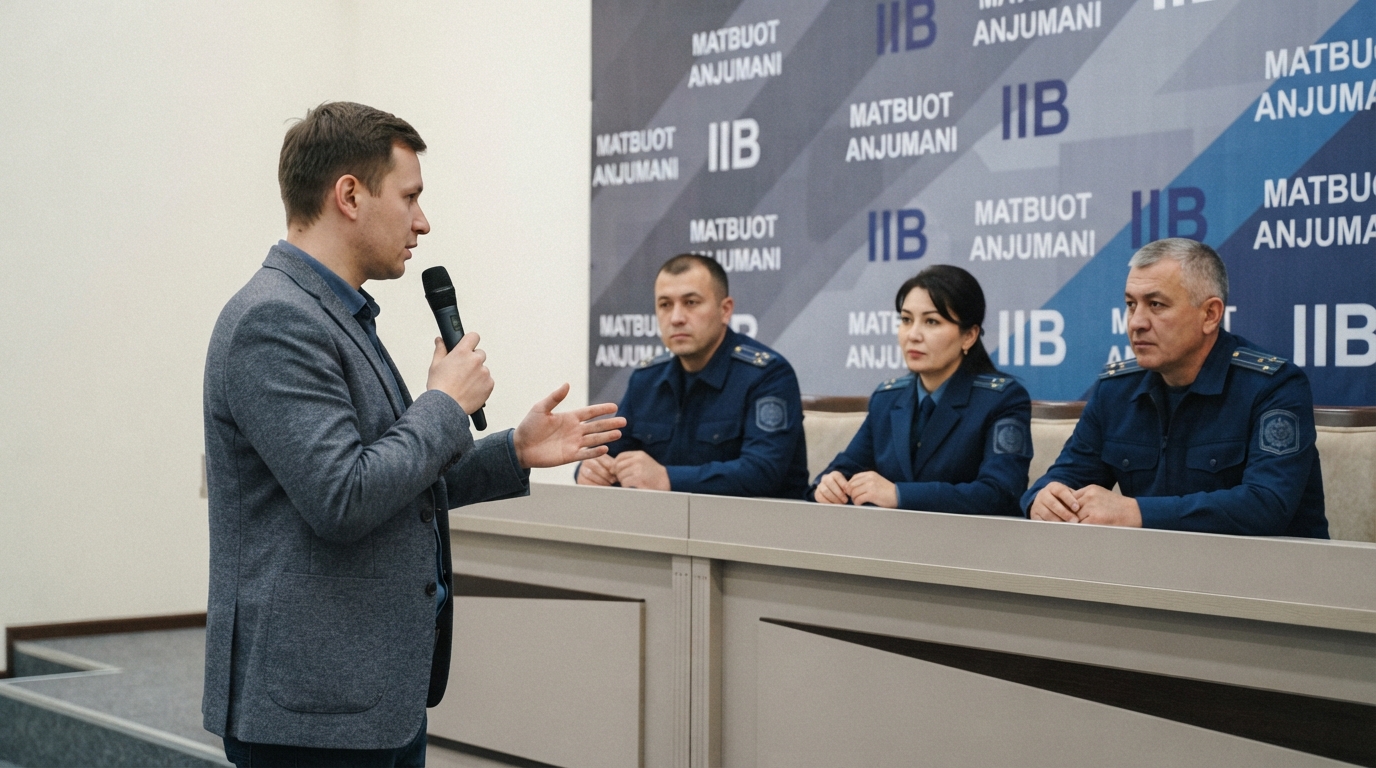
In the first nine months of 2026, nearly 8,000 wanted persons were detained, and 4,863 missing people were returned to their families. This was reported at a press conference held at the Content Preparation Center on October 9 with the participation of the leadership of the Ministry of Internal Affairs (MIA), Gazeta's correspondent reports.
According to Ramazon Ashrapov, certain types of crime decreased during the reporting period. Namely, 24,828 preventable crimes were recorded in January–September. This figure is 4,021 less compared to the same period last year.
In particular, crimes involving youth decreased by 24 percent, crimes by women by 20.7 percent, and crimes committed by unemployed citizens by 21.1 percent. Crimes involving minors decreased by 5.5 percent, crimes committed while intoxicated by 5.4 percent, and crimes committed by previously convicted persons by 8 percent.
"In nine months, 31,917 crimes were detected on the initiative of officers in the territory of our country, improving this practice by 31.2 percent," he said.
According to him, 13,293 crimes related to narcotic drugs and psychotropic substances were detected. 3 tons and 357 kilograms of narcotics were seized from illicit trafficking, and plants on an area of 17,120 square meters where narcotics were grown were destroyed. Also, the distribution among the population of 2 million 773 thousand controlled medicines was prevented.
During operational measures, 19 illegal laboratories producing narcotics were identified. In addition, the activities of 122 organized drug crime groups were suppressed.
In the direction of combating organized crime, 5,264 crimes were recorded. Of these, 2,585 were related to procuring, 165 to human trafficking, and 1,450 to illegal weapons. 790 cases related to the violation of administrative supervision rules were also detected.
Within the framework of the fight against corruption, 6,293 crimes were solved. Of these, 1,441 were related to taking or giving bribes, 2,166 to embezzlement and misappropriation, 387 to illegal currency operations, and 1,603 to fraud.
"Over 20,000 previously committed and unsolved crimes were solved by our operational services," Ashrapov said.
According to him, nearly 8,000 wanted persons hiding from court and investigative bodies were detained. 4,863 persons missing due to various reasons were returned to their families. During the reporting period, 1,404 crimes related to terrorism and extremism were detected, and legal measures were taken.
Mansur Qodirov said that this year, under the "Second Chance" project, 350 convicts serving sentences are being trained in modern professions and foreign languages.
"17 inmates in the educational colony were admitted to higher education institutions based on distance learning. They are studying at various universities in the prescribed manner," Qodirov said.
Rahimjon Naimov stated that currently, offenses related to domestic disputes and petty hooliganism are observed more often.
According to him, family disagreements, mistrust, and suspicions between spouses cause conflicts. To prevent such cases, prevention inspectors study the situation in families and try to identify problems early between spouses, mother-in-law and daughter-in-law, and close relatives.
"In nine months, we issued nearly 200,000 protection orders to women," he said.
He noted that conflicts in public places also sometimes lead to offenses and crimes. For example, insults and fights can arise from not giving way to another driver on the road.
"Cases of showing disrespect to someone on the street, getting out of the car as a result of not giving way and insulting another citizen are leading to crime," he said.
To prevent such cases, patrol service officers have strengthened patrolling in crowded places. Prevention inspectors are conducting explanatory work in markets, parks, and other public places.
At the press conference, one of the journalists asked for clarification regarding the dissemination of videos showing offending citizens apologizing publicly, while measures taken against MIA officers who broke the law are not disclosed. In particular, a question was asked about what measures are taken against Traffic Safety Service (TSS) officers accused of groundlessly punishing drivers in violation of traffic rules.
According to Saxipjamol Joldasova, if it is established that the requirements of the law were violated in an officer's actions, an internal investigation is conducted.
"Since public apology is not a form of disciplinary or other punishment, we have not established such a practice," Joldasova said.
According to her, the officer's actions are given a legal assessment, and an appropriate disciplinary measure is applied depending on the severity of the violation. If signs of a crime are identified in the actions, the materials are sent to the prosecutor's office. If necessary, the matter is also considered in court.
Joldasova said that work is also underway to improve the communication skills of traffic safety service officers and offense prevention inspectors with citizens.
"Training has also been established regarding external service officers working with bloggers and responding when asked unexpected questions," she said.
Shohruh G'iyosov reported that in the nine months of 2026, 245 negative reports related to internal affairs officers were spread on social networks.
"In only 18 of these cases, that is, 7 percent, did our officers actually commit inappropriate actions," G'iyosov said.
He noted that videos shared on social networks may show only a part of the incident. After measures are taken against some citizens for violating traffic rules, they film the officers and distribute the videos in a negative interpretation.
G'iyosov emphasized that it is not correct to always evaluate an officer's inability to answer questions in front of the camera as a sign of a violation.
"When an officer suddenly faces questions in front of a camera, they may stutter and not know what to say. This is a psychological condition. This alone does not mean the officer is at fault," he said.
Ozodbek Jo'raboyev stated that the ministry does not force citizens to apologize publicly. Such videos, according to him, are distributed to answer public questions about what measures were taken for the violation.
"We do not bring anyone out to make them apologize," Jo'raboyev said.
He explained that repentance for a deed can be taken into account when imposing a punishment. Therefore, a citizen's voluntary apology matters in the sentencing process.
Jo'raboyev emphasized that the lack of separate reports on social networks about measures taken against officers does not mean that their actions are not being investigated.
According to him, a report drawn up for a violation of traffic rules is not a final decision. The document is reviewed at subsequent stages. If shortcomings are identified in it, the report may be returned and an internal investigation conducted into the officer's actions. If a citizen is dissatisfied with the officer's actions, the matter may also be considered in court.
"Just because you didn't see it doesn't mean work isn't going on here. Every case is analyzed," Jo'raboyev said.
He noted that the ministry does not have the capacity to provide separate reports on measures taken against each officer. However, every case is considered in accordance with the established procedure.