

Those who walk faster had a 17 percent lower risk of death
It was found that a faster walking pace in daily life is associated with a lower risk of death. In a study involving more than four thousand people, a usual walking pace that was 10 steps per minute higher corresponded to a 17 percent lower relative risk of all-cause mortality. This association persisted even after accounting for age, lifestyle, and other health-related factors.
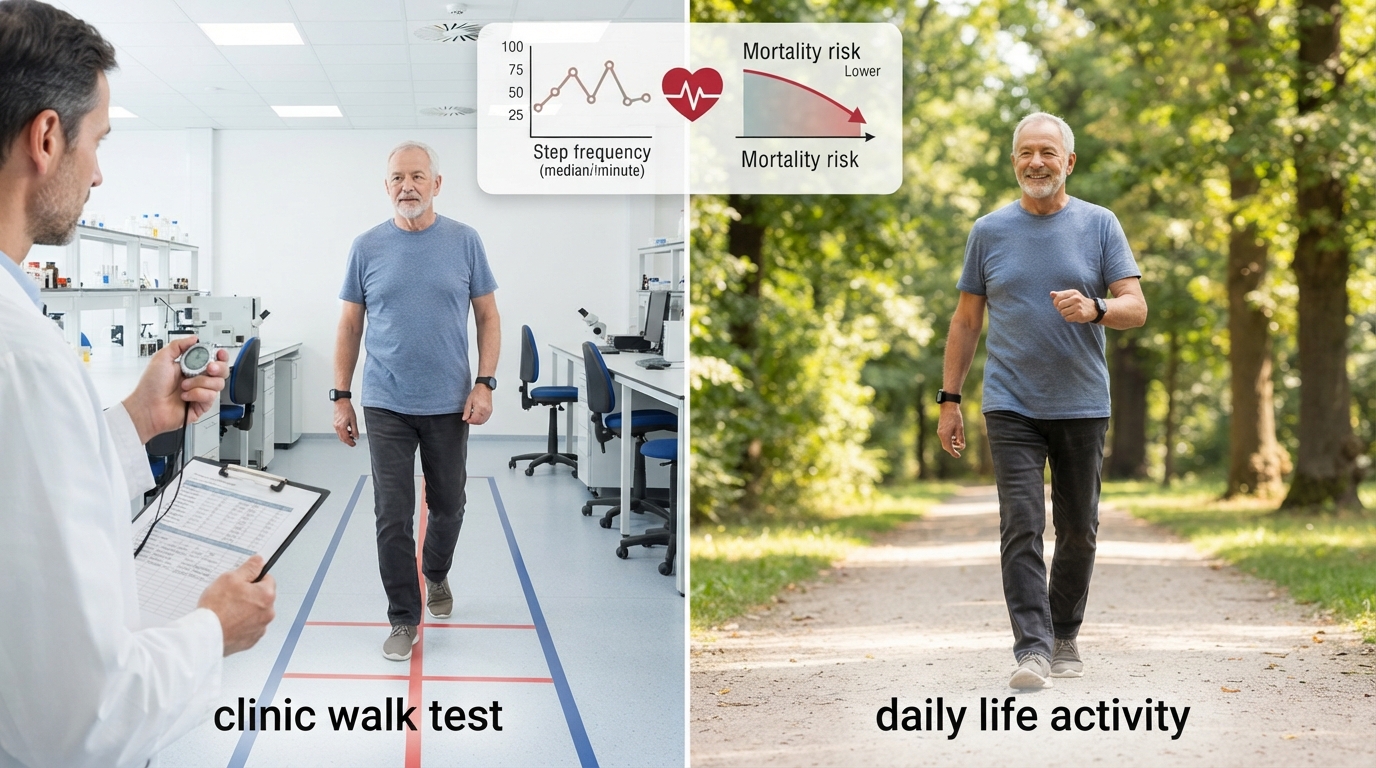
Faster walkers showed a 17 percent lower risk of death
Not only medical check-ups, but also a person's daily movements can provide information about their health. An international team of researchers has shown that the step frequency recorded by a wrist-worn sensor yields results close to a short clinical walking test in assessing the risk of death.
The results of the study were published in the journal JAMA Network Open. Representatives from the Norwegian University of Science and Technology, France's National Research Institute for Agriculture, Food and Environment, the UK's University of Leicester, and other European scientific institutions participated in it.
Walking reflects the combined work of the muscular, articular, nervous, and cardiovascular systems. With age, the pace of movement can change due to chronic diseases, decreased physical endurance, and other problems.
Therefore, walking speed is considered one of the indicators of the overall state of the body. It is also used to assess negative health outcomes, including the risk of death.
However, a short clinical test shows how a person walks at that exact moment. This result may not fully reflect their movement in daily life.
The scientists therefore compared two methods: measuring walking speed in a standard test and counting the number of steps taken per minute in routine life.
The analysis included 4,067 participants from the Whitehall II project in the UK. At the time the measurements were taken in 2012–2013, their average age was 69.3 years. Men made up 74.4 percent of the participants.
In the clinical trial, volunteers were asked to walk a distance of 2.44 meters at their normal pace. They were instructed to walk as if they were going about their business on the street. The test was repeated three times, and the average speed was calculated.
To evaluate daily physical activity, participants wore an accelerometer on their wrist for nine days. This is a sensor that records movement.
Participants who had valid recordings for at least one day were included in the analysis. An average of 7.9 days of usable data was collected for each person.
Based on the sensor recordings, two indicators were calculated. The first is the median step frequency. This is the middle value when the recorded walking speeds are arranged in order, helping to represent a person's typical walking pace.