

Thieves steal 600-diamond necklace from Vienna museum in broad daylight
Police are hunting two suspects they believe bought a ticket for the exhibition to get at the jewellery.
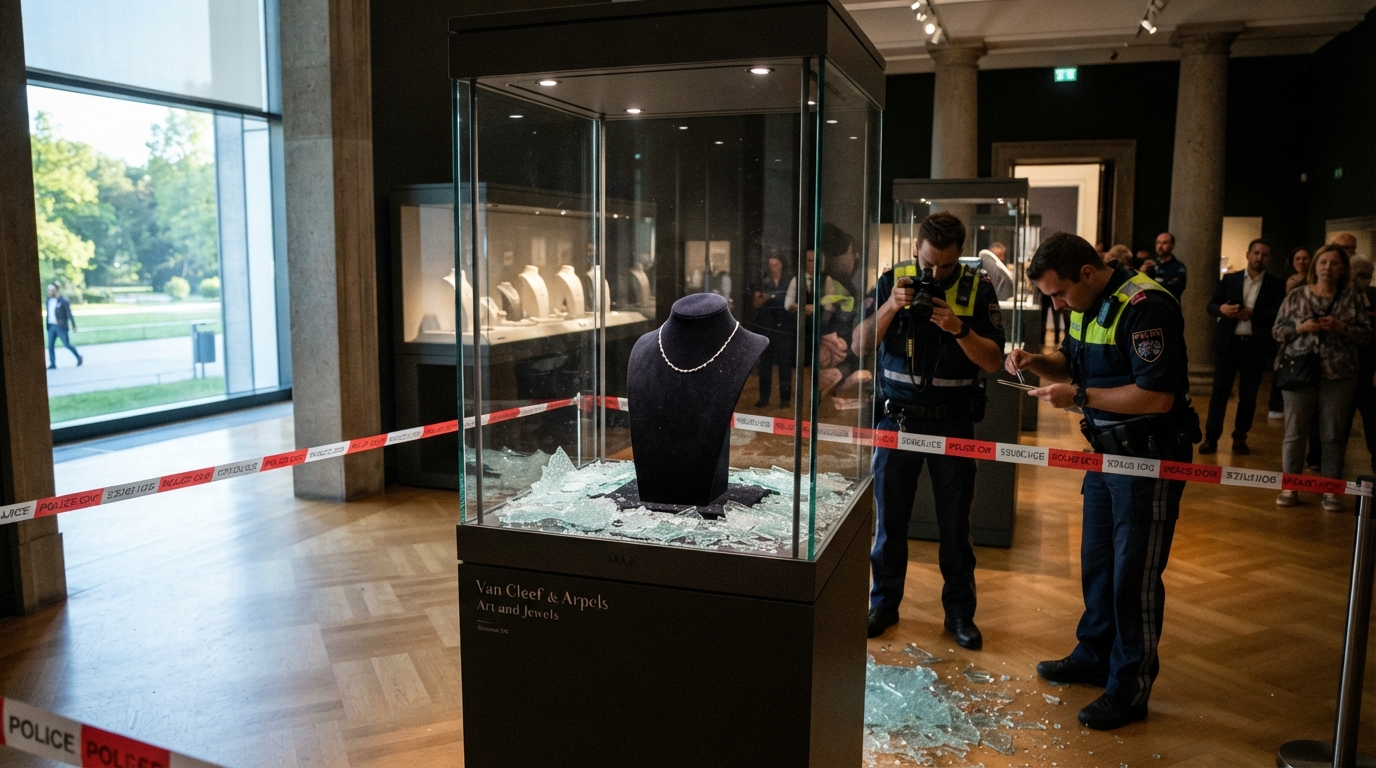
A global search is underway for two individuals who purloined a necklace adorned with over 600 diamonds from a Viennese museum in broad daylight, having first purchased entry to the exhibit.
According to police, the two suspects shattered a glass display case at the Vienna Museum of Applied Arts (MAK) on Thursday afternoon, making off with the platinum and diamond necklace, estimated to be worth more than $4 million (£3 million; €3.5 million).
The necklace, originally crafted for the former Egyptian royal family, was a centerpiece of an exhibition on the jewelers Van Cleef & Arpels, which was scheduled to run at MAK until September.
This theft marks the latest in a series of high-profile heists of artifacts from European museums.
Viennese police have released security camera images of the two unmasked suspects and are urging the public to provide any relevant information.
In a statement, police indicated that one of the perpetrators was also believed to be carrying what appeared to be a real firearm.
After seizing the necklace, they reportedly fled "towards the Vienna Stadtpark," located just south of the museum.
The necklace, weighing over 200 carats, was famously worn by Queen Nazli in 1939 for her daughter Fawzia's marriage to Mohammad Reza Pahlavi, who would become the future Shah of Iran.
Lilli Hollein, MAK general director, expressed that "the theft of a highly valuable piece of jewellery... has hit us hard."
She stated that MAK had collaborated with Van Cleef & Arpels to develop a specific security plan for the exhibition, emphasizing: "Security issues were taken very seriously and all security measures were carefully prepared."
Hollein confirmed that staff responded calmly and adhered to established protocols during the "armed incident," and that no one sustained injuries.
She added that MAK had thoroughly reviewed its security measures prior to the exhibition, "particularly in light of the incidents at major museums in recent years."
Also on Thursday, a significant collection of prehistoric jewelry and artifacts was stolen from a Spanish museum.
Earlier this month, four Renaissance paintings were stolen from a museum in Sicily, while three paintings by Renoir, Cézanne, and Matisse, valued at millions of euros, were taken from a museum in Parma earlier in the year.
These incidents follow a brazen daylight raid on the Louvre in Paris last October, where a masked gang stole priceless jewels.
The exhibition, excluding the stolen necklace, reopened later on Friday.
The recent spate of thefts has raised concerns about the security of European cultural institutions.
Europol noted that museum thefts are "becoming increasingly aggressive, with a shift towards violent and forceful methods," suggesting this "may indicate the involvement of new criminal networks."
The necklace stolen in Vienna on Friday was designed for the former Egyptian royal family and was worn by Queen Nazli in 1939 for the marriage of her daughter Fawzia to Mohammad Reza Pahlavi, the future Shah of Iran.
Van Cleef & Arpels describes it as a "triumph of white jewellery," with its diamonds exceeding 200 carats in weight.
When it was auctioned a decade ago, its estimated worth ranged from $3.6 million to $4.6 million.
Police dog units have been deployed in Vienna and the province of Lower Austria, while forensic experts are analyzing evidence and CCTV footage.
The exhibition has since reopened.