

There are 2 million robots in China, but the leader is different: who is ahead in factory robotization?
Although China has a huge figure in terms of the total number of industrial robots, South Korea leads in the level of robotization relative to the number of workers. In this country, there are 1,220 robots for every 10,000 employees in the manufacturing industry - more than nine times the world average.
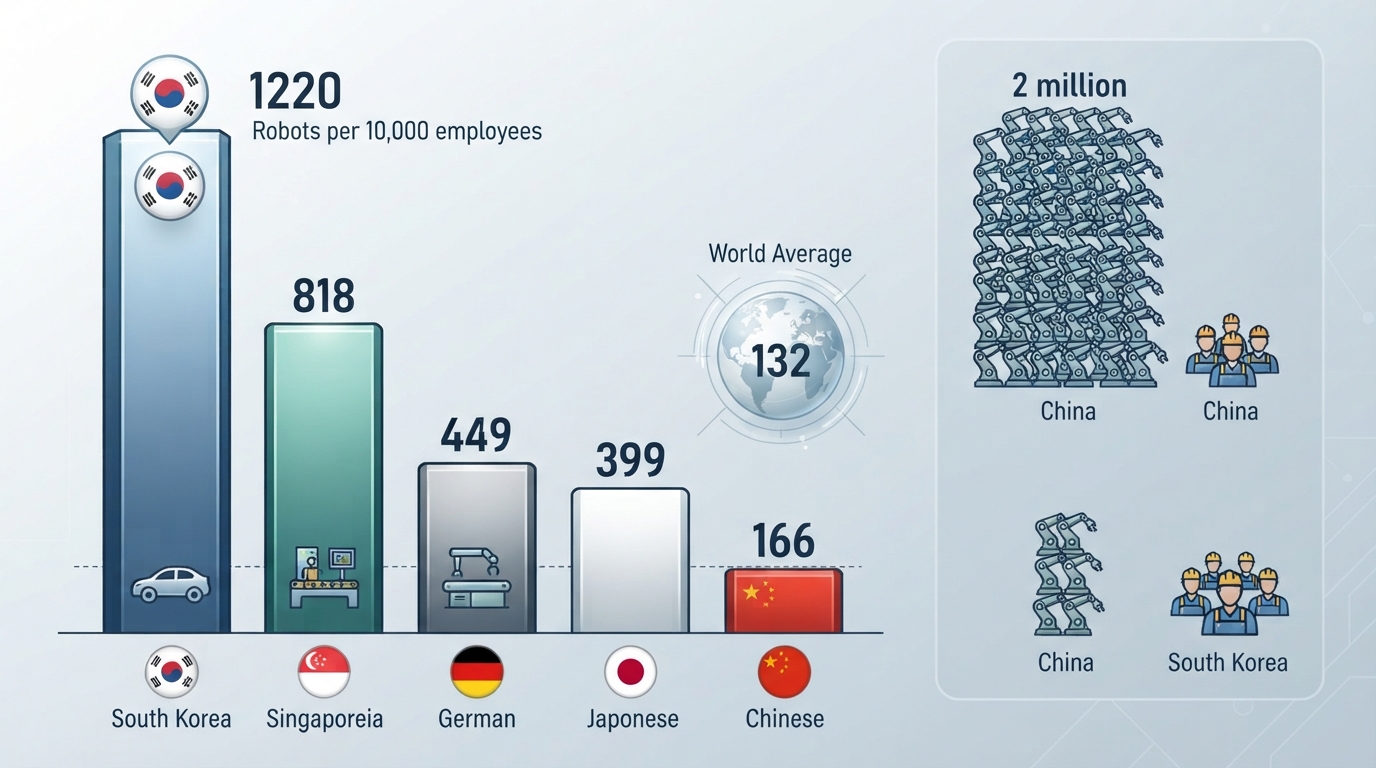
There are 2 million robots in China, but the leader is different: who is ahead in factory robotization?
The Visual Capitalist infographic compiles the 22 economies with the highest level of manufacturing robotization. The ranking was published by the International Federation of Robotics (IFR) in April 2026 and is based on 2024 data.
Here, it is not the total number of robots in the country that is taken into account, but how many industrial robots there are for every 10,000 employees working in the manufacturing industry.
Industrial robots perform tasks such as welding car bodies, assembling electronics, and packaging products. However, a high number of robots does not mean that a country is also a leader in this specific relative indicator.
South Korea and Singapore are ahead
In South Korea, there are 1,220 robots for every 10,000 industrial employees. The global average is 132.
In second-placed Singapore, there were 818 robots for every 10,000 employees. This is almost twice as high as the figure for third-placed Germany, where the number stood at 449.
The electronics and automotive industries are highly developed in South Korea. These two sectors are the world's largest consumers of industrial robots. In 2024, nearly half of the newly installed robots worldwide were accounted for by these industries.
Another factor driving automation is the demographic situation. According to the source, in 2025, the total fertility rate in South Korea was 0.75 children per woman. This is one of the lowest rates in the world, and manufacturers are facing a shrinking labor force.
A similar situation is observed in Singapore. In this country, which has a relatively small number of employees in the manufacturing industry, the fertility rate is 0.96 children per woman.
Why is China not the leader?
In 2024, nearly 2 million industrial robots were operating in China. This is equivalent to approximately 43 percent of all industrial robots in use worldwide.
However, a very large number of people work in the country's manufacturing industry. For this reason, the number of robots per 10,000 employees was 166.