

The young women guiding tourists through India's night sky
Astronomy tourism is giving young women in Hanle income, confidence and a new role in their community.
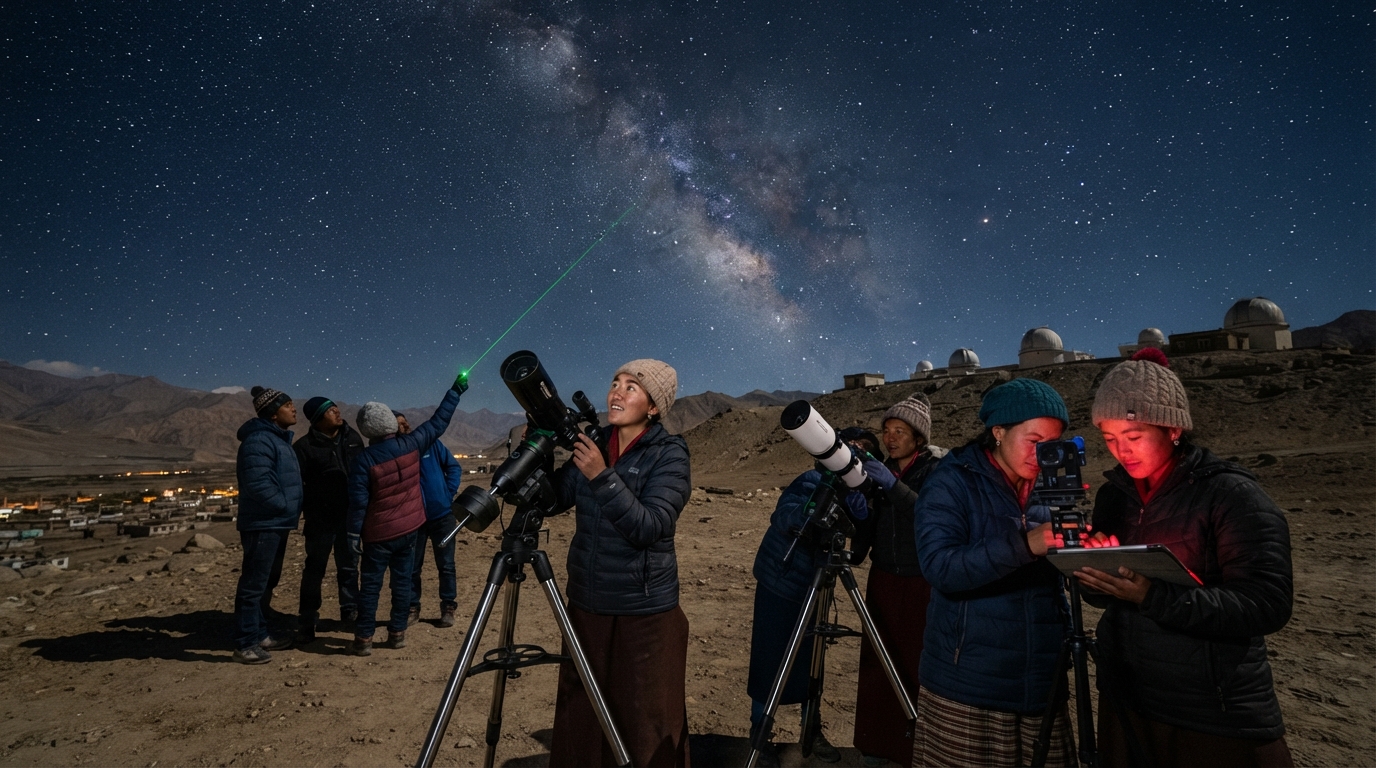
The young women guiding tourists through India's night sky
It is 10pm and freezing in Hanle.
Powerful winds blow across this isolated village in India’s Himalayan Ladakh region, but nobody appears bothered. Dinner is finished, yet instead of heading to bed, many residents are gathering outdoors.
The reason is overhead.
At 14,764ft (4,500m) above sea level, Hanle is famed for its exceptionally clear, dark skies. Bundled in heavy jackets, woollen hats and gloves, tourists and visitors come to admire the Milky Way and peer through telescopes at planets, the Moon and faraway stars.
Among them are four young women: Palzes Angmo, Tsering Dolker, Tsering Yangdol and Padma Chamchot.
They are Hanle’s astro-ambassadors, trained to lead visitors through the night sky.
By day, they cook meals, clean rooms and care for guests at their family-run homestays. By night, they set up telescopes, point out constellations with laser pointers and explain what visitors are seeing in the dark sky.
All four women are in their late 20s and grew up looking at these stars, but only a few years ago did they learn to observe them through a telescope.
“The sky here has always been twinkling like this,” says 28-year-old Dolker.
What has changed is that people now travel hundreds of kilometres to see what locals have long considered a normal part of life.
Hanle’s remote, high-altitude setting, dry air and lack of light pollution make its skies highly valued by astronomers. The cold desert provides suitable observing conditions on about 260 nights each year.
Hanle is also home to the Indian Astronomical Observatory, operated by the Indian Institute of Astrophysics, and is an important hub for astronomical research. In 2022, it became India’s first Dark Sky Reserve, helping shield its pristine skies from artificial light and placing Hanle on the astronomy tourism map.
Visitor numbers have since risen sharply: from around 3,000 a year five years ago to nearly 30,000 in 2024-25, according to government figures.
As the number of visitors increased, so did opportunities for local people.
In 2022, the Ladakh administration and the Indian Institute of Astrophysics trained 24 young people from Hanle and nearby villages in astronomy. These four women were among them.
Over 15 days, they learned to identify stars, planets and constellations, navigate the night sky, operate telescopes and photograph the Milky Way on their phones.
Becoming astronomy guides had never been part of their plans. They were anxious when they first used the equipment, worried they might damage something. Slowly, they learned how it worked and became more confident using it.
Hanle was designated as India’s first dark sky reserve in 2022.
Four years later, they are confident astronomers, with their evenings starting at around 9pm.
They set up telescopes for the night’s planets and constellations before guiding visitors from local homestays.
They show them the Moon’s craters, Saturn’s rings, Vega - the brightest star in the night sky - and other planets, using laser pointers to trace constellations and objects visible to the naked eye.
Then comes the Milky Way. At 11pm every night, the village turns off its lights, dropping Hanle into darkness as visitors rush to photograph the now-brilliant galaxy.
“When people look through the telescope and capture a photo alongside the Milky Way, they experience immense joy. We also help them with their mobile phone settings so they can capture the Milky Way,” says Padma Chamchot.
It often begins with helping one visitor take a photo and ends with a long queue. The women also take pictures for their own social media, comparing notes on the stars and other sights they captured that night.
The women also point laser at the sky to help visitors spot stars visible to the naked eye.
But by day, life is more ordinary.
Hanle has few hotels and no resorts, so visitors mostly stay in family-run homestays, often extensions of people’s homes. Chamchot’s family runs one too.
“Taking care of guests, cooking meals, cleaning rooms, and managing household chores fills our day,” she says.
“From nine in the evening, we begin setting up the telescopes for the night’s stargazing sessions.”
Their families’ homestays remain the main source of income, but the women earn about 25,000 rupees ($260; £193) a month from astronomy, charging 200 rupees a session. Earnings fall during the severe winter, when few tourists come, but the money has given them greater financial independence: they no longer need to ask their parents for money.
“We can save our earnings and spend them on things we want - including new phones,” Padma says.
For the astro-ambassadors, the change has been personal as well as financial.
“Before taking on this work, we lacked confidence,” they say.
However, Hanle’s growing popularity also brings risks. The same tourism that supports local livelihoods could also endanger the darkness that makes Hanle special.
Rapid construction and rising tourism also poses a threat to Hanle’s dark skies.
Visitor numbers have surged, driven in part by social media posts about Hanle’s night skies and its location on the route to Umling La, which is among the world’s highest motorable mountain passes. But more tourists also mean more traffic, construction and artificial light - all threats to the darkness they come to see.
Sonam Jorphail, a senior engineer and head of outreach at the IAO, says tourism is creating jobs and encouraging development in Hanle, but growth must be managed to protect its dark skies.
“They bridge the gap between the science community and common people - locals and visitors,” Jorphail adds.
But longtime residents say Hanle’s night sky is already changing. Padma’s father, Dhuntup Chamchot, in his 70s, remembers when the skies were even darker.
“Back then, when the weather was good, people would often sleep outdoors under the open sky,” he says.
The young women often take their families stargazing too.
“We frequently show the night sky to our families through the telescope. They enjoy looking at it now,” says Yangdol, one of the astro-ambassadors. “If one of us takes even a single day off, the families ask why the telescope was not set up,” she jokes.
The women say they have no wish to leave Hanle or its dark skies. They hope for advanced training and better telescopes and eyepieces to improve visitors’ experience.
Four years ago, the equipment was unfamiliar; now, they are building a future around the stars.