

Uzbekistan launches all-sky telescope at Maidanak
A new 31-module telescope at Uzbekistan’s Maidanak Observatory will monitor near-Earth objects and process up to 7 terabytes of data daily.
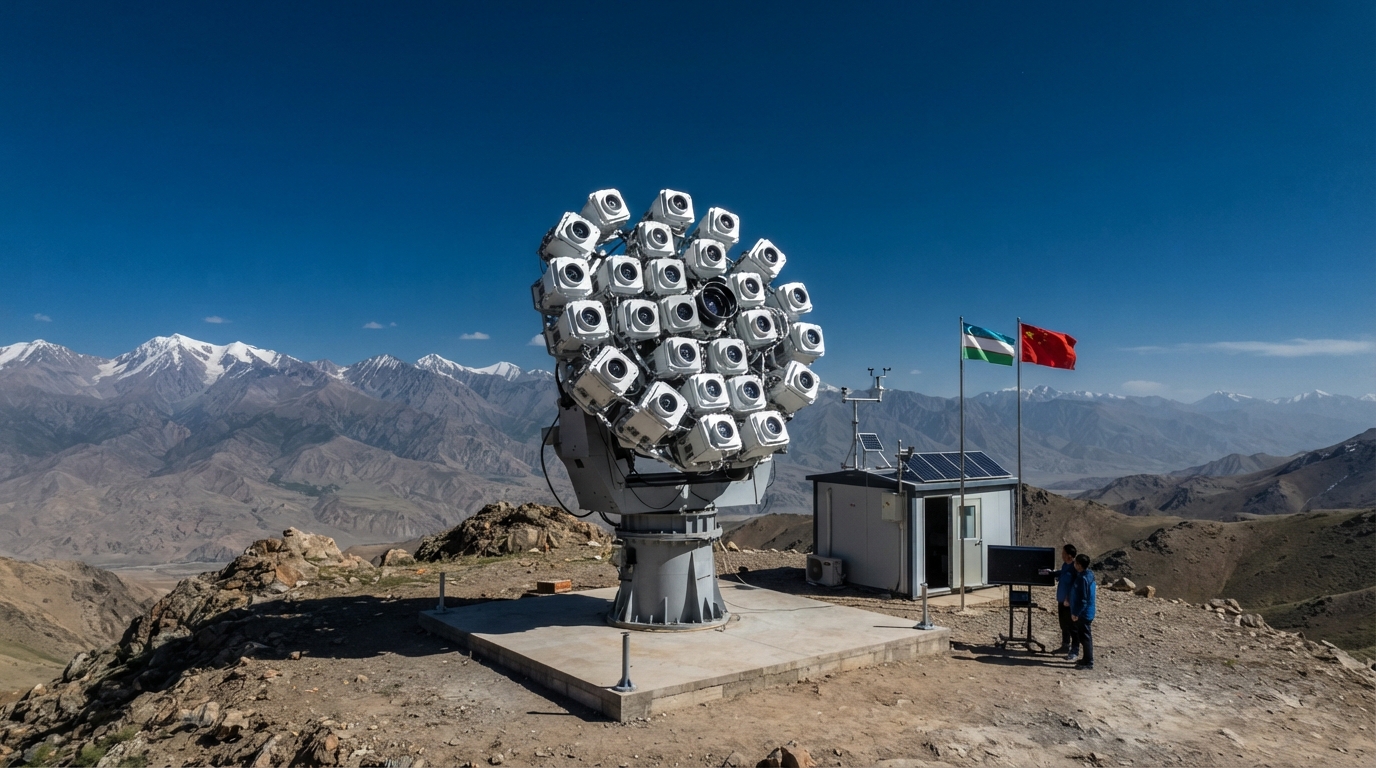
An all-sky telescope, capable of observing nearly the entire celestial sphere concurrently, has been successfully installed and activated at Uzbekistan's Maidanak Astronomical Observatory. This advanced system is the product of collaborative efforts between scientists from the Mirzo Ulugbek Astronomical Institute of the Academy of Sciences of Uzbekistan and the Shanghai Astronomical Observatory of the Chinese Academy of Sciences, as announced by the Academy of Sciences of Uzbekistan.
Comprising 31 distinct optical modules, each fitted with highly sensitive CMOS cameras, the new complex can simultaneously survey sky regions exceeding 20 degrees above the horizon. It possesses the sensitivity to detect celestial bodies as dim as the 14th magnitude.
A primary function of this system will be the identification and tracking of rapidly moving objects. The complex is specifically engineered to monitor near-Earth asteroids, meteors, bolides, artificial satellites, and space debris.
Operating as an automated astronomical monitoring system, the telescope processes data from its 31 imaging units in real time, utilizing 16 computers. The system generates an average of 6-7 terabytes of astronomical data daily, with a 150-terabyte storage system allocated for data retention.
Furthermore, the complex incorporates software that employs deep-learning algorithms to automatically detect moving objects within images. This system is capable of tracing the paths of identified objects, determining their astronomical coordinates, and computing preliminary orbital parameters.
The telescope also supports remote operation, with observation schedules planned automatically. The complex continuously monitors environmental factors such as temperature, humidity, atmospheric pressure, and wind speed.
The Academy of Sciences stated that the Maidanak Observatory was chosen for the telescope's installation due to its elevated location, pristine atmosphere, and consistent conditions conducive to astronomical observations. These attributes facilitate regular surveillance of near-Earth space.
According to the Academy of Sciences, the activation of this complex will enhance Uzbek scientists' capacity for observing near-Earth objects and managing extensive astronomical datasets. The equipment is also suitable for international research in space monitoring and for educating specialists in contemporary observation technologies.
The telescope's installation represents a culmination of scientific and technical collaboration between Uzbekistan and China. The complex was brought online in advance of Uzbekistan's 35th anniversary of independence.