

The WW1 soldier given his name back after 100 years
His remains, found more than 100 years after he died, will be given a full military funeral.
**The WW1 soldier given his name back after 100 years**
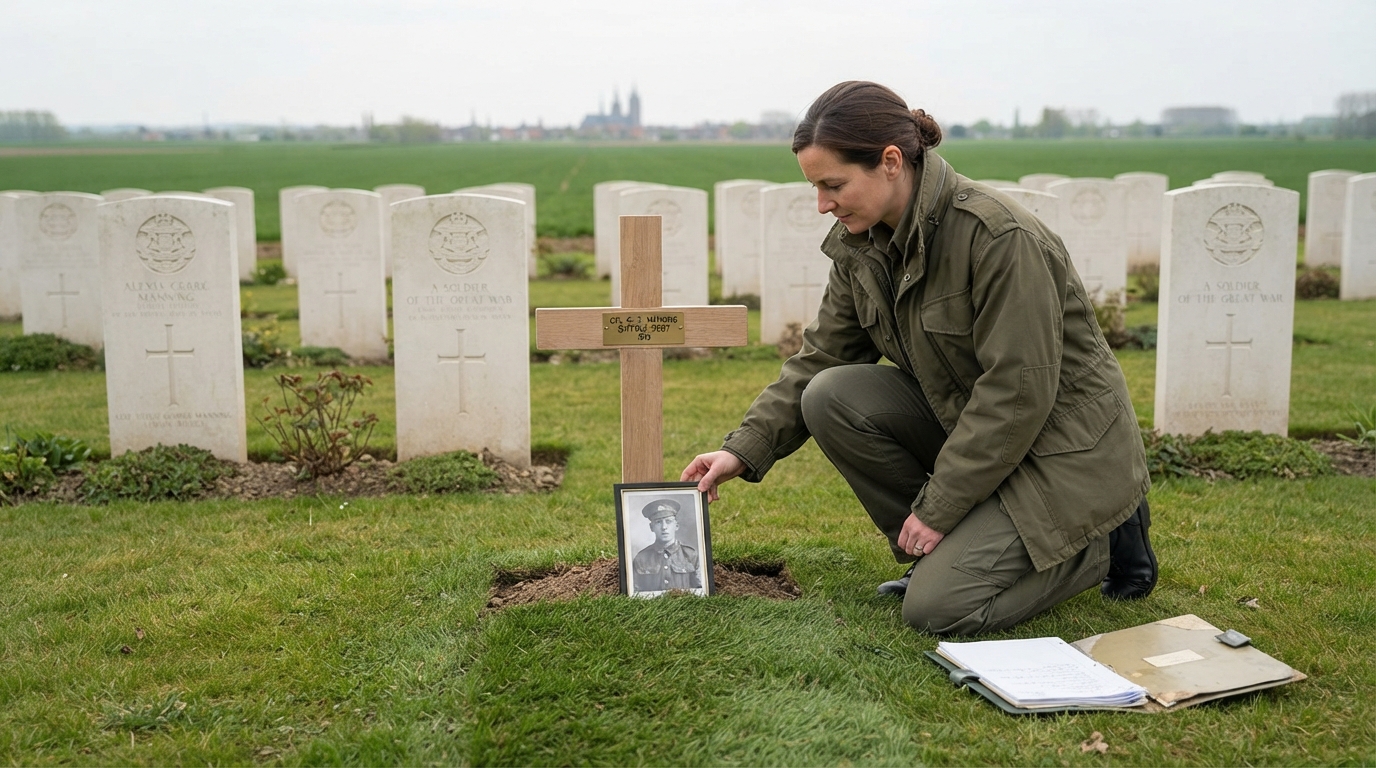
MOD war detective Alexia Clark is working to find living relatives of Manning
In 1915, Cpl George Thomas Manning of Ipswich was killed in World War One, but it took more than 100 years for his body to be found.
The soldier, from the Suffolk Regiment 2nd Battalion, was killed while fighting in Belgium, and his wife and two daughters died without ever knowing where he was buried.
In 2019, human remains were discovered in a ditch near Ypres and later confirmed to be his. Alexia Clark, the Ministry of Defence (MOD) detective who solved the case, said: "It's always a nice feeling to be able to give a man back his name."
A full military funeral is now planned in Belgium, and the MOD and the Ipswich War Memorial are looking for Manning's descendants so they can attend.
Manning was born in 1881 in Ipswich and was one of nine siblings.
In 1905, he married Florence Elizabeth Bayles, and the couple had two daughters.
When war began in 1914, Manning was fighting in Kemmel near Ypres in Belgium the following year.
The men faced sniper fire and shelling, and 140 lives were lost, including Manning, who died on 9 March 1915 aged 34.
Menin Gate in Ypres honours 55,000 British and Commonwealth soldiers who died in the area and have no known grave.
Alexia Clark, an MOD war detective, said the remains were found in Kemmel in 2019 during ditch clearance work.
They were recovered and taken by the Commonwealth War Graves Commission to a mortuary in France.
In 2024, the MOD received a report saying artefacts found with the body included two brass badges marked Suffolk.
The MOD concluded that only the 2nd Battalion of the Suffolk Regiment had ever been in this part of Belgium, and that 26 of the men killed were still missing.
Clark began building family trees for the missing men in order to find living relatives and ask them for a DNA sample to see whether it matched the remains.
Clark said: "I had been through six other men before I actually managed to get a match and prove that this particular man is George Thomas Manning.
"It's a really thrilling feeling when you get that report that comes through from the DNA contractors and it is, 'Yes, you've got it this time'.
"Especially when you've potentially got quite a lot of casualties to work through and to try and narrow it down from."
The person who matched Manning was a two-times great-nephew. Two more relatives have since been identified, including one in Australia.
It is not thought that Manning's daughters had children of their own. However, because he was one of nine children, Clark expected there to be many relatives still living.
Andrew Beal from the Ipswich War Memorial said he hoped the group could help give Manning's family some closure.
The MOD asked Ipswich War Memorial for help in finding other possible relatives still in Suffolk.
Andrew Beal from the group said they had researched Manning about 10 years ago and it was "wonderful" that his relatives would finally be given closure.
He said: "It probably was quite upsetting after the war [for Manning's family] to realise there was no grave and they couldn't find it.
"Over the years, we've come across letters and things from families, and they're absolutely heartbroken that there is no grave to visit.
"There's just a plaque on the wall – it's not the same really."
A full military funeral for Manning will take place next spring in Belgium, with his remains to be buried in a cemetery alongside others from the Suffolk Regiment.
Anyone who believes they may be related to Manning is urged to contact the MOD.