

Five WW2 soldiers named and honoured
The men had been buried as unknown soldiers in Normandy, France.
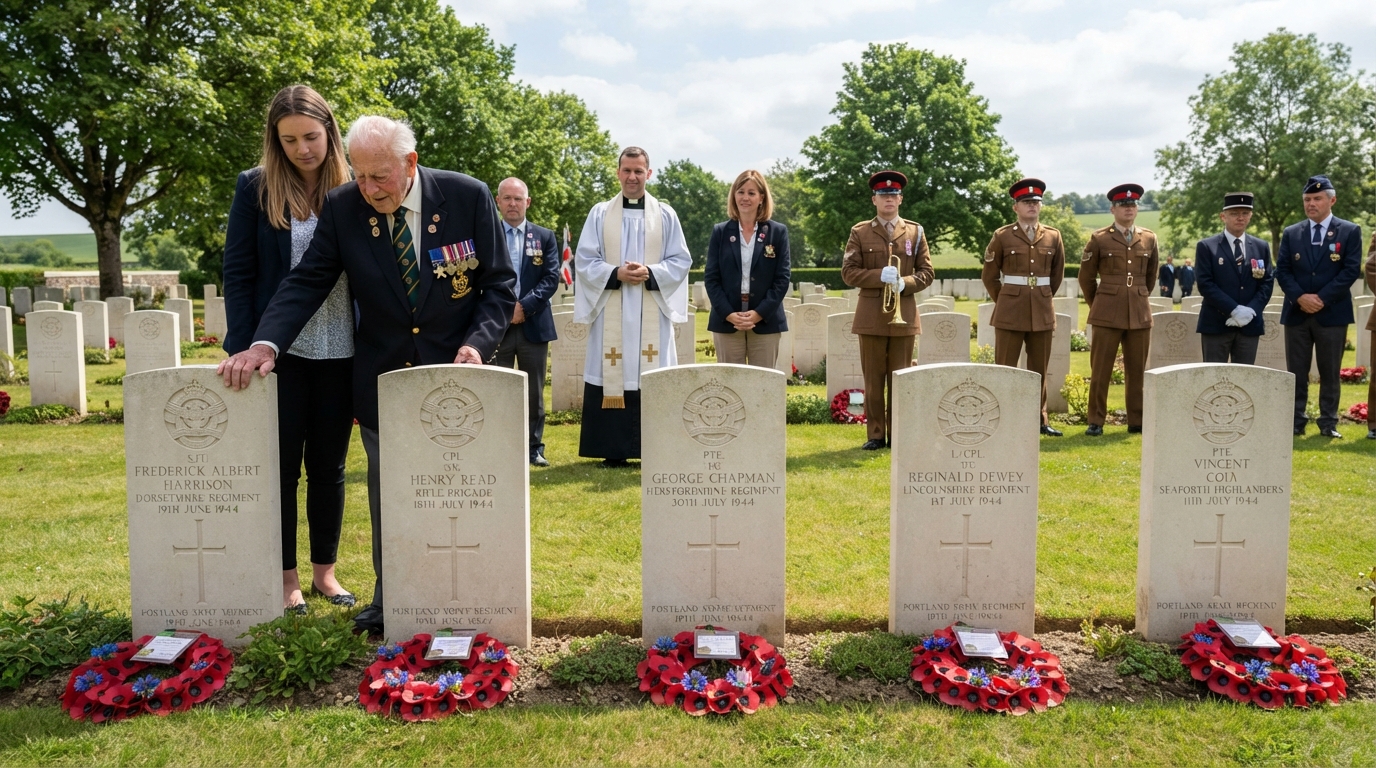
Five WW2 soldiers named and honoured
Five British soldiers who were killed in the aftermath of D-Day during World War Two have at last been identified, and services have been held for them in northern France.
Privates George Chapman and Vincent Coia, L/Cpl Reginald Dewey, Cpl Henry Read and Sjt Frederick Albert Harrison were buried as unknown soldiers after being killed in separate places during the Battle of Normandy, which followed the June 1944 landings.
The Commonwealth War Graves Commission (CWGC) has now replaced their headstones with new ones carrying their names.
Earlier this week, relatives of some of the men attended services in France, and the 95-year-old brother of Sjt Harrison sent a message saying: "I'm very proud of him."
He wrote: "Although I didn't know my brother very well, as I was only young when he left home to join the Army, I'm very proud of him and what he achieved, and what he went on to do for his King and country.
"It was soldiers like Fred that helped us win the war, and keep us safe. Always in my thoughts. Your young brother, Reg."
All five soldiers had been listed on the Bayeux Memorial to the missing.
The services, held at different cemeteries in Normandy, were arranged by the Ministry of Defence's Joint Casualty and Compassionate Centre (JCCC), known as the "War Detectives".
The team often relies on DNA taken from remains and living relatives to identify soldiers' remains with certainty.
In this case, however, because the soldiers had been buried in CWGC plots, the remains were not disturbed, and identification was confirmed using official records alone.
From left, Pte Coia, from Glasgow, Pte Chapman, from Stoke-on-Trent, and Cpl Read, from London
Rosie Barron, a JCCC caseworker, said Normandy had been "very welcoming" to the families and the military party who attended the services.
"For them, the Battle of Normandy is not just commemorated but celebrated as the moment that they regained their liberty after four long years of occupation. The sacrifices made by these men were not in vain," she said.
Barron said there were "many graves in Normandy which may yet be identifiable with further investigation".
The Reverend Paul Collins, who conducted the services, added: "These brave soldiers gave their lives in the events following D-Day, which led to the liberation of France and the defeat of the Nazis.
"It is fitting that due to the hard work of the JCCC and others we now know who these soldiers were and where they are buried."
L/Cpl Dewey, 26, from Bourne, Lincolnshire, a married father-of-one, served with 4th Battalion, The Lincolnshire Regiment and was killed during a German attack on 1 July 1944 at Tessel Bretteville.
Sjt Harrison, 27, from Stamford, Lincolnshire, who was married, stormed Gold Beach on D-Day with 1st Battalion, The Dorsetshire Regiment. He was killed as his battalion attacked a wood near Chateau de Cordillon on 19 June 1944.
Pte Coia, 19, from Glasgow, served with 7th Battalion, The Seaforth Highlanders, and was killed on 11 July 1944 while attacking the enemy on the Le Mesnil to Eterville road.
Cpl Read, 28, a married father-of-one, from London, who served with 8th Battalion, The Rifle Brigade, died from wounds sustained at Hubert-Folie on 18 July 1944.
Pte Chapman, 24, from Stoke-on-Trent, Staffordshire, served with 1st Battalion, The Herefordshire Regiment, and was killed near Caumont-sur-Aure on 30 July 1944.