

Historian's trek to honour WW2 pilot's sacrifice
Wilfred Surplice held his iced-up plane steady long enough for his crew to escape, says historian.
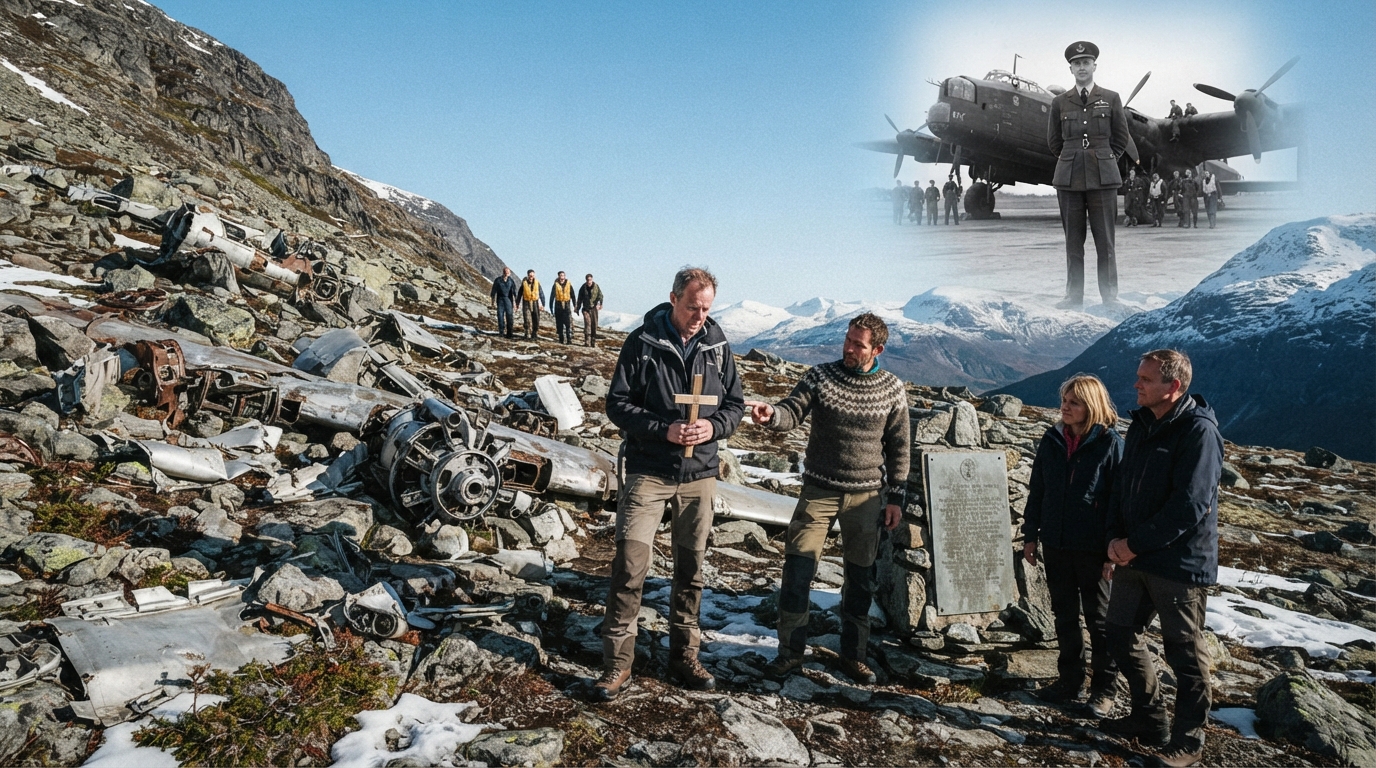
Historian Chris Bullock embarked on a journey to Skardfjell, Norway, to honor a World War Two pilot who perished during a resistance resupply mission.
"Upon reaching the crash site, it was truly awe-inspiring, with aircraft wreckage scattered in a thousand pieces," Bullock recounted.
He had undertaken a trek to a secluded area of Norway where, in 1944, Group Captain Wilfred Surplice, 30, the station commander of RAF Rivenhall, Essex, made the ultimate sacrifice to allow his crew to parachute to safety.
At the memorial, Bullock dispersed soil from Rivenhall and recited the Ode of Remembrance from Laurence Binyon's poem "For the Fallen," followed by a minute of silence.
"Many of us were moved to tears," said Espen Thronsen, who guided Bullock and whose grandfather aided in the return of four crew members to Britain.
Bullock described the visit as a "unique opportunity" to pay tribute to Surplice and to piece together the events of that frigid November night during WW2.
Residing near Rivenhall, Bullock has dedicated over a decade to researching its history, considering the group captain's fate "one of the key stories."
Group Captain Wilfred Surplice had been decorated with both the Distinguished Service Order (DSO) and the Distinguished Flying Cross (DFC).
Surplice, a married father of one, arrived at the airfield in October, leading squadrons responsible for delivering SOE and SAS supplies to France, the Netherlands, Denmark, and Norway.
"As a former soldier, I reflect on the immense difficulty for crews relocating to Rivenhall," said Bullock, who served 25 years in the Parachute Regiment. "You had your familiar pubs, your friends, and then suddenly you uprooted, and the station commander had to oversee the move... and maintain the morale of his men and women."
The personnel under his command had "lost many friends, many aircraft, many crews" at the Battle of Arnhem, making it part of his duty to restore their morale.
The group captain (far left) is pictured under his Stirling bomber with his crew when he was station commander at RAF Rivenhall, near Chelmsford.
The plane's debris was widely dispersed in the crash, with most of it remaining on the hillside, save for one section now housed in a museum.
This may explain Surplice's decision to lead a crucial supply drop of arms and equipment for the Norwegian resistance, established after German troops invaded the neutral country in 1940.
As station commander, the group captain was not obligated to participate.
"He periodically went to stay current, but also, I believe, to demonstrate leadership, especially given the RAF's particularly challenging times – he was undeniably a leader of men," Bullock stated.
All other pilots from 295 Squadron turned back upon reaching Norway due to poor visibility and the bitterly cold winter, unable to locate the drop zone.
Bullock (second left) relied on Espen Thronsen (far left) to find the site, accompanied by history enthusiasts Marianne Rokset and Trond Hjelmtveit.
Bullock explained: "Wilfred's aircraft began to freeze due to ice; as it stalled, it lost altitude. He made the decision to abandon the aircraft and ordered all the crew to bail out into the snowstorm with 20mph (32km) winds."
The six crew members survived their jump. Four were hidden by the resistance for weeks before repatriation, while two were captured almost immediately.
Crash survivors are shown enjoying a meal while on the run, from left to right: Einar Thronsen (resistance), Kenneth Bolton, Robert Chapin, Robert Dalton, and Michael Hicks.
After examining the scattered remains of the Stirling bomber at Skardfjell, Bullock is confident it crashed moments after the crew escaped.
He expressed his astonishment at the scene. "I walked up to different parts, and it was literally concertinaed; you could just see that the impact had been phenomenal," he said. "Wilfred obviously was in no way able to survive a crash like that."
His remains were recovered and eventually interred by the Commonwealth War Graves in Oslo, where Bullock also sprinkled earth from Rivenhall and placed a cross.
Bullock spent time reflecting on Surplice at his graveside in Oslo and laid a cross presented by the RAF Association in Essex.
Thronsen, from Skien in southern Norway, has dedicated years to researching his grandfather's involvement in the resistance. He guided Bullock on the two-hour trek to the memorial, a site only accessible on foot, with Bullock remarking he "couldn't have done it without him."
They were joined by Marianne Rokset and Trond Hjelmtveit, who share a keen interest in Norway's wartime history and its connection to Rivenhall.
"I believe it's important to remember the people who made these sacrifices," the historian added. "And I'd like to think that if Wilfred was still in and around the place where he died, that he was able to recognize that he's still being thought of."
Surplice, who joined the RAF in 1934, was survived by his widow Cicely and son Roy, born in 1938.