

The world's most competitive economies: the leaders have been revealed
Singapore took first place in the 2026 World Competitiveness Ranking compiled by IMD. In total, the ranking assessed the capabilities of 70 economies to conduct business, ensure a competitive environment, and create long-term economic value.
**The world's most competitive economies: the leaders have been identified**
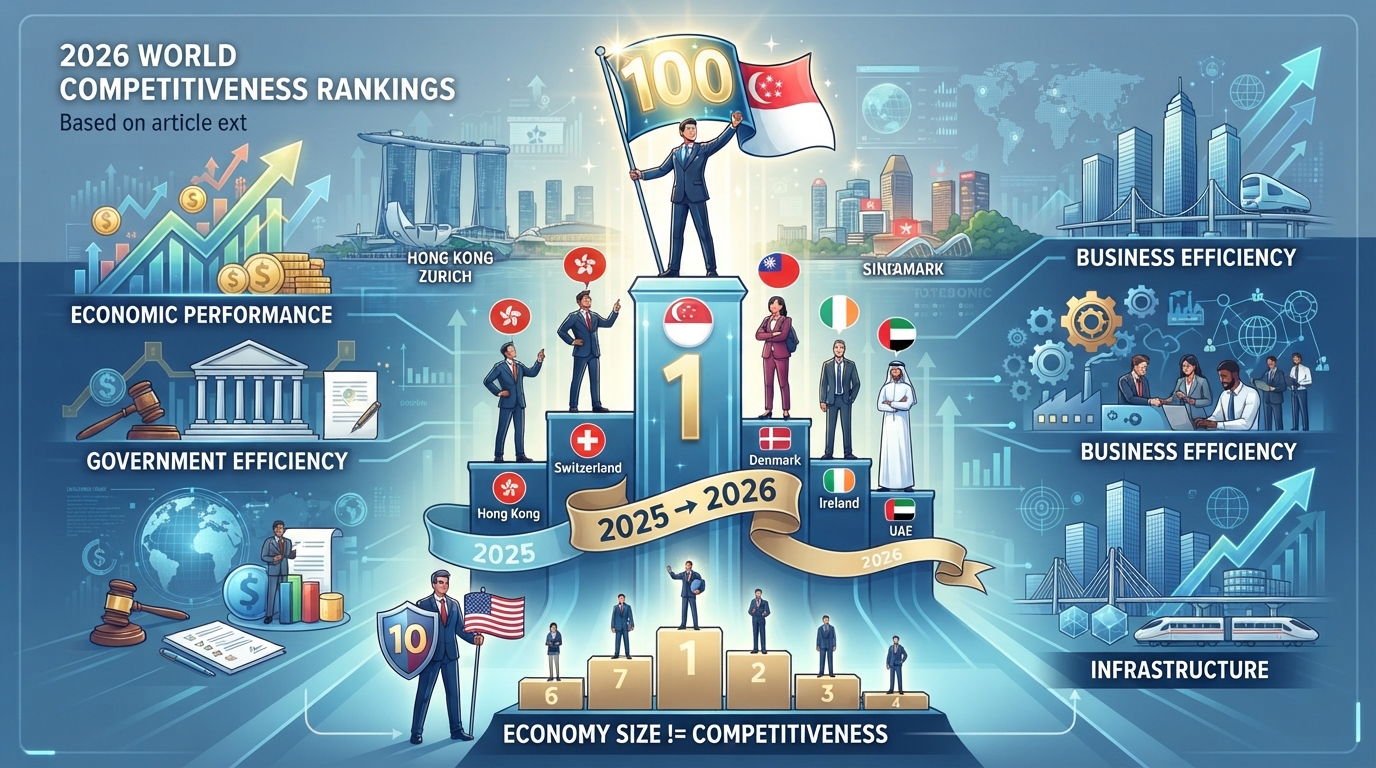
The ranking of the world's most competitive economies for 2026 has been announced. In it, Singapore took first place with a score of 100 points.
The next positions were occupied by Hong Kong and Switzerland.
Hong Kong scored 95.6 points, while Switzerland scored 95.3 points. Taiwan placed fourth in the ranking.
Denmark, Ireland, and the United Arab Emirates each accumulated 94.1 points. They occupied the fifth, sixth, and seventh places in the ranking, respectively.
Singapore was the only economy to rank in the top five across all four main competitiveness areas in the ranking. The country's business efficiency indicator rose to first place in 2026. This allowed Singapore to surpass Switzerland in the overall ranking and regain the lead.
The IMD methodology covers 341 criteria. They are divided into 20 sub-areas and four main factors: economic performance, government efficiency, business efficiency, and infrastructure.
Two-thirds of the final score is based on statistical data. The remaining one-third is based on the results of a survey conducted among company executives.
The ranking also shows that the size of an economy does not always represent its level of competitiveness. For example, despite the US remaining the world's largest economy, it ranked 10th in the 2026 IMD ranking.
Nine spots in the top ten of the ranking belong to European and Asian economies. Most of the most competitive economies combine high business efficiency, developed infrastructure, skilled workforce, and effective institutions. These factors create a stable and predictable environment for investment and entrepreneurial activity.
The 2026 report also pays special attention to trust in public institutions and the rule of law. It is noted that a stable and predictable regulatory system, the ability to effectively protect contract terms, and quality public administration help companies make long-term investment decisions even in conditions of geopolitical instability.