

"The Westminster era is coming to an end." Leaders of Wales, Scotland, and Northern Ireland signed an agreement
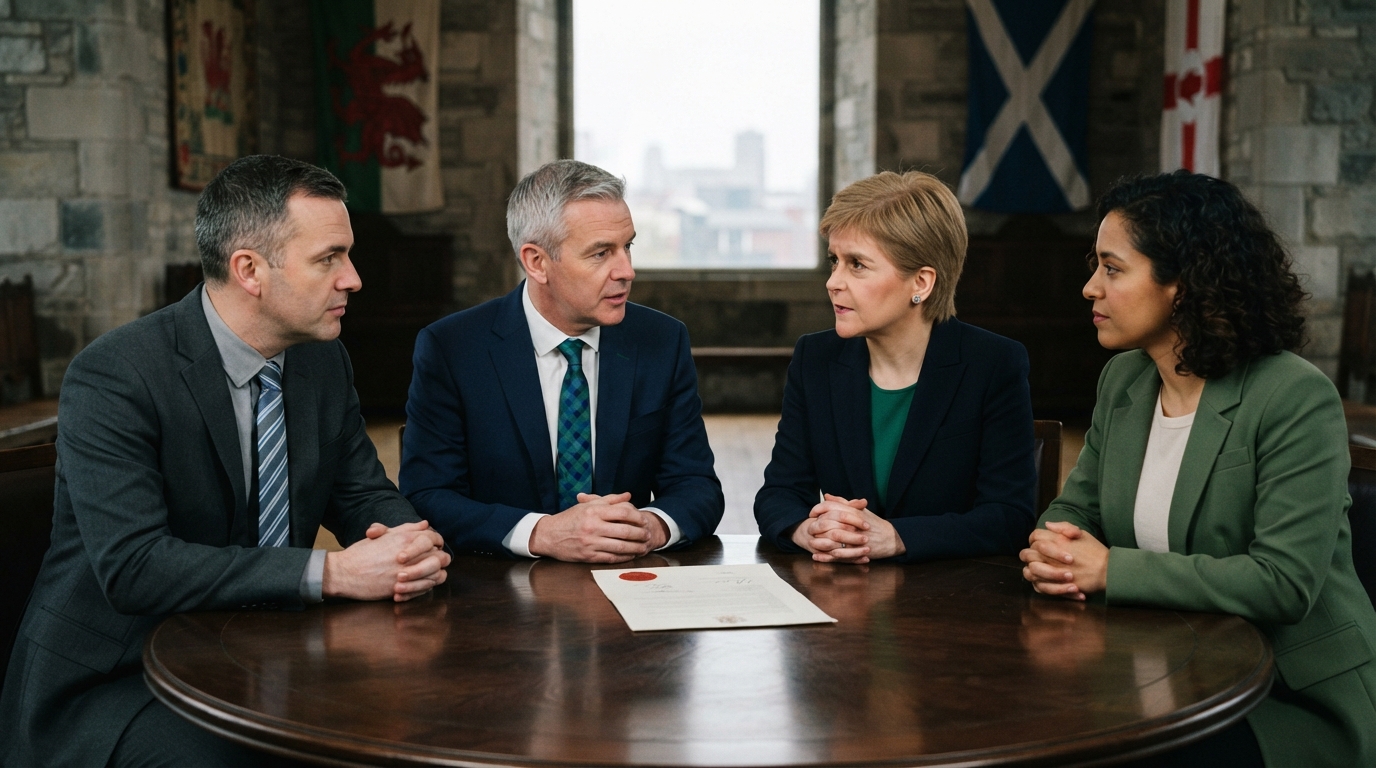
“The Westminster era is coming to an end.” Leaders of Wales, Scotland, and Northern Ireland sign an agreement
The First Ministers of Wales, Scotland, and Northern Ireland met on September 14 in the Welsh capital, Cardiff. They discussed "closer cooperation" on constitutional issues. All three leaders are striving to lead their countries out of the United Kingdom.
Scotland was represented at the meeting by John Swinney, leader of the Scottish National Party (SNP), and Wales by Rhun ap Iorwerth, leader of the Party of Wales (Plaid Cymru). Northern Ireland was represented by Michelle O'Neill, representing the republican Sinn Féin party, and Mary Lou McDonald, the president of the party.
At the end of the meeting, the leaders signed an agreement. It states that no government in Westminster (referring to the UK government) has the right to "block democracy." They also stated that "the Westminster era is coming to an end" and emphasized that the UK government must "prepare" for constitutional changes.
This event was the first face-to-face meeting of the nationalist party leaders since Plaid Cymru representative Rhun ap Iorwerth was elected as the head of the Welsh government. Ap Iorwerth came to power in May.
According to a statement by the Plaid Cymru representative ahead of the meeting, the "changing political landscape across these islands" shows there are strong reasons to strengthen "practical political cooperation" in areas such as energy, the economy, and cooperation with Europe. In addition, he noted, there are "broader political and constitutional issues facing our nations, as well as the issue of the right to self-determination."
Ap Iorwerth called the May elections a "turning point for Wales." According to him, "People are increasingly recognizing that the Westminster model is no longer working."
Swinney, leader of the Scottish National Party, shared this view: "The view that the Westminster system is not fit for purpose and does not serve the interests of ordinary people is gaining wider support. This has been acknowledged by Prime Minister Andy Burnham himself. And the people of Scotland, Wales, and Northern Ireland demonstrated this clearly at the polling stations."
O'Neill said that "those sitting in Westminster have never served the interests of the people of the island of Ireland."
Sinn Féin President Mary Lou McDonald said on the BBC: "Undoubtedly, our national histories are different. But we are united by one very important aspect — the firm belief that the future of Ireland must be decided by the people of Ireland, the future of Scotland by the people of Scotland, and the future of Wales by the people of Wales."
However, exactly how the scenarios for these countries leaving the United Kingdom will be implemented, and whether such a process will happen at all, remains unknown for now.
### What is the situation regarding independence in these countries?
For now, none of the leaders can hold a referendum on leaving the United Kingdom at their own will. Furthermore, the political and legal conditions in these territories differ significantly from one another.
Following the signing of the Belfast Agreement ("Good Friday Agreement") in 1998, which ended thirty years of conflict in Northern Ireland, the country gained its own legislature and a government with broad powers. These powers include control over policing and justice.
A similar process took place in two other territories of the Kingdom: Scotland and Wales gained their own parliaments and governments relatively independent of Westminster.
Initially, nationalist parties were in the minority in these regions. However, the SNP soon pushed representatives of traditional British parties out of power and has been governing Scotland for over a decade.
In Wales, Plaid Cymru nationalists came to power for the first time only following the elections held in May this year.
In Northern Ireland, under the terms of the Belfast Agreement, the First Minister and deputy First Minister have equal powers and responsibilities. Currently, the post of deputy First Minister is held by Emma Little-Pengelly, a representative of the Democratic Unionist Party (DUP), which supports Northern Ireland remaining within the United Kingdom.
Although Sinn Féin has the largest faction in the Northern Ireland Assembly, unionists overall hold slightly more seats than nationalists. Therefore, before bringing the idea of a referendum on leaving the United Kingdom and reuniting with Ireland to the agenda, both politicians and citizens must first reach a mutual agreement.
By the way, Little-Pengelly specifically emphasized that Michelle O'Neill attended Monday's meeting as a representative of the Sinn Féin party, not as a representative of the Northern Ireland Assembly.
UK Prime Minister Andy Burnham recalled that an agreed path for reunification in Northern Ireland has existed for a long time and is set out in the "Good Friday Agreement." According to him, "when a clear consensus emerges in the country and public sentiment changes significantly, the issue of a referendum will be considered by the Secretary of State for Northern Ireland."
"I can say that a similar situation has arisen in Scotland," he added. However, before Scottish independence supporters could draw conclusions from this, Burnham clarified the situation: "The issue of holding another referendum in Scotland is not on the agenda yet."
Scottish nationalists held a referendum on seceding from the United Kingdom in 2014. At that time, 55 percent of voters opposed breaking away from Britain, while 45 percent supported independence.
However, two years later, the United Kingdom voted to leave the European Union. Following this, Scots began demanding a new referendum because they wanted to remain in the EU. This was also shown by the voting results in Scotland on Brexit: 62 percent in favor of remaining, 38 percent in favor of leaving.
However, Westminster did not consent to holding a second referendum. In 2022, the UK Supreme Court confirmed that a new referendum cannot be held without London's consent. Despite this, after winning the elections in May, Swinney continues to demand a second referendum on Scottish independence.
Ap Iorwerth, on the other hand, is in no hurry to hold a referendum. He previously stated that there would be no referendum during the current parliamentary term and expressed a desire to start a "national conversation" on the issue. His government plans to set up a national commission to "prepare the ground" for Wales's future independence plans.
"We are separate nations with different paths of development and priorities," he told the BBC. "But there are also things that unite us... This is the pursuit of a different path, unlike the approach of the UK government. This could be a constitutional issue, or more sharply, the issue of establishing fairness in funding."
The Welsh First Minister did not mention the funding topic by accident. Scotland, Wales, and Northern Ireland receive funds from the UK Treasury based on the Barnett formula, which was introduced in 1998.
This formula calculates the annual change in funding levels based on spending in England, rather than the entire budget of the regions. Since the formula is linked to the population size of the regions, Scotland, which has a larger population, receives more funding than Wales and Northern Ireland.
Although the Barnett formula for Wales has been partially revised in recent years, Welsh officials still insist that the principles of funding the country need to be changed. In their view, the current formula puts Wales at a disadvantage.
Before becoming the UK Prime Minister, Burnham supported this idea. However, during his recent visit to Wales, he gave an ambiguous answer, without expressing a clear opinion on the prospects of this initiative.
Even assuming London does not oppose a referendum, today none of the three leaders can guarantee a positive outcome of an independence referendum in their country.
Against the backdrop of the Supreme Court ruling that directly banned a new referendum for Scotland, this meeting of the leaders of the parties promoting the idea of independence may be aimed less at being an allies' "war council" and more at reminding Westminster of their interests and showing their readiness to defend them.
Westminster's official response was not long in coming and surprised no one: "The Prime Minister remains committed to delivering reform across all four nations of the United Kingdom and firmly believes in the preservation of the union."