

The volunteers risking their lives to defuse Indonesia's wildfire 'carbon bombs'
Peat fires in Borneo are releasing ancient stores of carbon - and sending a toxic smog across South East Asia.
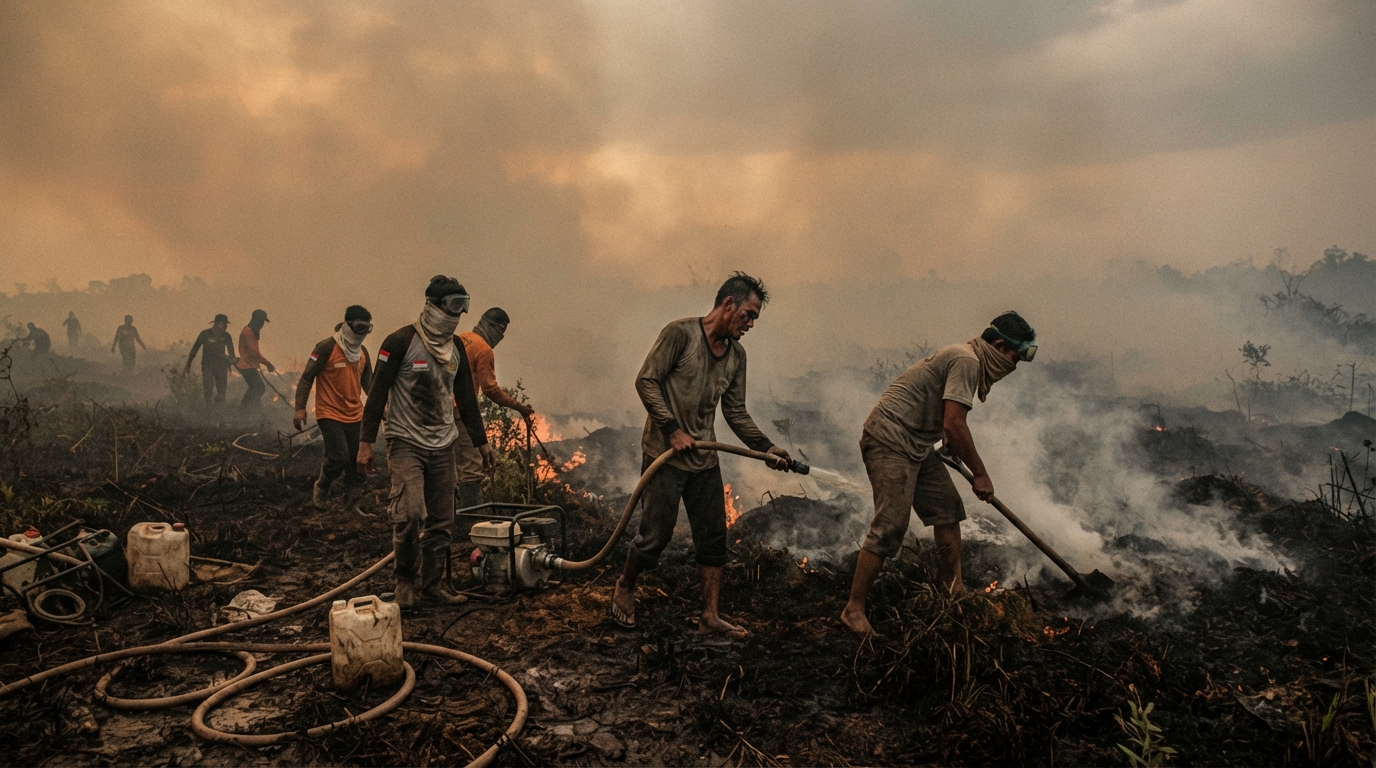
**The volunteers putting their lives on the line to tackle Indonesia’s wildfire “carbon bombs”**
Fahrin Ramadhianto has been battling Borneo’s wildfires for a month, and he has begun to feel the effects on his own body.
Over Borneo, the sky hangs low, though rain is nowhere in sight. The air, thick and amber-coloured, sits beneath a shroud of smog that has drifted beyond national borders — reaching Singapore, Manila and Kuala Lumpur.
At ground level, smoke rises from the earth.
“It’s like tear gas,” says Dwi Sujatmoko.
“It hits your nose straight away, your eyes burn – that’s more or less what it’s like,” he says. “People say these fires are extraordinary because of the flames and the smoke. And they’re right.”
The 35-year-old volunteer firefighter has spent more than a month wrapped in this haze, inhaling toxic microparticles of carbon that have been trapped for millennia as he works against what seems like an unstoppable fire front.
With hand tools, carts and portable fire pumps, he and thousands of other volunteer firefighters — many of them indigenous Dayak or Banjar people — are confronting an inferno that has burned through about 200,000 hectares of forest and farmland across Indonesian Borneo since early July.
Hidden underground, vast peat fires continue to smoulder, filling the air with poisonous fumes.
“Once a fire becomes uncontrolled, it harms many people. Not just humans, but also animals and plants,” Sujatmoko says. “If underground fire spreads and can no longer be controlled, the losses are enormous.”
Indonesia is in the grip of a wildfire disaster.
In the midst of a so-called “Super El Niño” that has intensified local drought conditions, thousands of active fire hotspots are spreading and multiplying across the country, driving a cross-border haze crisis that is the region’s worst in more than a decade.
What makes Borneo’s fires especially alarming is that they are burning through one of the world’s largest tropical peatland ecosystems.
This 4.5-million-hectare expanse of forest and swamp normally acts as a major store of ancient carbon.
When peatlands ignite, they can release millions of tonnes of carbon dioxide, carbon monoxide and methane into the atmosphere — a burst of greenhouse gas emissions that has earned them the label of a “carbon bomb”.
“Peatlands are incredibly effective carbon stores because their waterlogged conditions slow decomposition, allowing carbon to accumulate underground for thousands of years,” explains Dr Nisa Novita, a peatland researcher at Indonesian conservation NGO Yayasan Konservasi Alam Nusantara (YKAN).
“But this also means they can become a ‘carbon bomb’ when they are drained or burned, because that carbon can be rapidly released into the atmosphere.
“Tropical peatlands in Indonesia are among the world’s most effective natural carbon stores. The deeper the peat, the greater the carbon stock – and in Kalimantan, we have found peat deposits that can exceed 20 metres in depth.”
A peatland that deep has been known to contain more than 6,000 tonnes of carbon — roughly equal to the annual CO₂ emissions of 4,800 cars — per hectare. And when it burns, Dr Nisa says, that fossilised carbon can enter the atmosphere “very rapidly”.
“We’re doing everything we can to help deal with this haze disaster because it’s our duty,” says firefighter Dwi Sujatmoko
Across South East Asia, thousands of people are now feeling the effects of those emissions in their eyes, chests and throats.
In Indonesia, Brunei, Malaysia, Singapore and the Philippines, air pollution indices have surged to “unhealthy” extremes — in some cases nearly 75 times the World Health Organization’s recommended level — and hospital admissions have risen sharply.
From July to August, Indonesia’s Health Ministry logged more than 50,000 cases of respiratory infections tied to land and forest fires. More than 12,000 of those cases were children under five.
“Everybody who’s living within that pollution cloud is breathing in the products of those smouldering peat fires,” says Susan Page, a professor at the University of Leicester’s school of geology and the environment, who has studied peatlands in Asia for three decades.
“They’re breathing in carbon monoxide, which is toxic, and they’re breathing in the very finely divided particulate matter... [which] can pass through the alveoli in the lungs into the bloodstream and cause further problems elsewhere in the body, including issues with the heart.
“Living in this kind of pollution cloud is extremely unhealthy.”
Fighting peat fires requires soaking the ground so completely that it turns “like porridge”
The health toll is felt most sharply at the heart of the disaster: the fire front.
There, volunteer firefighters have been risking their lives and lungs to put out burning peatlands, which are notoriously hard to extinguish. Two volunteers in Central Kalimantan have died in recent days, reportedly after their health worsened while fighting fires.
Shrouded in toxic haze that can shave years off a person’s life, volunteers have been digging ponds, canals and borewells through bone-dry peat in a desperate effort to keep their hoses supplied.
Some have been forcing pipes into the ground to create makeshift irrigation systems to fight subterranean fires. Others have been sleeping just a stone’s throw from the frontline so they can keep battling the flames through the night.
“The worst thing here has been the smoke,” says Fahrin Ramadhianto, a volunteer firefighter in Banjarbaru, South Kalimantan, one of the hardest-hit areas.
“The smell is like decaying wood being burned – that’s the characteristic smell of peat. And that peat contains decomposed wood and organic material from many different sources.”
Indonesia’s peatland fires are not new.
Experts say the crisis stems from decades of land-use change, going back to the Suharto era, when huge areas of rainforest and peatland in Kalimantan were opened up for logging, plantations and large-scale development projects.
But authorities have historically been reluctant to blame industrial actors for major fires.
Instead, the same indigenous communities now involved in firefighting across the island have often been accused of starting the blazes, because of traditional farming methods that use controlled burns to clear vegetation.
Tono, a representative of the Dayak Kanayatn people of West Kalimantan, told the BBC that Dayak communities are often made scapegoats, even though they clear land with careful planning, caution and long-standing customs passed down through generations.
Tono says these communities’ traditional practices, known as uma bukit or “hill farming”, are based on the principle of living in balance with nature.
“The worst thing here has been the smoke,” says Fahrin Ramadhianto
But that balance is rapidly breaking down in Kalimantan, Indonesia’s most deforested region.
The area lost nearly 160,000 hectares of forest in 2025, more than one-third of the national total, much of it cleared for plantations and monocrop agriculture.
Those same industrial-scale development projects have largely been responsible for draining the region’s peat swamps, making them far more vulnerable to fire, Prof Page says.
“Peatlands aren’t really the ideal place to set up a plantation – but of course, once the more suitable mineral soils had been exhausted it became possible, by using large machinery, to drain the peatlands and create conditions which would be dry enough,” she says.
“So not only have you got the deforestation, but peatland drainage of course has also greatly increased the fire risk.”
Page also notes that, whether burning or not, a drained peatland releases carbon dioxide into the atmosphere “all of the time”.
“I think that’s forgotten,” she says. “I think it’s important to recognise that when we see the fires, they’re like a dramatic example of what is actually going on the whole time in a drained peatland... The fires are just the worst expression of [that].”
Now, as these latest fires continue to spiral out of control, Sujatmoko and others are facing a chain of challenges in the days, weeks and months ahead — not least a shortage of water.
Drainage and drought in Indonesia’s peatlands has made them even more vulnerable to fire
Putting out peat fires means saturating the ground so thoroughly that it becomes “like porridge”, Sujatmoko explains.
Even then, there is a strong chance the fire will return, like a smoking revenant, fed by hidden fuel buried deep in the unseen peat swamp.
Against repeated flare-ups, continuing drought and toxic smog, exhaustion is another major problem.
“We’re definitely tired,” says Sujatmoko.
“We get exhausted, we miss our families, our children, our wives. But for now, all of us are putting those things aside. We’re doing everything we can to help deal with this haze disaster because it’s our duty.”
“We also hope rain comes soon,” he adds. “We’ve spent months away from home... May all the efforts of those on the front lines be a blessing for everyone.”