

Indonesia haze spreads across region as firefighters battle wildfires
Authorities have deployed cloud-seeding aircraft to fight the fires, while some schools have suspended classes.
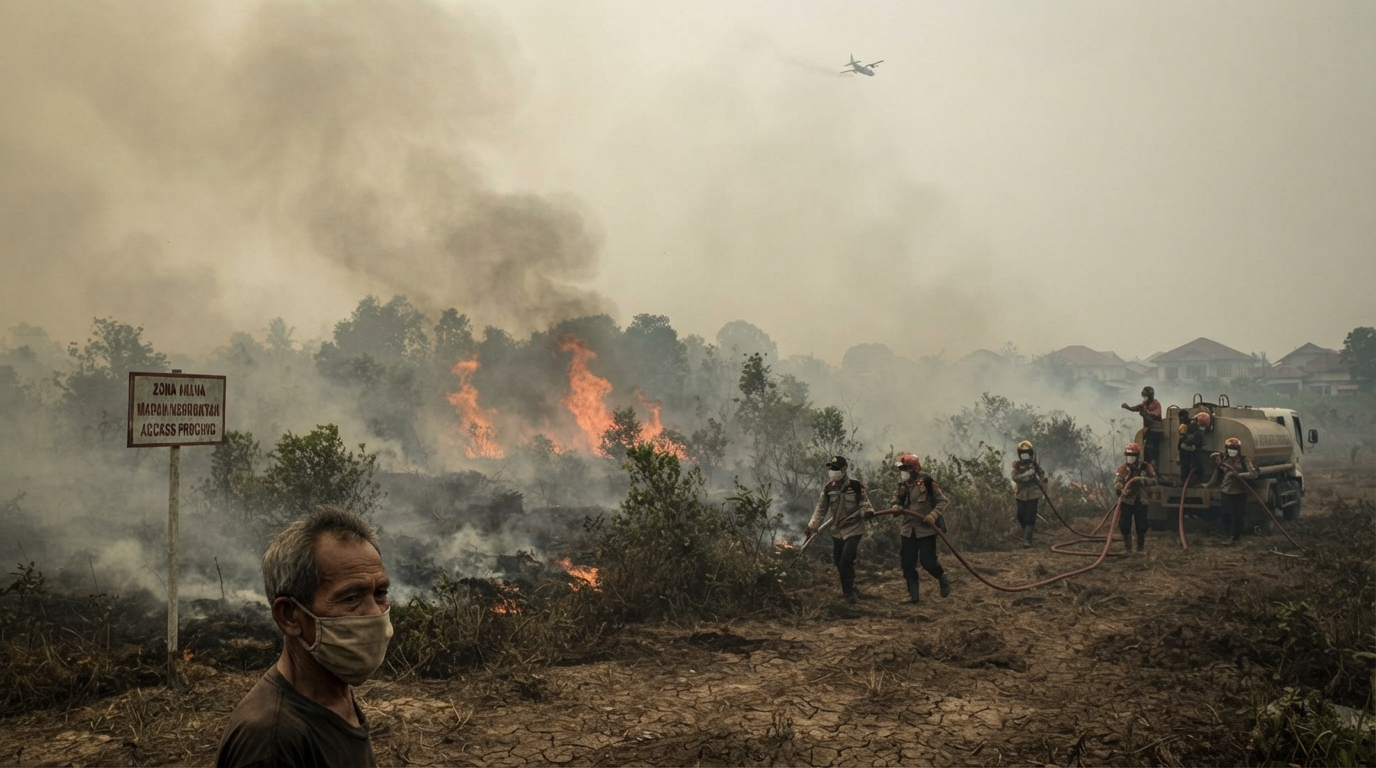
Indonesia is grappling with widespread haze as firefighters combat wildfires that have consumed over 107,000 hectares of land across the nation. This year, Indonesia, along with other Southeast Asian countries, is experiencing an extended hot and dry season, intensified by a more potent El Nino climate event, sometimes referred to as the "Godzilla" El Nino.
To suppress the blazes, authorities have deployed cloud-seeding aircraft, and some schools in affected regions have suspended classes for three consecutive days. The haze has also reached parts of Malaysia, with the air pollution index in Serian, a small town in Sarawak, reaching an "unhealthy" level of 195 on Wednesday.
Indonesian authorities are concentrating their firefighting efforts on six provinces particularly susceptible to fire during the annual dry season due to their extensive peatlands: Jambi, South Sumatra, West Kalimantan, Central Kalimantan, South Kalimantan, and Riau.
Darwin Romy, an indigenous Dayak residing in Palangka Raya, Central Kalimantan's largest city, informed BBC Indonesian that he has been enduring wildfires for over a month. He described the smoke as "quite thick," causing eyes to sting and a strong smell. Romy noted that the flames have approached residential areas and that water for firefighting is becoming scarce.
In West Kalimantan, the mayor of Pontianak, Edi Rusdi Kamtono, announced on Monday, as reported by AFP, that students would transition to online learning for the duration of the fires. He stated, "We have started to feel it, especially at night and in the morning, as haze has already blanketed the city of Pontianak."
Beyond these six provinces, a fire at Mount Bromo National Park in East Java raged for nearly a week, incinerating approximately 550 hectares of the park before being extinguished on Monday. Authorities have also issued warnings about new hotspots near the caldera of Mount Bromo, an active volcano and significant tourist attraction that has been closed to visitors since August 8.
While the official cause of the Mount Bromo fire is under investigation, local authorities suspect carelessness. Gatot Soebroto, head of the local disaster mitigation agency, told reporters on Monday that "A person lit a fire, then put it out, but the fire was not fully extinguished."
The haze has extended to neighboring Malaysia, where the small town of Serian in Sarawak recorded the state's highest Air Pollutant Index (API) reading of 195 on Wednesday morning. An API reading between 101 and 200 is considered "unhealthy," 201 to 300 is "very unhealthy," and anything above 301 is "hazardous." Malaysian media reported that at least nine areas across Sarawak registered unhealthy API readings as of Wednesday.
(Reporting by Lesthia Kertopati and Farida Susanty in Jakarta)