

The US and Central Asian countries have agreed to develop cooperation in trade, energy, and culture
The US and Central Asian countries intend to develop cooperation in trade, culture, and security within the C5+1 format, as well as strengthen their energy partnership, including in the extraction and processing of minerals.
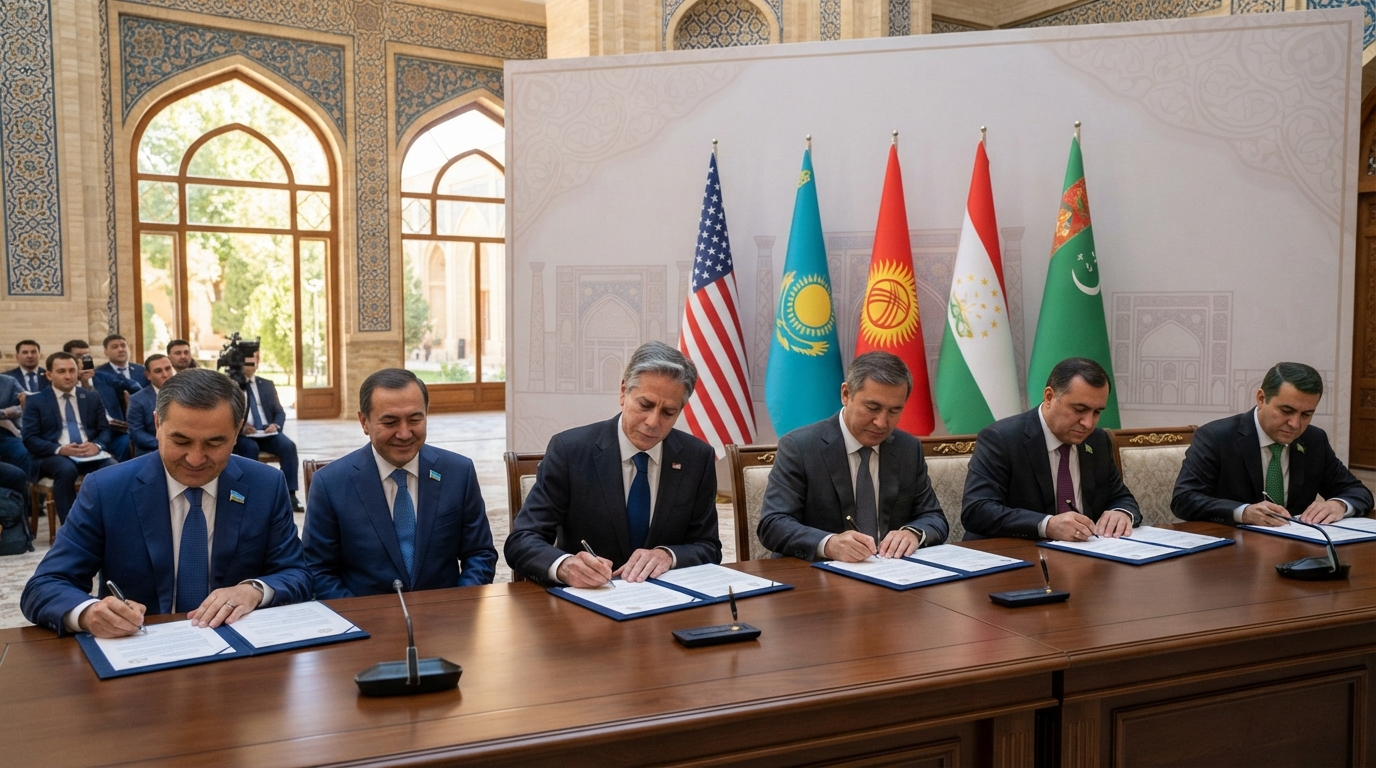
US and Central Asian Countries Agree to Expand Cooperation in Trade, Energy, and Culture
The foreign ministers of Uzbekistan, Kazakhstan, Kyrgyzstan, Tajikistan, and Turkmenistan, together with the US Secretary of State, signed a joint statement following the C5+1 ministerial meeting held on October 19 in Samarkand. The document outlines key areas of cooperation between the Central Asian states and the United States.
"This year, Kazakhstan, Kyrgyzstan, Tajikistan, Turkmenistan, and Uzbekistan mark the 35th anniversary of their independence, while the United States celebrates a milestone anniversary — 250 years since gaining independence. We look forward to continuing our enduring partnership across many generations," the statement reads.
The sides emphasized the importance of further developing the Trans-Caspian Transport Route to boost bilateral trade and investment, as well as to open new opportunities in rapidly growing markets.
"By facilitating deeper regional economic integration in Central Asia — through expanding intraregional trade, improving transport connectivity, harmonizing customs procedures, and strengthening industrial cooperation — we are creating a competitive regional market integrated with the economy of the United States," the statement says. "We will strive to ensure that Central Asia returns once again to the center of the global economy."
The B5+1 platform will continue to create opportunities for American companies in Central Asia. "At the same time, our governments seek to expand opportunities for enterprises from Central Asian countries to invest in the US market. Drawing on safe and reliable technology, advanced US expertise in the technological sphere, as well as the growing tech sectors of Central Asian countries, we aim to shape a region where e-commerce flourishes, innovative solutions are actively implemented, and talented entrepreneurs are provided with all the conditions for successful growth," the statement reads.
The sides noted that strengthening the energy partnership between the US and Central Asian countries will help build integrated high value-added supply chains and ensure sustainable economic growth and energy resilience.
"Each of our countries possesses unique reserves of untapped natural resources. We will combine our strengths to become a powerful collective driver for the development of the energy sector in the region... We see broad prospects for the extraction and processing of minerals, which will maximize the benefits for each of our countries. We also expect that Central Asian countries will be able to realize their export potential by developing innovative approaches to increasing the share of high value-added products within the region and creating mechanisms to bring these products to international markets," the statement says.
Central Asian countries and the US also intend to strengthen security cooperation within the C5+1 framework. Special attention will be paid to combating terrorism and transnational organized crime, as well as strengthening border security.
"Our joint efforts will contribute to enhancing security levels, including by countering illegal immigration, human trafficking, as well as illicit drug and weapons trafficking... A modern approach aimed at mitigating threats of the digital era — including through deepening cybersecurity cooperation in the C5+1 format — will strengthen our capacity to successfully counter cybercrime," the statement reads.
The sides welcomed the long-term cooperation between the US and Central Asian countries on the security of nuclear materials. "Building on the experience of creating a nuclear-weapon-free zone in Central Asia, we will deepen practical interaction on issues of nuclear security, non-proliferation safeguards, physical protection of nuclear materials, and the peaceful use of atomic energy," the statement notes.
The sides also reaffirmed their commitment to preserving the cultural heritage of all C5+1 participant countries and strengthening cooperation in this area.
"We will develop interaction between law enforcement agencies and cultural institutions in order to promote and protect the unique history of the C5+1 countries. We strive to expand professional, cultural, and educational exchanges; leverage new technologies to preserve and protect antiquities; integrate cultural heritage protection into the activities of law enforcement agencies; and train highly qualified personnel capable of playing a leading role on the world stage," the statement reads.