

The "trillion pound" oil fund the government believes Britain could have built
For the first time, the Treasury calculates how much the UK could have raised by investing North Sea proceeds.
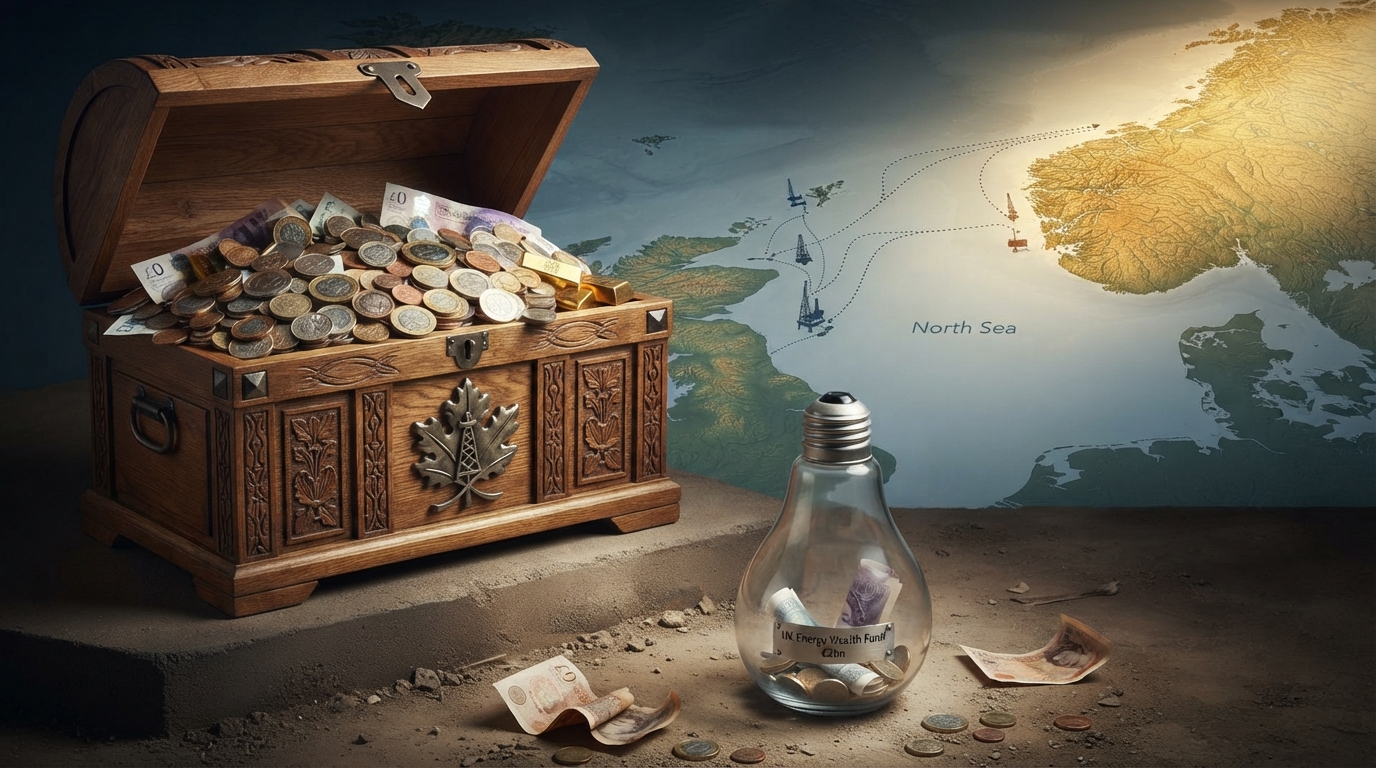
The “trillion pound” oil fund the government believes Britain could have built
After waiting half a century, the United Kingdom now has an oil fund.
Chancellor John Healey unveiled the creation of an Energy Wealth Fund at Wednesday’s announcement of Jackdaw gas approval, with £2bn in funding redirected from the existing National Wealth Fund.
Over the years, a number of energy-exporting countries, chiefly in the Gulf but also including Norway, have built multi-trillion funds from oil and gas revenues, creating vast national piggy banks.
This has long been a subject of debate in UK economic policy circles. If nearby Norway has accumulated a $2.4tn war chest from the same North Sea, where did Britain’s sovereign wealth fund go?
It is a pointed question in the same week that the national debt also reached £3tn for the first time.
“The proceeds of this oil and gas coming ashore now can be invested for the future generations,” the chancellor said.
“If we had done this when North Sea oil was first discovered in the 1980s, we’d have a British Sovereign Wealth Fund now that would be worth probably a trillion pounds.”
On Wednesday, Treasury officials calculated for the first time how much that missing British fund might have been worth.
The trillion pound figure comes from internal Treasury modelling. The assumption was that the UK’s historic North Sea receipts of £200bn had been invested, with no withdrawals, and had grown at a rate similar to Norway’s.
“Norway demonstrates the power of long-term investment: the government wants to learn from that principle, rather than copy its model wholesale,” one insider told me.
It was a “missed opportunity” which “had we systematically invested those receipts, we could have built a huge national asset for future generations”, they said.
It is a huge “What if?” often raised by economists critical of the Margaret Thatcher era.
In their view, the peak oil revenues were wasted on pre-election tax cuts, which were then spent on 1980s garden conservatories.
Others may argue that the revenues under later governments were squandered on wasteful public spending. It is worth noting that Norway’s fund only began in earnest in 1996.
The idea of a lost oil fund has also appeared in arguments from supporters of Scottish independence, and was proposed by some government advisers in the 1970s.
I have met some of the officials who run Norway’s fund. They are sometimes criticised by ordinary Norwegians on the Oslo commuter trains, who can all check the live value of the national fund.
Three percent of its value is withdrawn each year to finance a fifth to a quarter of government budgets. The country drew on the fund during the coronavirus pandemic.
It is intended to help finance Norway’s post-oil economy and society, as are some of the comparable funds in the Gulf. It is a gift to the future.
While the UK government says it will channel new revenues into its new fund, it will be managed quite differently. Norway’s fund must invest abroad, and has grown enormously on the back of investments in US big tech. The UK plan is to create a fund that can invest domestically in green energy. It may find it hard to match that performance.
UK energy tax revenues are also expected to decline as North Sea production slows. That slowdown may now ease, with Jackdaw and extensions to existing fields. Crucially, Norway’s state still controls its oil companies, which also gives it a share of their profits.
Two billion Norwegian kroner was exactly the initial investment in Norway’s fund 30 years ago. It is now worth more than a thousand times that amount.
Nobody expects the Energy Wealth Fund’s £2bn to become worth £2tn by 2056. The question is: what might have been, if a similar, far-sighted idea had been adopted here decades ago?