

"The tram has become a part of my life." The story of a female tram driver from Samarkand
After 22 years as a homemaker, Dilorom Oblokulova became a tram driver in Samarkand. Her husband supported her decision and at first even worked alongside her as a conductor. For six years now, she has been carrying passengers and enjoying their gratitude. Gazeta spoke with her about the profession and the trams.
"The tram has become a part of my life." The story of a female tram driver from Samarkand
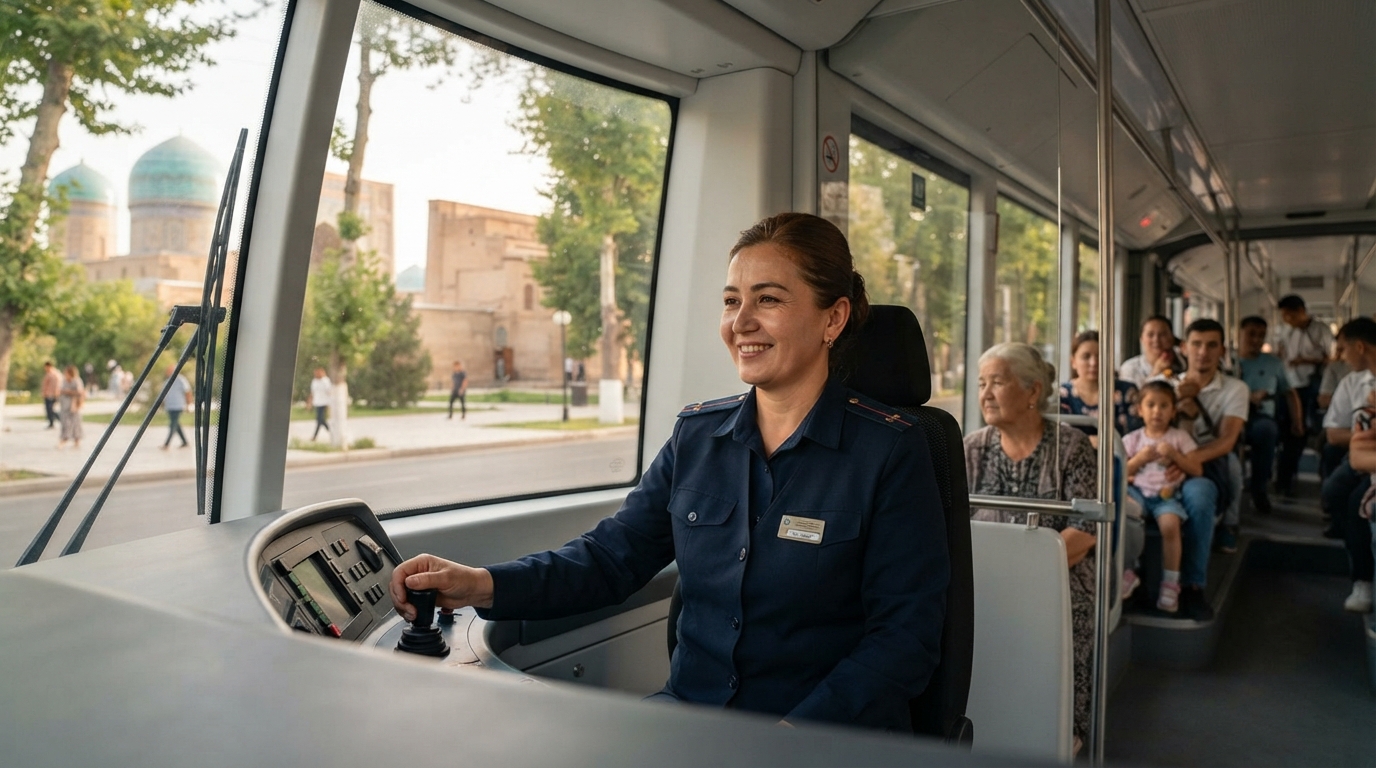
Dilorom Oblokulova has been working as a tram driver in Samarkand for six years, transporting hundreds of passengers to their destinations daily.
The tram driver told "Gazeta" correspondent Mirolim Isajonov how, after 22 years as a homemaker, she decided to master a new profession.
In 2012, Dilorom Oblokulova graduated from driving school to learn how to drive a car and received her driver's license. But due to family circumstances, she was unable to buy a car, so she never got behind the wheel. All this time, the woman was engaged in housekeeping and raising children.
In 2019, on the streets of Samarkand, she saw a woman driving a tram. This very incident marked the beginning of a new chapter in her life.
"I asked myself the question: 'Why shouldn't I master this profession too?' My husband was beside me. I told him about my desire to learn how to drive a tram. He supported me, and together we went to the tram depot," noted Dilorom Oblokulova.
At that time, only three female tram drivers worked at the depot. One of the employees named Sanobar also supported the future colleague's decision to study.
Mastering a new profession proved to be difficult. "At first, I was scared. Operating a tram is not easy. You are responsible not only for yourself, but also for hundreds of passengers in the car. There were doubts before the training started," she said.
In 2019, Dilorom-opa underwent four and a half months of training to become a tram driver. Then she practiced for three months alongside experienced drivers, and in February 2020 she began working independently.
During this period, her husband's support again played a big role. Dilorom Oblokulova was sometimes anxious and even thought about quitting her studies. But her husband constantly encouraged her. To support her at the beginning of her work, he even worked on the tram as a conductor. Passengers did not know about this, only colleagues knew.
Dilorom-opa's brother also supported his sister's decision.
"I told my brother: 'I enrolled in training, but I'm afraid. People will look, I'll feel awkward.' And he replied: 'Sister, do you believe in yourself? Then act. Don't you see how women work in other countries? What are you shy about?' These words also gave me strength," the woman said.
At first, it was not easy for her to get used to the surprised looks of passengers and the attention of passersby. But over time, Dilorom-opa began to perceive it as a normal occurrence.
"At first I was shy, thinking that everyone on the street would look at me. After all, women here rarely work in such positions, we are not used to it. Now, on the contrary, I am proud of my job," says the driver.
In Samarkand, trams run on two routes: from the railway station to the Sartepa residential area, and from the station to the Siab Bazaar. Dilorom-opa mostly works on the first route. The tram covers six kilometers in approximately 21 minutes.
Trams operate from 6:00 to 23:00. Throughout the day, passenger traffic changes. In the morning, there are more people rushing to work and schoolchildren. At lunchtime, the tram is used by children returning from school, and in the afternoon by parents picking up children from kindergartens.
According to Dilorom-opa's observations, passengers' travel purposes vary widely.
"Once, an elderly woman got on the tram. At that moment, the tram was standing still due to a power outage. I suggested she take a bus. But she replied: 'No, I don't need to go anywhere, I just got bored at home, so I decided to take a ride on the tram.' There are passengers like that too," shared Dilorom-opa.
Foreign tourists also often use the tram. Especially those who arrive at the railway station and choose public transport instead of a taxi. They ask the drivers which places can be reached by tram.
Many tourists use the second route, in particular, to get to the Islam Karimov Mausoleum and the Siab Bazaar.
The tram interior is also convenient for families with children. The fare is 3,000 sums when paying with cash and 2,000 sums when paying with a bank card.
Operating a tram is not as simple as it might seem from the outside.
"All our attention must be focused on the road. You need to keep an eye on both people and cars. Some drivers pull onto our tracks, and pedestrians walking while looking at their phones don't even hear the tram's bell. We must always be on alert," says the driver.
In six years of work, Dilorom-opa has not encountered inappropriate behavior from passengers. On the contrary, many are surprised to see a woman behind the wheel of a tram and are curious about her profession.
"When passengers get off the tram and say: 'Thank you, opajon, stay healthy,' it makes me feel good. I think that we helped them cover the distance and reach their destination. At such moments, I am even happier to be in my profession," says Dilorom Oblokulova.
In six years, the tram has become something more than just a job for Dilorom-opa.
"My sons sometimes say: 'Mom, don't go to work, stay home, we will give you money ourselves.' But I don't work just for the salary. I like my profession, I've gotten used to it. On the tram, you meet different people, talk to passengers. It's better for me to work than to sit at home. The tram has become a part of my life," she says.
The job also helped Dilorom Oblokulova acquire new skills and improve her communication in Uzbek and Russian. She also wants to learn English to communicate with tourists. Her husband supports this desire of hers as well.
Dilorom-opa is proud to have been born in Samarkand and that the city has a tram system. In her opinion, it is not only a convenient public transport, but also a good opportunity to admire the city landscapes through large windows. She would like to see tram service appear in other cities of Uzbekistan as well.
Dilorom-opa, who once doubted before choosing a new profession, now urges other women to believe in themselves.
"My advice to girls and homemakers striving for success is to study and work hard. It's never too late to start. If you believe in yourself, you can achieve a lot. Women in Uzbekistan are strong and not afraid of hard work. Everything is in your hands," she said.