

“Tram has become a part of my life.” Story of a female train driver from Samarkand
Dilorom Obloqulova, who was a housewife for 22 years, opened a new chapter in her life in 2020 by starting work as a tram driver in Samarkand. For a woman driver who has been delivering hundreds of passengers to their destinations for six years, operating a tram has become a part of her life. Gazeta spoke with her.
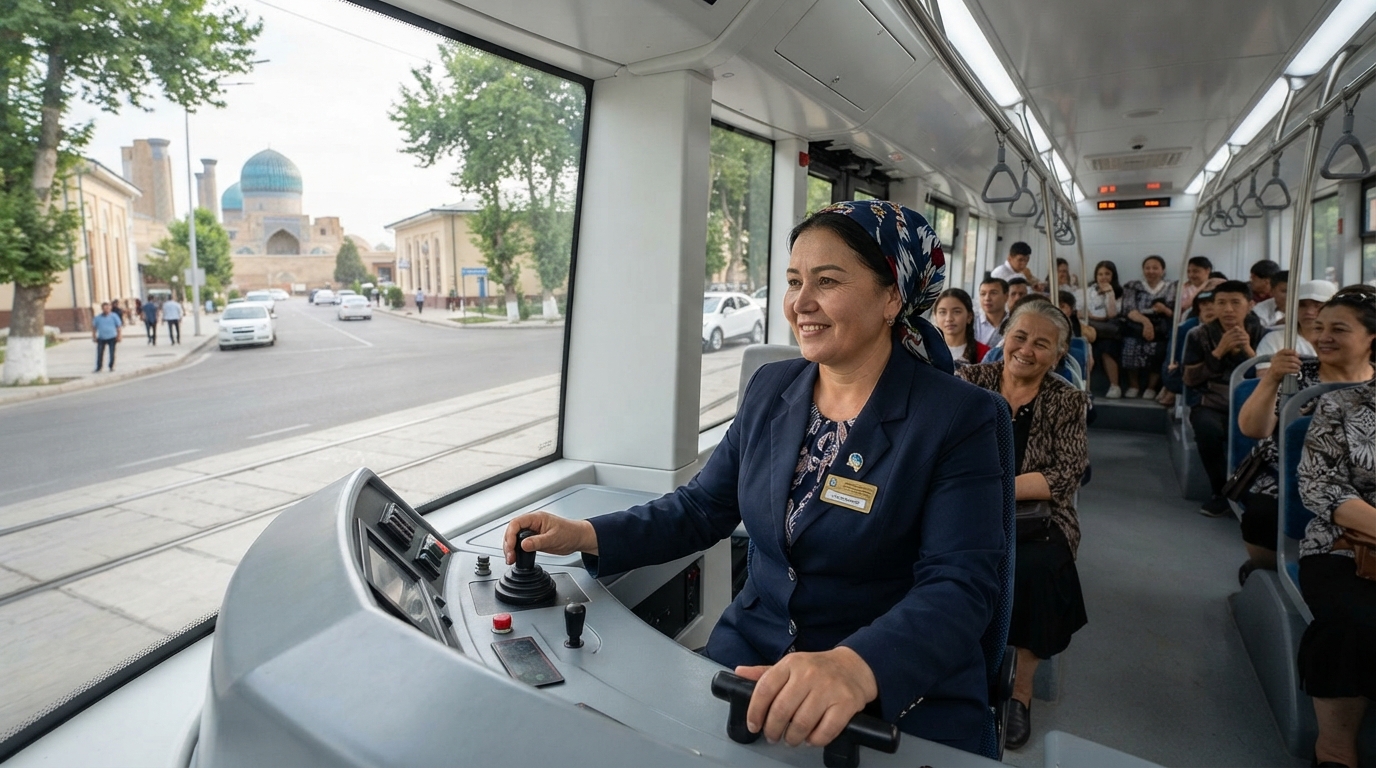
“Tram has become a part of my life.” The story of a female driver from Samarkand
Dilorom Oblokulova, who works as a tram driver in the city of Samarkand, has been carrying hundreds of passengers to their destinations every day for six years. Prior to this, she was a housewife for 22 years. In 2019, after seeing a woman driving a tram, she decided to learn the profession herself.
Starting her work in 2020 with the support of her husband and relatives, Dilorom-opa is proud of her profession today.
In 2012, Dilorom Oblokulova studied at a driving school to learn how to drive a car and received a driver's license. However, due to family circumstances, she could not afford to buy a car and did not get behind the wheel. Therefore, she engaged in household chores and raising children.
Seeing a woman driving a tram on the streets of Samarkand in 2019 served as an impetus for opening a new chapter in her life.
“I asked myself: 'Why shouldn't I learn this profession too?' My husband was beside me. I told him about my desire to learn to drive a tram. He supported me, and we went to the tram depot together,” says Oblokulova.
At that time, only three female tram drivers worked at the depot. An employee at the depot named Sanobar also supported her decision and encouraged her to study. Nevertheless, mastering a new profession was not easy. At first, Dilorom-opa was embarrassed by people's reaction and being in everyone's spotlight on the street. In addition, the responsibility of driving a heavy vehicle frightened her a little.
“I was afraid at first. Driving a tram is not easy. In it, besides yourself, you are responsible for hundreds of passengers in the car. That is why I hesitated before entering the studies,” she says.
In 2019, Dilorom-opa studied for four and a half months in a training course for tram drivers. Then she completed a three-month internship with experienced drivers. And in February 2020, she began working independently.
Her husband's help was important in this process. Dilorom Oblokulova sometimes worried that she would not be able to handle the profession and even thought about dropping out of her studies. But her spouse always encouraged her. In the early period of her work, he even worked as a conductor on the tram to help her. They hid this from the passengers; only their colleagues knew that they were husband and wife.
Her younger brother also supported his sister's decision. Having seen women working in various professions in other countries while abroad, her brother advised Dilorom Oblokulova to believe in her own strength.
“I told my brother: 'I got into the course, but I'm afraid, people will see, I'm embarrassed.' And he said: 'Sister, do you believe in yourself? Do it. Don't you know how women work in other countries? What are you embarrassed about?' Those words also gave me strength,” she says.
Initially, it was difficult to get used to the surprise looks of passengers and the attention of people on the street. But over time, Dilorom-opa began to accept this situation as ordinary.
“At first, I was embarrassed, thinking everyone on the street was looking. Because in our country, women haven't worked much in such jobs, we aren't used to it. Now, on the contrary, I am proud of my work. Many people look with admiration,” says the driver.
In Samarkand, the tram runs on two routes: from the railway station to Sartepa and from the station to the Siyob market. Dilorom-opa mainly works on the first route. The tram covers the six-kilometer distance from the station to Sartepa in approximately 21 minutes.
Trams operate from 6:00 in the morning until 23:00 in the evening. The flow of passengers also changes during Dilorom Oblokulova's workday: in the morning, people rushing to work and students increase. At lunchtime, children returning from school use the tram, and in the second half of the day, parents picking up their children from kindergarten do.
According to her observations, it is not only those going to work or study who board the tram, but also elderly people who want to ride around the city. For some, riding the tram is an opportunity to distract themselves a little from daily worries.
“One day, an elderly woman boarded. At that time, the tram was stopped because the electricity was off. I suggested she go by bus. 'No, I don't have urgent business, I was just bored at home and came out to take a ride on the tram,' she said. There are passengers like that too,” says Dilorom-opa.
Foreign tourists also use the tram a lot. Especially tourists arriving at the station choose public transport instead of a taxi. They ask the drivers which destinations the tram goes to. According to Dilorom-opa, tourists traveling on the second route, particularly toward the Islam Karimov Mausoleum and the Siyob market, are often encountered.
The spaciousness of the tram interior is also convenient for families with children. The fare is 3,000 soums in cash and 2,000 soums via plastic card. However, driving a tram is not as easy as it looks from the outside. The driver must constantly monitor the road, the movement of other vehicles, and pedestrians. Especially navigating some of Samarkand's narrow streets requires special attention.
As Dilorom Oblokulova emphasizes, some car drivers end up on the tram tracks. Pedestrians distracted by their phones who do not notice the approaching tram are also encountered. Such situations require constant vigilance from the driver.
“Our attention must be only on the road. It is necessary to watch both people and cars. Some drivers get in our way, and pedestrians looking at their phones don't even hear the tram's bell. Therefore, we must always be vigilant,” she says.
During six years of work, Dilorom-opa has not faced inappropriate treatment from passengers or men. On the contrary, many are surprised to see a female driver, ask about her profession, and express their admiration. The gratitude of passengers gives her a sense of satisfaction from her work.
“When passengers get off and say 'Thank you, sister, stay healthy,' I feel very happy. Then I think that we made their long journey short and helped them reach their destination. At that moment, I feel even prouder of my profession,” says Dilorom Oblokulova.
Over six years, the tram has meant more than just a ordinary workplace for Dilorom-opa. Although her children tell her not to go to work and rest at home, she continues her activity of her own accord.
“My sons sometimes say: 'Mom, don't go to work anymore, sit at home, we will give you a salary ourselves.' But I don't go to this job just for the salary. I love my profession, I've grown accustomed to it. On the tram, you see different people, communicate with passengers. Working is better than sitting at home,” she says.
The job has also given Dilorom Oblokulova new skills. As a result of constant communication with passengers, she learned to speak fluently in Uzbek and Russian. Now she also wants to master English to communicate with tourists. Her husband supports this desire of hers too.
Dilorom-opa is proud to have been born in Samarkand and that there is a tram in the city. In her opinion, the tram is not only convenient public transport, but also a good means for viewing city sceneries. Through the large windows, passengers can freely observe the city. She wants trams to be launched in other cities of Uzbekistan as well.
Dilorom-opa, who once hesitated to master a new profession, today calls on housewives like herself and other women to believe in their strength.
“My advice to girls and housewives who admire me is — let them study, search, and make an effort. It is never too late. If you believe in yourself, much can be achieved. Uzbek women are strong, they are not afraid of work. Everyone can do it,” she says.