

The town whose council wants migrants to move in
Greenock wants to attract immigrants to settle in the town and reverse its declining population.
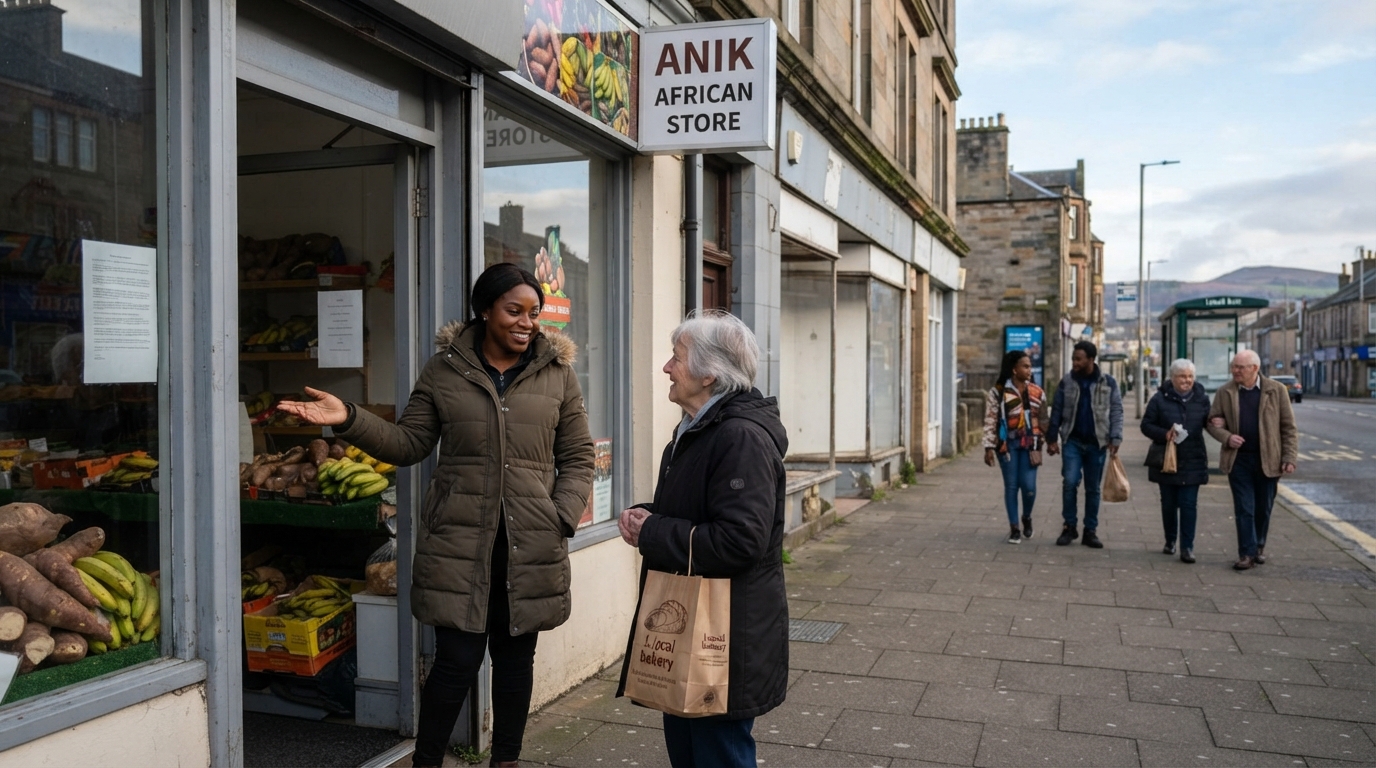
Greenock, a town on Scotland's west coast, is experiencing a decades-long population decline, prompting its council to actively seek migrants to reverse the trend.
A new establishment, Anik African Store, opened in May on Greenock's struggling High Street, introducing Nigerian staples like yams, plantain, okra, and catfish. This isn't the only African food shop in the vicinity, with another just meters away, reflecting a shift in the local demographic. Locals note that five years ago, seeing a Black person in Greenock was uncommon; now, hundreds of Africans and refugees have settled in the area.
The local council has devised a strategy to attract even more people to this part of western Scotland, aiming to counteract the shrinking population. Christianah Omilana, owner of Anik and a UK arrival in 2021, describes Scottish people as "lovely and accommodating," adding that "immigrants will come when there is work." She also praises the welcoming and friendly nature of Greenock residents.
However, a significant factor in Greenock's depopulation, and that of the broader Inverclyde area, has been the scarcity of employment. No other Scottish local authority has been as severely impacted by population decline. Inverclyde's resident count is 22,000 lower than in 1981, with its current population of 78,000 projected to decrease by another 16% over the next two decades.
Addressing this population deficit is the council's top priority, focusing on retaining current residents and drawing new ones. Sunday, an Anik customer who recently moved from Devon to join his wife working at Inverclyde Royal Hospital, describes Greenock as a "lovely, friendly" town. He believes that if the local council can create jobs, "everything in Greenock will change, because people [from Africa] would like to come."
Many of Greenock's African residents are employed or studying in Glasgow or Paisley, drawn to the town by affordable housing. A significant number have arrived on skilled work visas, known as sponsorship, contributing to the health and care sectors. Inverclyde Council's repopulation strategy aims to encourage these individuals to establish roots in the area, alongside attracting other legal migrants and those granted refugee status.
Despite these efforts, the lack of job opportunities remains a core issue for the town. Tiffany, a 29-year-old mother, describes Greenock as "a ghost town" with "nothing in it. There's nothing to do, there are no shops. There is no employment." She moved away for work but returned to raise her child, now contemplating another move due to the difficulty of finding jobs compatible with childcare.
Greenock boasts a rich industrial past, earning the moniker "Sugaropolis" in the 19th century as a global sugar refining hub. Thousands of ships were also constructed there over nearly 300 years. More recently, IBM employed over 5,000 people at its campus near Greenock before its closure in 2016. In the last four years alone, 1,500 jobs have disappeared, with companies like Amazon and EE relocating. The local shipyard recently announced a quarter of its workforce would be cut, and supporters of the Greenock Morton football team are fundraising to prevent financial collapse. This dire situation has prompted Scotland's First Minister, John Swinney, to plan a visit this month to assess the problems firsthand.
While many Africans find employment in health and social care, job opportunities for long-term local residents and refugees can be scarce. Muriel, an elderly resident at Lyle Gateway Community Cafe, observes, "When the work disappears, people disappear." Gathered with other seniors, she recalls a vibrant town bustling with people and shops. Now, conversations are peppered with words like "depressing" and "empty." The pensioners, while welcoming to migrants, express skepticism about the sustainability of the council's repopulation strategy, questioning where new arrivals would find work when current residents struggle.
Jonathan Fleming, the Church of Scotland minister at Lyle Kirk, which houses the cafe, directly experiences the depopulation crisis. His church conducts "a lot more funerals than we do weddings and baptisms," a shift he describes as "a lot more dramatic than it used to be." The church has been assisting Iranian refugees who are eager for paid work but unable to find it, leaving them "trapped" and unable to contribute as they wish.
The number of international arrivals in Inverclyde has tripled recently, reaching approximately 750 per year since 2023. Hundreds of African migrants, along with refugees from Ukraine, Afghanistan, and other nations, have settled in the area, many with positive stories. The council's repopulation plan includes English classes, assistance with skilled employment access, and support for schools to provide "anti-racist education." Mo Almalarashid, a Syrian refugee who arrived in Greenock in 2018 without English, found a supportive community and now works as a gym instructor after dedicated study.
Despite these positive developments, tensions have arisen. A local teenager was sentenced to 10 years last year for planning mass murder at the local mosque. In June, a protest outside a hotel housing asylum seekers led to one woman being charged with a hate crime and three police officers being injured. However, in May's Scottish Parliamentary elections, Reform UK, a party advocating for reduced immigration, placed a distant third in Inverclyde, significantly behind the winning SNP candidate, even with its Scottish leader running in the constituency.
Other council areas in Scotland, Wales, and Northern Ireland are projected to face similar depopulation challenges within the next decade, potentially looking to Inverclyde's approach. Stephen McCabe, who has largely led Inverclyde's minority Labour-led council since 2007, believes the repopulation plan is showing results, with the population stabilizing over the past two years, primarily due to immigration.
McCabe emphasizes that repopulation is central to all of Inverclyde Council's aspirations, from housing projects and school renovations to, crucially, job creation. He envisions opportunities in maritime, renewables, and defense sectors, reimagining the Clyde river's use for the 21st century, though this requires substantial Scottish and UK government support.
Regarding asylum seekers, who are generally not permitted to work while awaiting Home Office decisions, McCabe acknowledges "an unease." While the council has "willingly" participated in a Home Office dispersal scheme, accepting over 200 asylum seekers, he believes the area has received "a disproportionate share," with a Home Office contractor reportedly purchasing numerous local houses. Nevertheless, McCabe stresses that migrants and refugees who can work are welcome in Inverclyde. "Without those people, our health service would really be struggling... The refugees who have come have brought benefits to this area. They will bring ambition. They'll bring children to this area."
Greenock's population is not only shrinking but also aging. The decline in children has led to a nursery closure, while the elderly population has increasing health needs. Coupled with high levels of deprivation, public services face growing pressure amid a shrinking tax base. Remaining residents bear a heavier burden, with council tax rising by almost 8% this year.
A contrasting vision for Greenock can be found just 15 minutes away in Gourock. Once similarly deprived, Gourock now boasts a thriving High Street with independent retailers, bolstered by a recent £5 million council investment and residents with greater spending power. Matthew Quinn, a 19-year-old local and former Scottish Youth Parliament member, believes Gourock's success lies in embracing its role as a commuter town, a model he suggests other parts of Inverclyde should adopt.
Quinn argues that the council's focus on creating numerous local jobs is misguided. With many people now working from home, he believes the area should leverage its proximity to Glasgow (approximately 40 minutes away). "If we accepted that the jobs are in Glasgow, then our focus should be on public services and ensuring we have a nice environment for people to live. Then I think we would be much more successful," he states. "It's not that [people] are desperate to leave, it's that there's no reason to stay."
Some Greenock residents are actively addressing this challenge. Derek Mitchell, with infectious optimism, plans to transform a former sugar refinery next to an Aldi car park into a vibrant hub for teaching and inspiring young people. His focus on science, technology, engineering, arts, and maths aims to equip them with future skills. "If you build a sense of belonging, naturally and organically, people don't want to leave." Mitchell and a group of locals have purchased the building, estimating a £5 million investment is needed as they seek partnerships. "A lot of people are starting to do things for themselves," he says. "They see there's potential - they're fed up of waiting."
At a time when immigration is a concern across much of the UK, Inverclyde's decision to embrace migrants and refugees stands out. Its severe population shortage and striking solution may offer a potential path forward for other communities soon to face similar depopulation challenges.