

Personnel shortage and hungry personnel
A $75 salary and mass exodus: Turkmenistan faces a labor shortage
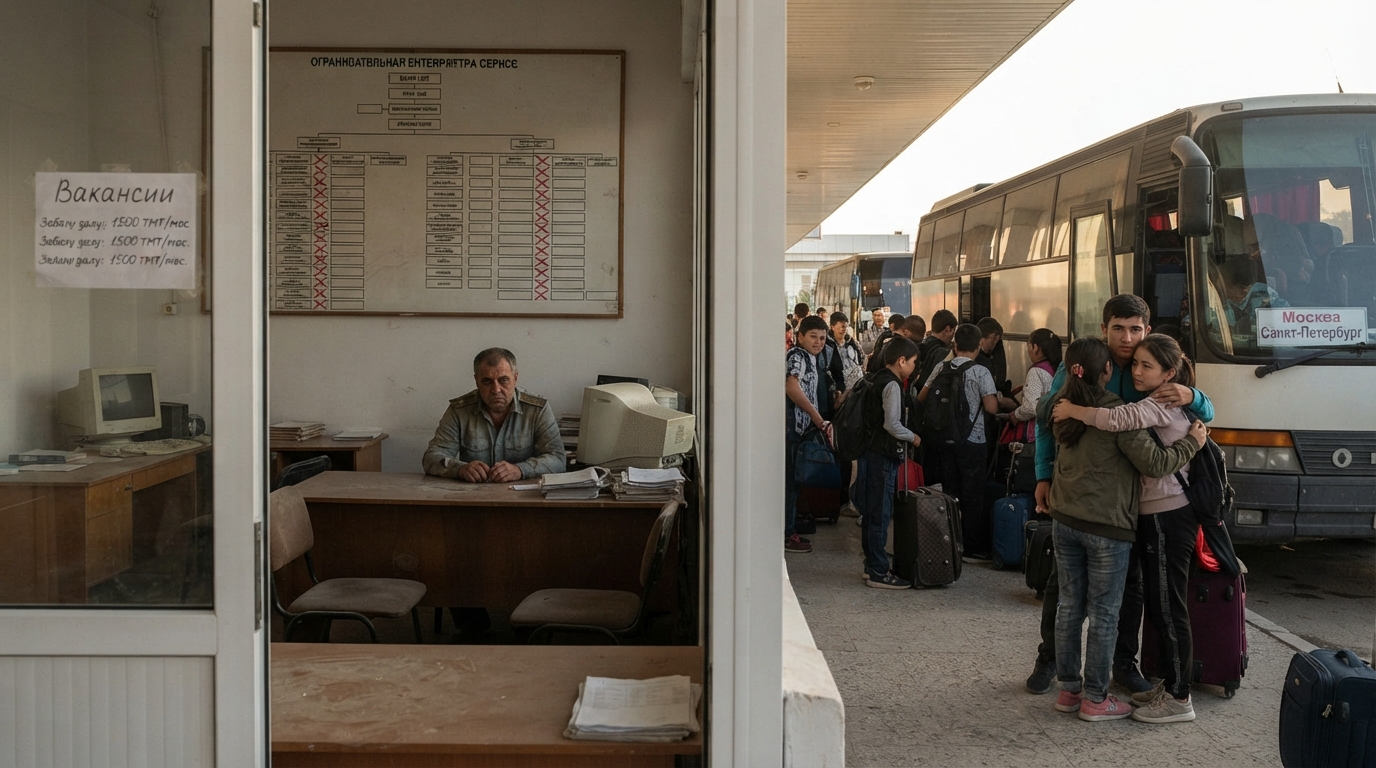
**Staff Shortage and "Hungry" Workforce: Turkmenistan Faces Labor Shortage Amid Low Wages and Population Outflow**
State-owned enterprises in Turkmenistan are experiencing a severe shortage of employees, due to low wages and the ongoing outflow of the population. According to turkmen.news sources, in some regions, government agencies remain understaffed, and employers are forced to abandon the previous practice of charging bribes for employment. In some cases, job seekers are being hired without additional payments, simply to fill a vacancy.
**Staff Shortage in the Provinces**
The problem is most acute in the provinces. Sources report that the staffing shortage spans a wide range of sectors – from utilities and transportation to energy and education. The key reason is not only the lack of willing workers, but also the extremely low wages in the public sector.
For example, according to a resident of the Lebap province, a driver at a state-owned enterprise can earn approximately 1,500 manat (approximately $75) per month. Notably, until recently, the source claimed, the salary for such a position was up to 30,000 manat, 20 times the monthly salary. However, according to the publication's sources, the situation is changing, and due to a labor shortage, some managers are willing to waive the requirement for unofficial payments for employment.
**Low salaries do not retain workers**
A similar situation is observed in the public utilities sector and other low-paid professions. Postmen and public utility workers earn an average of 1,500-2,000 manat (approximately $75-$100) per month.
Turkmen.news sources emphasize that with this income level, it is becoming extremely difficult for workers to provide for their families, cover daily expenses, and still remain in the state employment system. The problem is particularly acute among young professionals, who are reluctant to enter these professions due to low incomes. Moreover, even experienced professionals are considering leaving.
One of the publication's sources, an electrician, said that approximately 70% of workers in his field are over 50. Salaries start at approximately 1,400 manat and reach 2,800 manat.
For many workers, private taxi driving is an additional source of income. According to the source, after their main job, they can earn 100-150 manat for a few hours, and up to 200-300 manat for a full day. On certain routes, the income can reach 400 manat. Thus, in a few days or a week, a person can earn more than they would earn in a main government job over a significantly longer period.
This income gap creates a serious problem for state-owned enterprises: even the presence of a vacancy no longer guarantees that they will be able to find and retain an employee.
**The Unemployment Paradox: A Shortage of Skills While There Are Unemployed**
Against this backdrop, the situation appears contradictory. On the one hand, unemployment is reported in Turkmenistan, especially in the regions. On the other hand, enterprises are experiencing a labor shortage. One possible explanation is the discrepancy between the job openings offered and employee expectations.
If an official job provides too low an income, an individual may formally be unemployed while simultaneously working part-time in the informal sector or considering labor migration.
An additional factor is the geographic distribution of jobs. Sources also point to differences between regions and a shortage of specialists in certain fields.
As a result, the problem lies not simply in the size of the working-age population, but in the fact that state organizations are finding it increasingly difficult to attract people to the conditions offered.
**Emigration as the Main Alternative**
Sources cite labor migration as one of the most serious factors in the labor shortage. According to the publication's sources, many residents of Turkmenistan are leaving for Russia and other countries because they can earn significantly higher incomes there.
One resident of the Dashoguz region said that an acquaintance of his, who worked as a welder in Turkmenistan, began earning approximately 110,000 Russian rubles (approximately $1,200) after moving to the Moscow region. According to the source, his income in Turkmenistan was approximately ten times less.
Another example concerns a woman who worked as a lab technician in a farmers' association. After moving to the Leningrad region, she began working as a nurse's aide, completed relevant training, and became a junior nurse. Her income, according to the source, is approximately $1,500 per month. The source claims that she sends a significant portion of her earnings to her family in Turkmenistan. Over the course of several years, the family managed to purchase an apartment.
According to a turkmen.news report, similar stories are common in various families. Not only blue-collar workers but also educated professionals—doctors, teachers, and other government employees—are leaving abroad.
**The outflow of specialists affects education and other sectors**
The personnel problem, according to the cited testimonies, extends beyond businesses. The report also mentions a student shortage at some universities. According to sources, some educational institutions are experiencing a shortage of applicants, and admission requirements for some specialties are being lowered.
This creates a vicious circle: the country needs qualified specialists, but young people don't always see attractive job prospects within the country. As a result, some talented graduates consider emigrating even before they begin their professional careers.
**Why People Leave Even After Employment**
Even if someone gets a job at a state-owned enterprise, it doesn't mean they'll stay there for long. Turkmen.news sources claim that some employees work for about six months, after which they either transfer to the private sector or leave the country. Thus, state-owned enterprises face two problems: they struggle to attract new employees and even more so to retain those already hired.
Meanwhile, the previous system, which allegedly required a bribe to secure a job, is becoming increasingly unviable given the labor shortage. An employer seeking to fill a vacancy can no longer always dictate terms to a potential employee.
While previously, even low-paying government jobs could be obtained through the demand for unofficial payment, now, in some cases, employers are willing to hire people without such payment.
However, this does not mean the problem has been solved. Without improving the attractiveness of jobs, the labor shortage may persist. Low wages continue to push workers to seek additional income, move to the private sector, or migrate.
As a result, the state employment system finds itself in a situation where the formal availability of jobs does not guarantee a sufficient number of workers. While public sector incomes remain significantly lower than those available in the private sector or abroad, retaining workers remains a challenge.
Alexandra Koltayevskaya